
Research use only. American Peptides supplies materials for in vitro laboratory research. Nothing on this page is medical advice, a diagnosis, or a recommendation for human or veterinary use.
What Is a Peptide? A Plain-English Definition
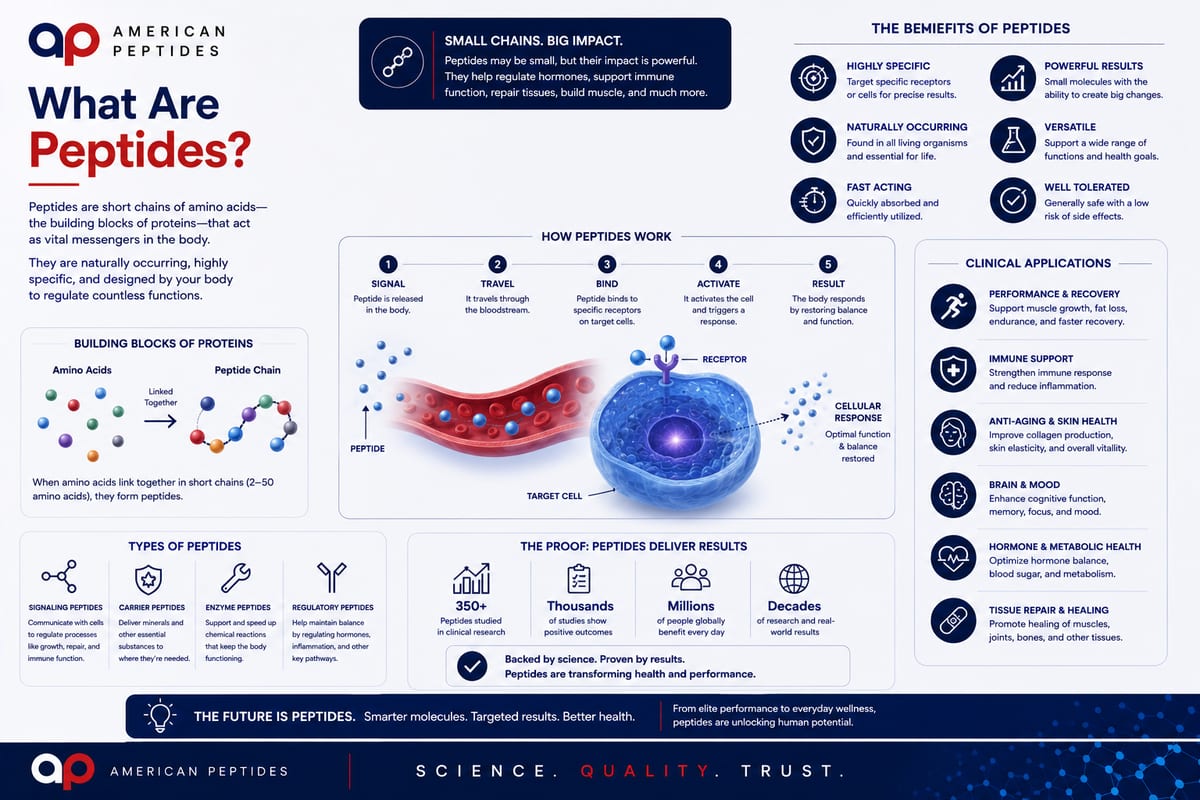
A peptide is a short chain of amino acids (typically 2 to 50 residues) linked by peptide bonds. Peptides differ from proteins primarily by length: chains under approximately 50 amino acids are conventionally classified as peptides, while longer chains that fold into stable three-dimensional structures are classified as proteins.2
The peptide bond itself is a covalent amide linkage formed when the carboxyl group (-COOH) of one amino acid reacts with the amino group (-NH2) of the next, releasing a water molecule. The C-N bond length of a peptide bond is approximately 1.33 Å — shorter than a typical C-N single bond (~1.47 Å) because of partial double-bond character from resonance. This rigidity is what gives peptides their defined backbone geometry.
By convention, peptide sequences are written from the N-terminus (free amino end) to the C-terminus (free carboxyl end). A dipeptide weighs around 200 Da; a 50-residue peptide typically lands between 5,000 and 6,000 Da, depending on side-chain composition.
The Building Blocks: Amino Acids and the Peptide Bond
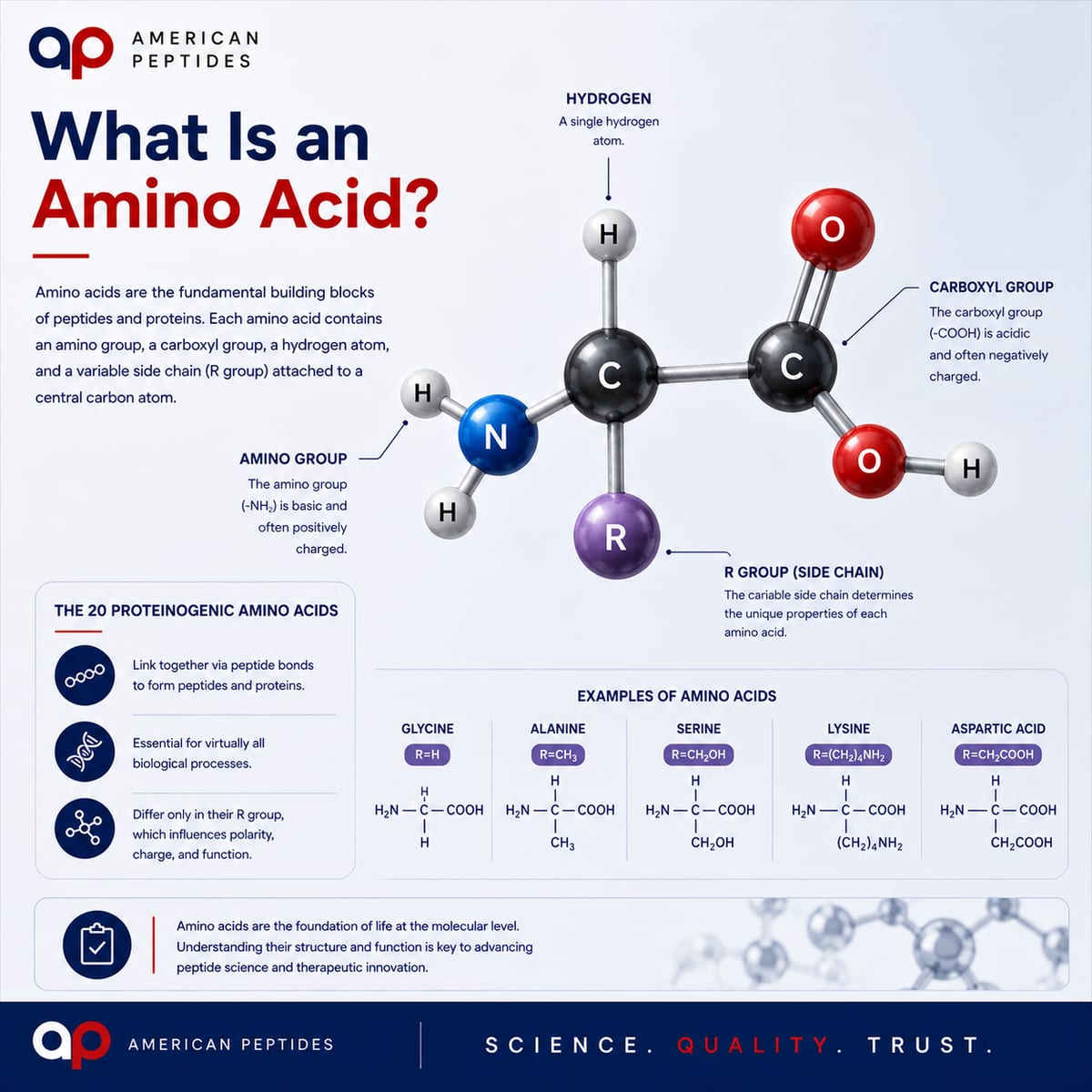
Every amino acid shares the same backbone: a central alpha carbon bonded to an amino group, a carboxyl group, a hydrogen atom, and a variable side chain (the "R group"). The R group is what makes glycine different from tryptophan — it determines polarity, charge, hydrophobicity, and reactivity.
Twenty proteinogenic amino acids are encoded by the standard genetic code. Research peptides may also incorporate non-proteinogenic residues (D-amino acids, N-methylated residues, beta-amino acids) to tune stability or binding properties.3
When two amino acids join, the resulting dipeptide has one peptide bond. A pentapeptide has four. A 50-mer has 49. The repeating N-Cα-C(=O) backbone is the structural spine of every peptide and every protein.
Classification by Length
| Class | Length (residues) | Typical MW |
|---|---|---|
| Dipeptide / Tripeptide | 2–3 | ~200–400 Da |
| Oligopeptide | ~4–20 | ~400–2,200 Da |
| Polypeptide | ~20–50 | ~2,200–5,500 Da |
| Protein | >~50 (folded) | >~5,500 Da |
The 50-residue boundary is a convention, not a hard physical law. Insulin (51 residues across two chains) is universally called a protein; some references call ubiquitin (76 residues) a peptide. What matters in practice is whether the chain folds into a stable tertiary structure (protein) or stays largely unstructured or as a short motif (peptide).
Peptide vs. Protein: The Practical Difference
Three differences matter day-to-day in a lab:
- Length and folding. Peptides are short enough that most do not adopt a fixed 3D fold in solution. Proteins fold into defined tertiary (and often quaternary) structures stabilized by hydrogen bonds, disulfide bridges, and hydrophobic packing.
- Synthesis route. Peptides under ~50 residues are routinely made by solid-phase chemical synthesis (SPPS). Larger proteins are usually expressed recombinantly in E. coli, yeast, or mammalian cells.1
- Verification. A synthetic peptide's identity is confirmed by mass spectrometry (exact mass to within 1 Da) and purity by reversed-phase HPLC. Recombinant proteins additionally require gel electrophoresis, activity assays, and often endotoxin testing.
How Research Peptides Are Synthesized
Modern research peptides are overwhelmingly produced by solid-phase peptide synthesis (SPPS), the method introduced by Bruce Merrifield in 1963 and recognized with the Nobel Prize in Chemistry in 1984.1 The principle is simple and powerful:
- The C-terminal amino acid is anchored to an insoluble resin bead.
- Each subsequent amino acid (with its reactive groups temporarily protected) is coupled to the growing chain one at a time, moving C-terminus to N-terminus.
- After each coupling, excess reagents are washed away — the peptide stays bound to the resin.
- When the sequence is complete, the peptide is cleaved from the resin and side-chain protecting groups are removed.
- The crude peptide is purified by preparative reversed-phase HPLC and verified by mass spectrometry.
The Fmoc/tBu strategy is the modern workhorse for most research peptides. The output is reported as HPLC purity (often ≥98% for research-use) and net peptide content (the mass fraction that is actual peptide, the rest being water, trifluoroacetate counter-ions, and residual solvents).
Why Purity and Identity Matter
In a research setting, a peptide is only as useful as its Certificate of Analysis (CoA). The CoA should report:
- HPLC purity — the percentage of the main peak relative to all UV-detectable peaks.
- Mass spectrometry confirmation — the observed monoisotopic or average mass must match the theoretical mass of the sequence.
- Net peptide content — corrects for water and counter-ion mass when calculating molar concentrations.
- Lot number and synthesis date — enables traceability for reproducibility.
Without these data points, dose-response curves drift, assay variability balloons, and results stop being reproducible. The cost of an undocumented peptide is rarely the peptide itself — it is the wasted experiments downstream.
Naturally Occurring vs. Synthetic Research Peptides
Many research peptides originate as fragments or analogues of endogenous sequences. BPC-157, for example, is a partial sequence derived from a human gastric protein. TB-500 is a synthetic fragment of the naturally occurring protein thymosin beta-4. GHK-Cu is a copper-binding tripeptide found in human plasma.
Whether a peptide is "natural" or "synthetic" is largely a question of provenance, not chemistry. A synthetic peptide with the same sequence as a natural one is chemically indistinguishable once purified — same backbone, same side chains, same mass. The only differences are isotopic distribution and the absence of post-translational modifications that may or may not be present in the natural source.3
Storage, Shelf Life, and Reconstitution
Research peptides ship as lyophilized (freeze-dried) powder. Removing water dramatically slows the chemical degradation pathways — hydrolysis, oxidation, deamidation — that limit peptide stability in solution.
As a general framework for shelf life in a research setting:
- Lyophilized, −20°C or colder, desiccated: typically stable for 24+ months for most sequences.
- Lyophilized, 4°C: generally stable for several months.
- Reconstituted in aqueous buffer, 4°C: often stable for days to a few weeks depending on sequence (cysteine- and methionine-containing peptides degrade faster).
- Reconstituted, −20°C with aliquoting: extends usable life to months, but freeze-thaw cycles should be minimized.
Reconstitution is a chemistry-only operation: dissolve the powder in an appropriate sterile solvent (bacteriostatic water or sterile saline are common for short-term lab solubility), record the resulting concentration, and store appropriately.
Frequently Asked Questions
What exactly is a peptide?
A peptide is a short chain of amino acids (conventionally 2 to ~50) joined by peptide bonds. Each peptide bond is an amide linkage formed by the loss of water between adjacent amino acids. Peptides have a defined sequence written from the N-terminus to the C-terminus and a defined molecular formula and mass.
What's the difference between a peptide and a protein?
Length is the headline distinction: peptides are typically under ~50 amino acids; proteins are longer. The deeper distinction is structural — proteins fold into stable three-dimensional shapes that are essential to their function, whereas peptides are usually too short to fold and act through short motifs or linear binding. There is no sharp boundary; the cutoff is a convention.
How are peptides synthesized?
The dominant method for research peptides is solid-phase peptide synthesis (SPPS), introduced by R.B. Merrifield in 1963.1 Amino acids are added one at a time to a peptide chain anchored to an insoluble resin bead. After the sequence is complete, the peptide is cleaved off the resin, purified by reversed-phase HPLC, and verified by mass spectrometry. Larger proteins are typically produced by recombinant expression instead.
What is solid-phase peptide synthesis (SPPS)?
SPPS is a method in which a peptide chain is built up step-by-step while anchored to an insoluble polymer bead. The C-terminal amino acid is attached to the resin first, and each new residue is coupled with its reactive groups protected to prevent unwanted side reactions. Excess reagents are washed away between steps, and the finished peptide is cleaved from the resin at the end. The technique was developed by Bruce Merrifield and earned him the 1984 Nobel Prize in Chemistry.1
How long do peptides last (shelf life)?
Lyophilized peptides stored at −20°C with desiccant are typically stable for 24 months or longer for most sequences. Once reconstituted in aqueous solution, stability drops sharply — days to a few weeks at 4°C, or several months at −20°C if aliquoted to avoid freeze-thaw cycles. Sequences containing cysteine, methionine, tryptophan, or N-terminal glutamine are more degradation-prone than average.
What's the molecular weight of a typical peptide?
Roughly 110 Da per residue is a useful first approximation. A dipeptide is around 200 Da, a 10-mer around 1,100 Da, and a 50-mer around 5,500 Da. Exact mass depends on which amino acids are present — glycine adds 57 Da per residue while tryptophan adds 186 Da.
How long is a peptide bond?
The C-N peptide bond is approximately 1.33 Å long — intermediate between a single C-N bond (~1.47 Å) and a double C=N bond (~1.27 Å). This shortened length reflects partial double-bond character from resonance, which restricts rotation around the bond and gives the peptide backbone its characteristic planar geometry.
Are research peptides the same as dietary supplements?
No. Research peptides are unapproved investigational compounds supplied for in vitro laboratory use only. They are not dietary supplements, not drugs, and not intended for human or veterinary consumption. They are not regulated as either, and they are not interchangeable with FDA-approved peptide medications.
Does sequence really matter that much?
Yes. The sequence determines everything: mass, charge, solubility, stability, and biological activity. Swapping a single amino acid — or even inverting a residue from L to D — can change a peptide's behavior dramatically. Two peptides with the same amino acid composition but different sequences are different molecules.3
References
- Merrifield RB. Solid-phase peptide synthesis. Adv Enzymol Relat Areas Mol Biol. 1969;32:221-296. PMID: 4307033. (Foundational review of the method that earned the 1984 Nobel Prize in Chemistry.)
- Lau JL, Dunn MK. Therapeutic peptides: Historical perspectives, current development trends, and future directions. Bioorg Med Chem. 2018;26(10):2700-2707. PMID: 28720325.
- Muttenthaler M, King GF, Adams DJ, Alewood PF. Trends in peptide drug discovery. Nat Rev Drug Discov. 2021;20(4):309-325. PMID: 33536635.
Last reviewed: 2026-05-25 by American Peptides Research Team.