
What Is HPLC? A Researcher's Guide to Peptide Purity Verification
What is HPLC? High-performance liquid chromatography (HPLC) is an analytical separation technique that pushes a liquid sample under high pressure through a column packed with a stationary phase. As the sample travels through the column, its components separate based on how strongly each one interacts with the column material. A detector at the column's exit records each component as it elutes, producing a chromatogram. In peptide chemistry, HPLC is the standard method for measuring purity and confirming retention time identity.
What is HPLC?
High-performance liquid chromatography — HPLC — is the most widely used analytical separation method in modern chemistry. Its job is conceptually simple: take a complex mixture, send it through a packed column under high pressure, and let the column physically separate the components so each can be measured individually. What makes HPLC powerful is the precision of that separation. Modern HPLC can resolve a peptide from a single-amino-acid deletion variant within minutes, on submilligram samples, with reproducibility down to fractions of a second in retention time.
In peptide chemistry, HPLC is the analytical anchor of every Certificate of Analysis. When a COA reports "Purity ≥99% by HPLC," the underlying measurement is an HPLC chromatogram in which the target peak was integrated and compared against every other peak detected by the instrument. Reading and interpreting that chromatogram — not just the headline percentage — is the difference between a researcher who has verified purity and one who has merely been told a number.
A brief history of liquid chromatography
The technique traces to Mikhail Tsvet, a Russian-Italian botanist who in 1903 separated plant pigments by passing a solvent through a column packed with calcium carbonate. He named the method chromatography — "color writing" — because the pigments resolved into colored bands as they migrated down the column.
For the next sixty years, liquid chromatography remained a low-pressure technique with limited resolution. The breakthrough came in the late 1960s and 1970s, when Csaba Horváth at Yale built the first systems that pushed solvents through finely packed columns under high pressure. The original term was high-pressure liquid chromatography; as the technique matured, the field reframed it as high-performance to emphasize resolution over the engineering.
The peptide-specific evolution came with the parallel rise of reversed-phase chromatography and solid-phase peptide synthesis. Reversed-phase columns separate molecules by hydrophobicity, which suits peptides exceptionally well, because most synthesized peptides differ from their byproducts (truncations, deletions, oxidations) by predictable changes in hydrophobicity. The two techniques developed together and remain inseparable in modern peptide analytical chemistry.
How HPLC physically works
Strip HPLC to its physical mechanism and what remains is a controlled race. A small volume of liquid sample is injected into a flowing stream of solvent (the mobile phase) and pushed through a long, narrow tube packed with porous particles (the stationary phase). Different molecules in the sample interact with the packing material to different degrees. Strong interactions slow a molecule down; weak interactions let it pass through quickly. By the time the sample emerges from the far end of the column, what entered as a mixture has been physically separated into a sequence of zones — each component eluting at its own characteristic time.
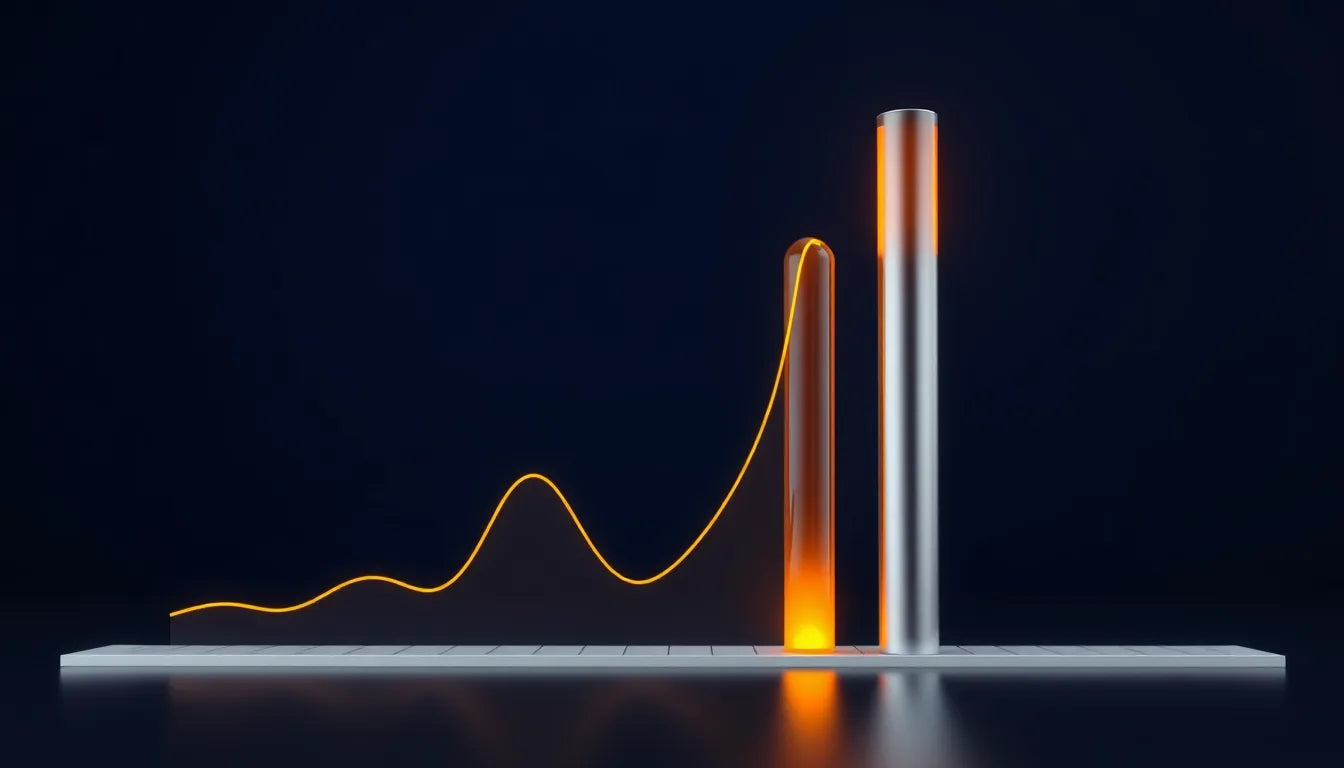
A detector at the column outlet records the eluting compounds and produces the chromatogram: a plot of detector signal versus time, with each separated component appearing as a peak.
Two parameters define the separation:
- Retention time — how long a given compound takes to traverse the column. Reproducible retention time is the fingerprint of a specific compound under fixed conditions.
- Peak shape — the symmetry and width of the peak, which reports on how cleanly the column separated that compound from neighbors.
A good HPLC method produces sharp, symmetric peaks at reproducible retention times. A bad method produces wide, tailing, or co-eluting peaks that obscure quantification.
Reversed-phase HPLC — the workhorse for peptides
The HPLC variant that handles almost all peptide analysis is reversed-phase HPLC (RP-HPLC). The "reversed" comes from the historical contrast with normal-phase chromatography: normal-phase uses a polar stationary phase and nonpolar mobile phase, while reversed-phase uses a nonpolar stationary phase (typically a silica particle coated with C18 hydrocarbon chains) and a polar mobile phase (water mixed with an organic solvent, usually acetonitrile or methanol).
Peptides are amphipathic — they carry both hydrophilic charged groups and hydrophobic residues. On a C18 column under aqueous conditions, the hydrophobic residues stick to the C18 chains and the peptide is retained. As the mobile phase shifts toward higher acetonitrile (a gradient elution), peptides progressively lose their hydrophobic grip and elute in order of increasing hydrophobicity.
A typical peptide gradient runs from ~5% acetonitrile to ~60% acetonitrile over 15–60 minutes, with 0.1% trifluoroacetic acid (TFA) added as an ion-pairing modifier to sharpen peaks. The TFA pairs with positively charged peptide side chains, reducing their interaction with residual silanol groups on the column and producing the sharp, symmetric peaks researchers expect from a credible chromatogram.
The HPLC instrument, part by part
An HPLC system has six functional components, every one of which can affect the data on a chromatogram:
   Solvent reservoirs
         │
         ▼
      Pump   ←──  delivers mobile phase at controlled flow rate (typ. 1 mL/min)
         │
         ▼
      Injector ←─  introduces sample (typ. 5–100 µL) into flow stream
         │
         ▼
      Column  ←──  separates components (C18, 50–250 mm × 2.1–4.6 mm i.d.)
         │
         ▼
      Detector ←─  records eluting compounds (UV-Vis, MS, fluorescence, etc.)
         │
         ▼
      Data system ←  integrates peaks, calculates retention times, computes purity
The pump delivers solvent at constant flow under high pressure — typically 100–400 bar for analytical HPLC, higher for UPLC. Pump stability is what makes retention times reproducible run to run.
The injector introduces a fixed sample volume into the flow stream. Modern autosamplers control volume to within 1%.
The column is the heart of the instrument. For peptide work, the standard is a C18 column with 3–5 µm porous silica particles, 100–250 mm long, 2.1–4.6 mm internal diameter. The smaller the particle, the higher the resolution — and the higher the pressure required.
The detector records what comes off the column. The standard for peptide purity is a UV-Vis detector measuring at 214 nm or 220 nm. More advanced systems pair the UV detector with a mass spectrometer (the LC-MS configuration covered in our LC-MS guide).
The data system integrates the chromatogram and calculates peak areas. Integration algorithms vary; how the software decides where one peak ends and another begins materially affects reported purity.
Reading an HPLC chromatogram
A chromatogram on a COA looks deceptively simple: a flat baseline interrupted by one or more peaks. The information density is much higher than the visual suggests. When reading one, work through the following in order:
Baseline stability. Before judging peaks, judge the baseline. A flat, stable baseline before and after the major peak indicates a clean separation. A drifting baseline (rising slowly through the run) usually means the gradient is pulling baseline-absorbing material off the column. A noisy baseline can hide small impurities.
Peak symmetry. A clean peak is roughly Gaussian — symmetric on both sides. Fronting (a leading shoulder) suggests column overload or a poorly equilibrated column. Tailing (a trailing shoulder) suggests interaction with residual silanols, often correctable with more TFA or a higher-quality column.
Peak width. Sharp peaks reflect efficient separation. Broad peaks reflect either column degradation or genuinely heterogeneous sample.
Peak count. Count every peak above baseline noise — not just the major peak. A chromatogram that integrates only the main peak and ignores small neighbors is reporting an inflated purity.
Retention time. Compare the target peak's retention time to a reference standard run under the same conditions. Identity by retention time is a corroborating signal, never a confirming one (mass spectrometry confirms identity, not retention time).
What "purity" actually measures in HPLC
HPLC purity is a relative percentage, not an absolute one. The calculation is:
Purity (%) = (Area under target peak / Sum of all integrated peak areas) × 100
This is critical to understand: HPLC reports the fraction of UV-absorbing material in the analyzed sample that is the target peak. It does not report:
- How much peptide is in the vial (that requires net peptide content)
- Whether the major peak is actually the target peptide (that requires mass spec identity)
- Whether non-UV-absorbing impurities are present (water, counterions, some salts don't absorb at 214 nm)
The two questions HPLC cannot answer on its own — what is the peak, and how much is in the vial — are why complete COAs pair HPLC purity with LC-MS identity and net peptide content measurements.
Wavelength matters — 214 nm, 220 nm, 280 nm
UV detection works by absorbing light at a specific wavelength. Peptides have three classes of chromophore:
- The peptide bond itself (–CONH–) absorbs strongly in the 210–220 nm range
- Aromatic side chains (Trp, Tyr, Phe) absorb around 280 nm
- Disulfide bonds absorb weakly around 250 nm
For credible peptide purity work, the standard is 214 nm or 220 nm — the wavelengths that capture the peptide bond universally. A COA reporting HPLC purity should state the detection wavelength. When it does not, the headline purity number is uninterpretable.
Common HPLC artifacts that mislead readers
Even a credible HPLC run can produce data that misleads an unprepared reader. The common artifacts:
Co-elution. Two compounds that happen to share retention time appear as a single peak. The result inflates apparent purity and masks an impurity. Co-elution is the reason orthogonal methods (LC-MS, different column chemistries) exist.
Solvent front. The very first material to come off the column is the solvent peak — visible as a sharp deflection at the start of the chromatogram. It should not be integrated as a peak.
Gradient artifacts. As the gradient shifts solvent composition, baseline drift can create false peaks or distort real ones. Modern systems compensate, but older or poorly calibrated systems don't.
Sample carryover. If a previous sample's component lingers on the column, it can elute during the next run as a phantom peak. Credible labs run blank injections between samples.
Detector saturation. If too much sample is injected, the detector saturates and the peak shape distorts — usually flattening at the top. The reported purity becomes unreliable.
HPLC vs. UPLC and where the field is heading
A common modern variant is ultra-high-performance liquid chromatography (UPLC), which uses sub-2-µm particles and pressures up to 1000+ bar. The result is much faster separations (a 30-minute HPLC method can run in 5 minutes on UPLC) with sharper peaks and better resolution.
The peptide field is moving steadily toward UPLC for routine work and toward 2D-LC (two-dimensional separations) for orthogonal verification of identity and purity. These advances tighten the resolution gap that older HPLC methods left open between target peptides and closely related impurities.
For the foreseeable future, classical HPLC remains the standard cited on COAs. Knowing how to read it remains the foundational skill.
Frequently asked questions
What is the difference between HPLC and GC?
HPLC uses a liquid mobile phase and separates non-volatile compounds; gas chromatography (GC) uses a gaseous mobile phase and separates volatile compounds. Peptides are not volatile, so peptide analysis uses HPLC. Residual organic solvents on peptide COAs are typically measured by GC.
Why is RP-HPLC preferred for peptides?
Reversed-phase HPLC separates by hydrophobicity, which matches the way peptides differ from common synthesis byproducts (truncations, deletions, oxidations). The technique has been refined for peptide work since the 1970s and is supported by decades of method literature.
What does TFA in the mobile phase do?
Trifluoroacetic acid (0.1% TFA) is added as an ion-pairing reagent. It pairs with positively charged peptide side chains, neutralizing residual interactions with silanol groups on the column. The result is sharper peak shape and more reproducible retention times.
How much sample is needed for HPLC purity analysis?
Analytical HPLC typically requires 5–100 µg of peptide per injection. Preparative HPLC (for purification rather than analysis) uses much larger amounts.
Can HPLC distinguish stereoisomers?
Standard reversed-phase HPLC generally cannot distinguish D- and L-amino-acid variants of the same peptide. Chiral chromatography, capillary electrophoresis, or NMR are required for stereochemical analysis.
What is the minimum acceptable HPLC purity for research peptides?
Common research-grade purity standards are ≥95% for general research and ≥98% or ≥99% for sensitive assays. The appropriate threshold depends on the experiment and the impurity profile. The integrated chromatogram is more informative than the headline number.
Why do two labs sometimes report different purity numbers for the same peptide?
Different methods (column, gradient, wavelength, integration parameters) produce different chromatograms. A peptide measured on a C18 column with a 30-minute gradient at 220 nm will not produce an identical chromatogram on a C8 column with a 60-minute gradient at 214 nm. Reproducibility within a method is high; absolute purity numbers across methods can vary by a few percentage points.
Key takeaways
- HPLC is a high-pressure liquid separation technique used to measure peptide purity and confirm retention-time identity.
- Reversed-phase HPLC on a C18 column with aqueous acetonitrile + 0.1% TFA is the standard peptide method.
- A chromatogram reports separation, not identity — the peak shape and baseline carry as much information as the headline purity number.
- HPLC purity is a relative percentage of integrated UV signal, not an absolute measure of vial content.
- Detection wavelength matters: 214–220 nm captures the peptide bond; 280 nm only captures aromatic residues.
- Co-elution, sample carryover, and detector saturation are common artifacts that can mislead readers of single chromatograms.
- Pairing HPLC with mass spectrometry (LC-MS) is what closes the gap between purity and identity.
Related reading
- How to read a peptide Certificate of Analysis (COA)
- Mass spectrometry (LC-MS) for peptide identity confirmation
- Glossary: 50 peptide and analytical chemistry terms
Related research
- How to Read a Peptide Certificate of Analysis (COA): A Researcher's 2026 Guide
- Mass Spectrometry (LC-MS) for Peptide Identity Confirmation
- Endotoxin Testing Explained: LAL, rFC, and the Limulus Story
- Sterility Testing for Research Peptides: USP <71> Fundamentals
- HPLC vs Mass Spec: What Each Test on a Peptide COA Actually Measures