
Research-use-only context. This is a molecular-biology overview of TB-500 and its parent peptide thymosin beta-4 (Tβ4), based on published in vitro and pre-clinical literature. It is not a dosing guide, not an efficacy claim, not medical advice, and not a recommendation for human or animal use. American Peptides supplies TB-500 for in vitro research only.
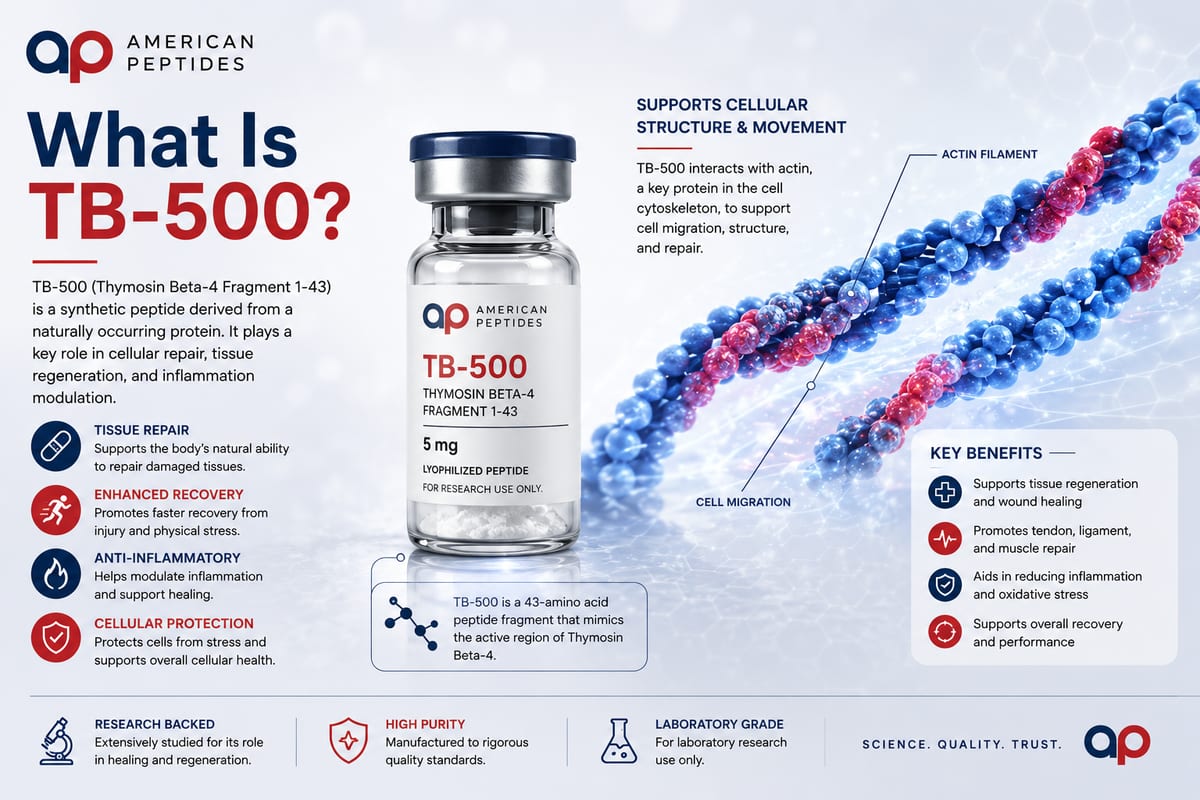
TB-500 is a synthetic peptide based on thymosin beta-4 (Tβ4), a naturally occurring 43-amino-acid actin-sequestering protein (~4,963 Da) first identified in calf thymus and later shown to be the dominant G-actin-binding peptide in most mammalian cells (Safer, Elzinga & Nachmias, 1991). In the research literature, "TB-500" most commonly refers not to the full Tβ4 protein but to a short, N-terminally acetylated synthetic fragment corresponding to residues 17–23 of Tβ4 — the sequence Ac-LKKTETQ — which contains the actin-binding motif (Ho et al., 2012; Esposito et al., 2012). Some research-peptide suppliers also use the "TB-500" label for full-length synthetic Tβ4; always verify the sequence on the Certificate of Analysis. Below is the molecular-biology breakdown for working researchers — strictly receptor- and pathway-level pharmacology, no outcome claims.
What TB-500 actually is at the molecular level
The confusion around TB-500 starts at nomenclature, so it helps to separate three related entities:
| Entity | Sequence | Approximate mass | What it is |
|---|---|---|---|
| Thymosin beta-4 (Tβ4) | 43 amino acids (full sequence beginning SDKPDMAEI…) | ~4,963 Da | The endogenous protein. Dominant intracellular G-actin-sequestering peptide. |
| TB-500 (research-peptide label) | Most commonly the N-terminally acetylated 17–23 fragment, Ac-LKKTETQ (7 aa) | ~889 Da (Ac-LKKTETQ-OH) | A synthetic fragment encompassing Tβ4’s actin-binding motif. Characterized in doping-control literature (Esposito et al., 2012). |
| AC-SDKP | Ac-Ser-Asp-Lys-Pro (residues 1–4 of Tβ4) | ~487 Da | A separate N-terminal tetrapeptide cleaved from Tβ4 in vivo by prolyl oligopeptidase. Studied independently as an angiogenic / anti-fibrotic factor (Wang et al., 2004). |
Conflating these three molecules is one of the most common errors in the secondary literature. Tβ4 is the full protein, TB-500 is most often a short actin-binding fragment of it, and AC-SDKP is a different short fragment with its own pharmacology. All three are studied in different assay systems with different readouts.
The actin-sequestering mechanism
Tβ4’s defining biochemical activity was established by Safer, Elzinga and Nachmias in 1991, who showed that the previously characterized actin-sequestering peptide "Fx" was sequence-identical to Tβ4 and forms a 1:1 complex with G-actin monomers, inhibiting their polymerization into F-actin filaments (Safer, Elzinga & Nachmias, 1991). Later mutational mapping localized the critical actin-binding contacts to the central helical region of Tβ4, with the 17-LKKTETQ-23 motif identified as essential for the actin interaction (Van Troys et al., 1996). Biophysical studies confirmed that Tβ4 binding measurably changes the conformation and dynamics of the actin monomer itself (De La Cruz et al., 2000).
This is the molecular rationale for the "TB-500" design: synthesizing the 17–23 actin-binding motif as a stand-alone short peptide allows researchers to study an actin-interaction signal independent of the rest of the Tβ4 sequence, in a molecule that is far simpler to synthesize, characterize, and quantify by mass spectrometry. Tβ10 was subsequently shown to share the same monomer-sequestering function, establishing β-thymosins as a family of actin regulators (Yu et al., 1993).
Wound-healing and migration pathways studied in animal models
Beyond pure actin biochemistry, Tβ4 has been studied in a range of injury and migration models. In the Goldstein-lab program at George Washington University, Tβ4 was reported to accelerate corneal re-epithelialization and reduce inflammatory infiltrate after alkali injury in mice, with several inflammatory chemokines reduced several-fold in treated corneas versus controls (Sosne et al., 2002). That program later progressed to clinical research on Tβ4 eyedrops for dry eye and neurotrophic keratopathy (Sosne, 2018).
In a separate landmark paper, Bock-Marquette and colleagues reported in Nature that Tβ4 forms a complex with PINCH and integrin-linked kinase (ILK), activating Akt and promoting cardiomyocyte and endothelial-cell migration and survival in a mouse coronary-ligation model (Bock-Marquette et al., 2004). The broader regenerative biology of Tβ4 across dermatology, ophthalmology, and cardiology was synthesized in a 2012 review from the Goldstein, Hannappel, Sosne and Kleinman labs (Goldstein et al., 2012).
AC-SDKP: the separate N-terminal tetrapeptide
Tβ4 is also a substrate for prolyl oligopeptidase, which liberates the N-terminal tetrapeptide AC-SDKP (Ac-Ser-Asp-Lys-Pro). AC-SDKP is then degraded by angiotensin-converting enzyme (ACE) — the same enzyme targeted by cardiovascular ACE inhibitors — which is one reason it has received independent attention. In published animal and in vitro studies, AC-SDKP stimulates endothelial-cell proliferation, migration, and tube formation in a dose-dependent manner and increases capillary density after myocardial infarction in rodent models (Wang et al., 2004). It is mechanistically distinct from the LKKTETQ-style "TB-500" fragment: AC-SDKP signals via angiogenic / anti-fibrotic pathways rather than through direct G-actin binding.
Comparative peptides table
| Peptide | Relationship to Tβ4 | Primary research context |
|---|---|---|
| TB-500 (Ac-LKKTETQ) | 17–23 actin-binding fragment of Tβ4 | Actin sequestration, cell-migration assays |
| Full Tβ4 (43 aa) | Native peptide | Wound healing, corneal repair, cardiac repair (Goldstein et al., 2012) |
| AC-SDKP | Residues 1–4 of Tβ4, cleaved by prolyl oligopeptidase | Angiogenesis, anti-fibrosis (Wang et al., 2004) |
| BPC-157 | Unrelated; gastric-juice-derived peptide | Often studied alongside TB-500 in pre-clinical tissue-repair literature |
Why purity and sequence verification matter
Because "TB-500" is a label rather than a single defined sequence in commerce, batch-specific verification is non-negotiable for a working researcher. The minimum questions a Certificate of Analysis (COA) should answer:
- What is the actual sequence in this vial? Ac-LKKTETQ-OH (the 7-aa fragment), full 43-aa Tβ4, or something else entirely? Mass-spectrometry data should match the claimed sequence within typical instrument tolerance.
- What is the HPLC purity? Common synthesis impurities at this length include deletion sequences and incomplete acetylation; both shift the apparent pharmacology in actin-binding assays.
- Does the lot number on the vial match the lot number on the COA? Lot mismatch is a frequent source of irreproducibility in peptide research.
Every TB-500 lot we ship has independent third-party HPLC and mass-spectrometry verification at ≥99% purity. See current COAs.
Laboratory handling
TB-500 is supplied lyophilized for stability. Reconstitution, storage temperature, light exposure, and freeze-thaw cycle count all measurably affect short-peptide integrity in published stability work. Researchers should keep reconstituted stocks cold and protected from light, minimize freeze-thaw cycles, and maintain lot traceability against the COA. This is bench-chemistry guidance for in vitro research only — it is not administration guidance, and TB-500 is not a drug, supplement, food, or medical product.
Frequently Asked Questions
What is the difference between TB-500 and full thymosin beta-4?
Thymosin beta-4 (Tβ4) is the full 43-amino-acid endogenous protein (~4,963 Da), first identified as the dominant G-actin-sequestering peptide in mammalian cells (Safer, Elzinga & Nachmias, 1991). "TB-500" is a research-peptide label most commonly applied to a short, N-terminally acetylated synthetic fragment, Ac-LKKTETQ, corresponding to residues 17–23 of Tβ4 — the region carrying the actin-binding motif characterized by mutational mapping (Van Troys et al., 1996; Esposito et al., 2012). Some suppliers use the "TB-500" label for full-length synthetic Tβ4; verify against the lot COA.
How does TB-500 relate to actin?
The 17–23 LKKTETQ region of Tβ4 makes the critical contacts with G-actin monomers; deletions or mutations in this region abolish the actin interaction in published mutational studies (Van Troys et al., 1996). The parent Tβ4 protein forms a 1:1 complex with G-actin and prevents its polymerization into F-actin filaments (Safer, Elzinga & Nachmias, 1991), and Tβ4 binding measurably alters monomer conformation and dynamics (De La Cruz et al., 2000). The TB-500 fragment is studied as an isolated probe of this actin-binding motif.
Why is TB-500 studied alongside BPC-157?
The two peptides are sequence- and origin-unrelated — TB-500 is a Tβ4 fragment, BPC-157 is a synthetic peptide derived from a gastric-juice protein — but they are frequently paired in pre-clinical tissue-repair literature because they engage different mechanisms of interest in injury models. TB-500’s research context centers on actin-sequestering and cell-migration pathways (Safer, Elzinga & Nachmias, 1991); BPC-157’s pre-clinical literature emphasizes nitric-oxide and growth-factor signaling. Researchers designing comparator studies should be explicit that these are distinct pathways studied in distinct assay systems — not interchangeable molecules.
What is AC-SDKP and is it the same as TB-500?
No. AC-SDKP (Ac-Ser-Asp-Lys-Pro) is the N-terminal tetrapeptide cleaved from Tβ4 by prolyl oligopeptidase — residues 1–4 of the parent protein — and is studied for angiogenic and anti-fibrotic activity in endothelial and cardiac models (Wang et al., 2004). TB-500, as most commonly characterized in the analytical-chemistry literature, is the 17–23 actin-binding fragment Ac-LKKTETQ (Esposito et al., 2012). Different residues, different mechanism, different pharmacology.
Is TB-500 approved for human or veterinary use?
No. TB-500 is not approved as a drug, supplement, food, or medical product in any jurisdiction we are aware of, and it is prohibited in equine sport — the analytical-chemistry literature on TB-500 detection was developed largely for veterinary doping control (Ho et al., 2012). American Peptides supplies TB-500 strictly for in vitro laboratory research.
What molecular weight should I expect on the COA?
If the lot is the standard Ac-LKKTETQ-OH fragment, the monoisotopic / average mass should be near ~889 Da. If the lot is full-length synthetic Tβ4 (43 aa), the mass should be near ~4,963 Da. If your COA does not match either, the material is not what is conventionally labeled TB-500 — do not proceed without sequence clarification from the supplier.
How should TB-500 be handled in the lab?
Store lyophilized at −20 °C or colder. Reconstitute in an appropriate aqueous buffer immediately before use, keep reconstituted stocks cold and protected from light, aliquot to minimize freeze-thaw cycles, and maintain lot-number traceability against the COA. This is bench-chemistry handling guidance only — not administration guidance.
Citations
- Safer D., Elzinga M., Nachmias V.T. "Thymosin beta 4 and Fx, an actin-sequestering peptide, are indistinguishable." J Biol Chem. 1991;266(7):4029–4032. PubMed.
- Yu F.X., Lin S.C., Morrison-Bogorad M., Atkinson M.A., Yin H.L. "Thymosin beta 10 and thymosin beta 4 are both actin monomer sequestering proteins." J Biol Chem. 1993;268(1):502–509. PubMed.
- Van Troys M., Dewitte D., Goethals M., Carlier M.F., Vandekerckhove J., Ampe C. "The actin binding site of thymosin beta 4 mapped by mutational analysis." EMBO J. 1996;15(2):201–210. PubMed.
- De La Cruz E.M., Ostap E.M., Brundage R.A., Reddy K.S., Sweeney H.L., Safer D. "Thymosin-beta(4) changes the conformation and dynamics of actin monomers." Biophys J. 2000;78(5):2516–2527. PubMed.
- Sosne G., Szliter E.A., Barrett R., Kernacki K.A., Kleinman H., Hazlett L.D. "Thymosin beta 4 promotes corneal wound healing and decreases inflammation in vivo following alkali injury." Exp Eye Res. 2002;74(2):293–299. PubMed.
- Wang D., Carretero O.A., Yang X.Y., Rhaleb N.E., Liu Y.H., Liao T.D., Yang X.P. "N-acetyl-seryl-aspartyl-lysyl-proline stimulates angiogenesis in vitro and in vivo." Am J Physiol Heart Circ Physiol. 2004;287(5):H2099–H2105. PubMed.
- Bock-Marquette I., Saxena A., White M.D., Dimaio J.M., Srivastava D. "Thymosin beta4 activates integrin-linked kinase and promotes cardiac cell migration, survival and cardiac repair." Nature. 2004;432(7016):466–472. PubMed.
- Goldstein A.L., Hannappel E., Sosne G., Kleinman H.K. "Thymosin β4: a multi-functional regenerative peptide. Basic properties and clinical applications." Expert Opin Biol Ther. 2012;12(1):37–51. PubMed.
- Esposito S., Deventer K., Goeman J., Van der Eycken J., Van Eenoo P. "Synthesis and characterization of the N-terminal acetylated 17–23 fragment of thymosin beta 4 identified in TB-500, a product suspected to possess doping potential." Drug Test Anal. 2012;4(9):733–738. PubMed.
- Ho E.N., Kwok W.H., Lau M.Y., Wong A.S., Wan T.S., Lam K.K., Schiff P.J., Stewart B.D. "Doping control analysis of TB-500, a synthetic version of an active region of thymosin beta4, in equine urine and plasma by liquid chromatography-mass spectrometry." J Chromatogr A. 2012;1265:57–69. PubMed.
- Sosne G. "Thymosin beta 4 and the eye: the journey from bench to bedside." Expert Opin Biol Ther. 2018;18(sup1):99–104. PubMed.
This article is for laboratory research reference only. American Peptides products are sold strictly for in vitro research. Not for human or animal consumption, not a drug, not a supplement, not a medical product.
Last reviewed: 2026-05-25 by American Peptides Research Team.