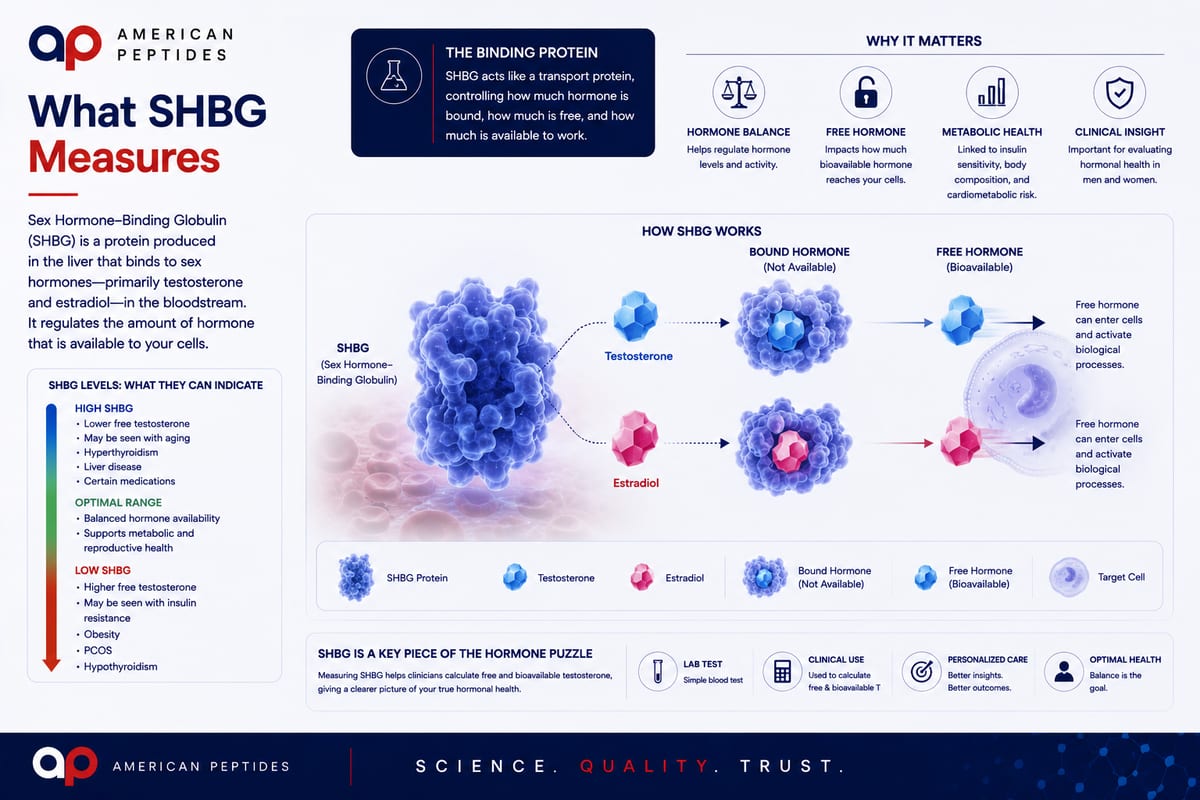

Total testosterone measures all the testosterone in a blood sample, bound and unbound together; free testosterone measures only the small fraction that is not bound to carrier proteins. They are different assays answering different questions, and confusing them is a common source of misunderstanding. This is an educational explainer of the assay concept — not medical advice, diagnosis, or interpretation of personal results.
The bound-and-free model
In blood, testosterone exists in three pools: tightly bound to SHBG, loosely bound to albumin, and a small unbound “free” fraction. Total testosterone sums all three. Free testosterone isolates the unbound portion, which is generally regarded as the biologically active part. The difference between the two assays is entirely about which pools they count.
| Assay | Counts | Question it answers |
|---|---|---|
| Total testosterone | All bound + free | How much is present overall? |
| Free testosterone | Unbound only | How much is in the active fraction? |
Why the two can diverge
Because SHBG controls how much hormone is bound, a change in SHBG can move free testosterone substantially while total stays similar — and vice versa. This is the central reason a “normal total” and an “unexpected free” can coexist, and why SHBG is read alongside both, as covered in what SHBG measures.
How free testosterone is determined
Free testosterone can be measured directly with specialized methods or estimated by calculation from total testosterone, SHBG, and albumin. Each approach has assumptions and limitations, which is exactly why the methodology matters and why results are interpreted by a clinician rather than compared naively across labs. The principle that an assay is defined by its method and assumptions is the same one behind what HbA1c measures.
Why this distinction recurs everywhere
The total-versus-free idea underlies much of the confusion in hormone discussions, including symptom-association topics, age-related changes, and hormone optimization as a concept. Understanding which fraction an assay reports is prerequisite to reading any of that critically.
The interpretation boundary
Knowing the difference between the assays is not the same as interpreting values. What a total or free result means for an individual depends on the method used, reference ranges, the full clinical picture, and professional judgment — the exclusive domain of a licensed healthcare provider. Nothing here supports self-assessment or evaluating any product.
Why the concept is worth knowing
As education, the bound/free model resolves one of the most common points of confusion in hormone panels and explains why two numbers labelled “testosterone” can tell different stories. That clarity is the aim — not health guidance.
Why method choice changes the conversation
A subtle but important point is that “free testosterone” is not one number — it is a family of numbers depending on how it was obtained. Direct measurement methods and calculation-based estimates rest on different assumptions, and results are not always interchangeable across laboratories or techniques. This is why naively comparing a free value from one source to a reference range or a prior result from another can manufacture a difference that is methodological rather than real. The disciplined reading is to treat the assay method as part of the result itself, exactly as one would with HbA1c or SHBG. Layer on the biological reality that SHBG continuously shifts the bound/free balance, and it becomes clear why a single testosterone number — total or free — is rarely the whole story, and why panels and trends, interpreted by a clinician, are the unit of meaning rather than any isolated value. For an individual, what total or free testosterone implies is determined entirely by method, reference ranges, the full clinical picture, and professional judgment from a licensed healthcare provider. The educational takeaway is narrow and durable: two numbers both labelled “testosterone” can answer different questions, and knowing which fraction an assay reports — and how — is prerequisite to reading any hormone discussion, including symptom-association topics, critically rather than as marketing.
The durable takeaway
Strip everything down and one rule remains: know which fraction an assay reports and how it was obtained before you compare it to anything. Total answers “how much overall,” free answers “how much unbound,” and SHBG is the link between them. What any value means for a person is set by method, reference ranges, the full picture, and a licensed healthcare professional — never an article. That single discipline makes the whole hormone literature, including optimization discussions, readable instead of confusing.
Frequently Asked Questions
What is the difference between total and free testosterone?
Total counts all testosterone (protein-bound plus unbound); free counts only the small unbound fraction, generally regarded as the biologically active part.
Why can the two diverge?
Because SHBG controls how much is bound, a change in SHBG can shift free testosterone substantially while total stays similar, and vice versa.
How is free testosterone determined?
Either measured directly with specialized methods or calculated from total testosterone, SHBG, and albumin — each with its own assumptions and limitations.
Which one is "the active" testosterone?
The free, unbound fraction is generally considered the biologically active portion, but interpretation still requires full clinical context.
Can I interpret my results from this article?
No. This explains the assay concept only. A specific value requires the method, reference ranges, full picture, and a licensed healthcare professional.
Why does this distinction matter so much?
Because it underlies common confusion in hormone topics — age-related changes, symptom associations, optimization discussions — all of which assume you know which fraction is reported.
Is this medical advice?
No. It is general education about laboratory assays, not a diagnosis, treatment recommendation, or interpretation of personal results.
Related Optimization Protocols
Reviewed by the American Peptides Education Team. Educational content only — not medical advice.
For educational purposes only. Not medical advice, a diagnosis, or a treatment recommendation. Laboratory results must be interpreted by a qualified licensed healthcare professional. No product is implied to affect any lab marker.