

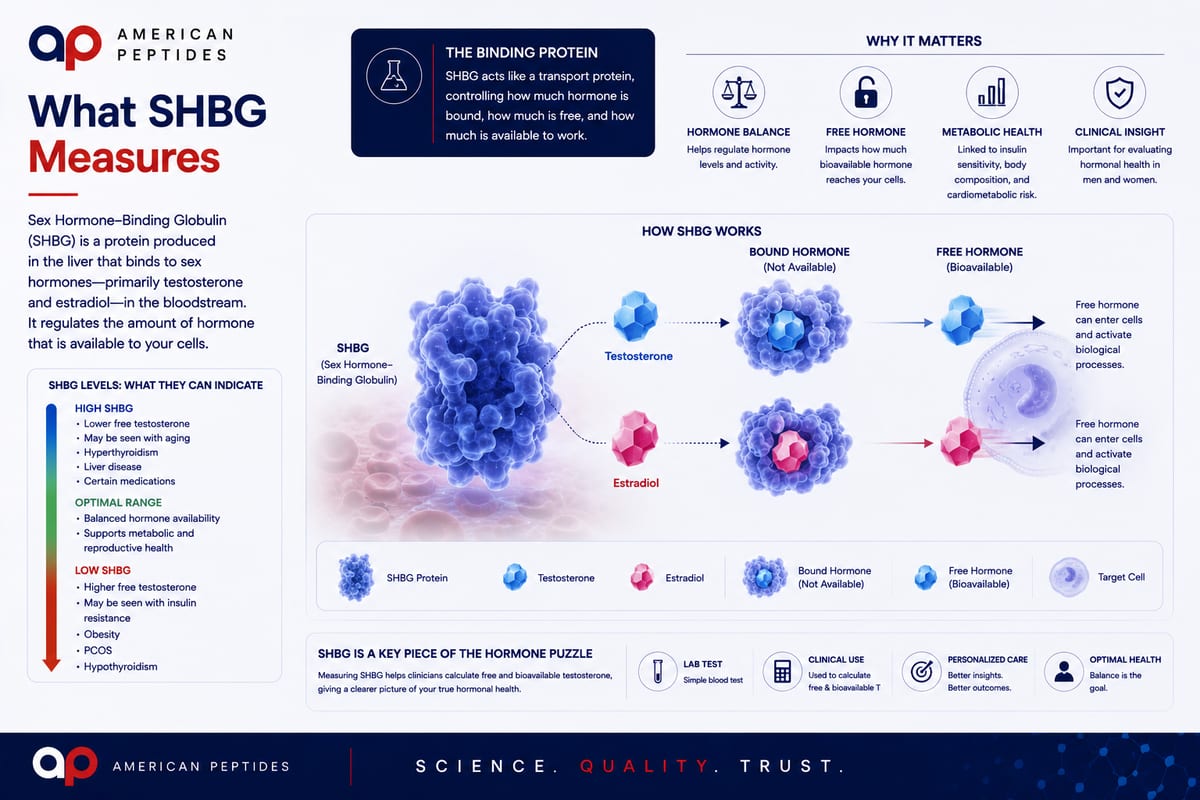
SHBG — sex hormone-binding globulin — is a protein made mainly by the liver that binds sex hormones in the bloodstream and controls how much of them circulates in a free, unbound form. The SHBG lab marker measures the concentration of this transport protein. This is an educational explanation of the concept only; it is not medical advice, diagnosis, or interpretation of personal results.
The transport-protein concept
Most sex hormones do not float freely in blood — they travel bound to carrier proteins, principally SHBG and, more loosely, albumin. Bound hormone is held in reserve; the small unbound (“free”) fraction is generally considered the biologically active portion. SHBG therefore acts like a buffer that sets how much hormone is free at any time.
Why measuring SHBG matters conceptually
Because SHBG controls the bound-versus-free balance, the same total hormone level can correspond to very different free levels depending on SHBG. This is exactly why total and free measurements can diverge — a point explored directly in total vs free testosterone. SHBG is the variable that links the two.
| Fraction | State | General view |
|---|---|---|
| SHBG-bound | Tightly bound | Reserve, not immediately active |
| Albumin-bound | Loosely bound | Partially available |
| Free | Unbound | Considered the active fraction |
What can move SHBG
SHBG production responds to a range of physiological factors, so its level is not fixed. Because it shifts, the interpretation of a hormone panel depends on reading SHBG alongside total and free values rather than any one number alone. The general lesson — an assay measures one defined quantity under specific assumptions — mirrors what HbA1c measures.
Why it is rarely read alone
SHBG by itself says little; its value is in context. Clinicians read it together with total hormone and calculated or measured free hormone to understand the overall picture. This contextual, multi-marker logic is the same reason ongoing lab monitoring emphasizes trends and panels over isolated single results.
Where it fits the wider topic
SHBG is part of the broader hormone-science backdrop behind discussions of testosterone changes with age and hormone optimization as a concept. Understanding the transport-protein idea makes those topics far easier to read critically rather than as marketing.
The interpretation boundary
Knowing what SHBG measures is not the same as interpreting a result. What any SHBG value means for an individual depends on the full panel, reference ranges, and clinical context — the exclusive domain of a licensed healthcare professional. Nothing here is a basis for self-assessment or for evaluating any product.
Why the concept is worth knowing
As education, the transport-protein model explains a recurring source of confusion in hormone panels — why “normal total” and “low free” can coexist. That conceptual clarity is the purpose here, not health guidance.
Why SHBG is the hidden variable in hormone panels
The single most clarifying idea about SHBG is that it is rarely interesting on its own — it is the variable that explains apparent contradictions elsewhere on a panel. When a total hormone level looks unremarkable but the free fraction does not, SHBG is usually the reason, because it sets how much hormone is held in reserve versus available. That is why clinicians read it as a modifier of the total and free values rather than as a standalone result, and why a hormone panel is interpreted as an integrated picture, not a stack of independent numbers. SHBG also responds to a range of physiological states, so it is not a fixed personal constant; its movement is part of what the panel is designed to capture over time. The general lesson generalizes well beyond hormones: an assay reports one defined quantity under specific assumptions, and meaning emerges only in context — the same principle behind HbA1c and trend-based monitoring. For an individual, what any SHBG value implies is determined by the full panel, reference ranges, and clinical judgment from a licensed healthcare professional — never by an article. Held as education, the transport-protein model simply explains a recurring source of confusion and connects cleanly to broader hormone-science topics like age-related testosterone change and hormone optimization as a concept, without implying anything about a person or a product.
The takeaway in one line
SHBG is the hidden modifier that explains why “normal total” and an unexpected free fraction can coexist — read it with the panel, never alone. Like HbA1c and every assay, it means what its context allows, and what a value implies for a person is determined solely by a licensed healthcare professional. As education, the transport-protein model simply makes total vs free hormone topics legible.
Frequently Asked Questions
What does SHBG measure?
The blood concentration of sex hormone-binding globulin, the transport protein that binds sex hormones and controls how much circulates in free, unbound form.
Why does SHBG matter for hormone interpretation?
Because it sets the bound-versus-free balance, the same total hormone level can mean different free levels depending on SHBG — it links total and free measurements.
What is the "free" fraction?
The small unbound portion of a hormone, generally considered the biologically active part, as opposed to the protein-bound reserve.
Is SHBG fixed?
No. Its production responds to various physiological factors, so it shifts — which is why it is interpreted alongside total and free hormone, not alone.
Can I interpret my SHBG from this article?
No. This explains the concept only. A specific value requires the full panel, reference ranges, and a licensed healthcare professional.
How does SHBG relate to testosterone topics?
It is the variable connecting total and free testosterone and part of the hormone-science backdrop behind age-related changes and optimization discussions.
Is this medical advice?
No. It is general education about a laboratory marker, not a diagnosis, treatment recommendation, or interpretation of personal results.
Related Optimization Protocols
Reviewed by the American Peptides Education Team. Educational content only — not medical advice.
For educational purposes only. Not medical advice, a diagnosis, or a treatment recommendation. Laboratory results must be interpreted by a qualified licensed healthcare professional. No product is implied to affect any lab marker.