
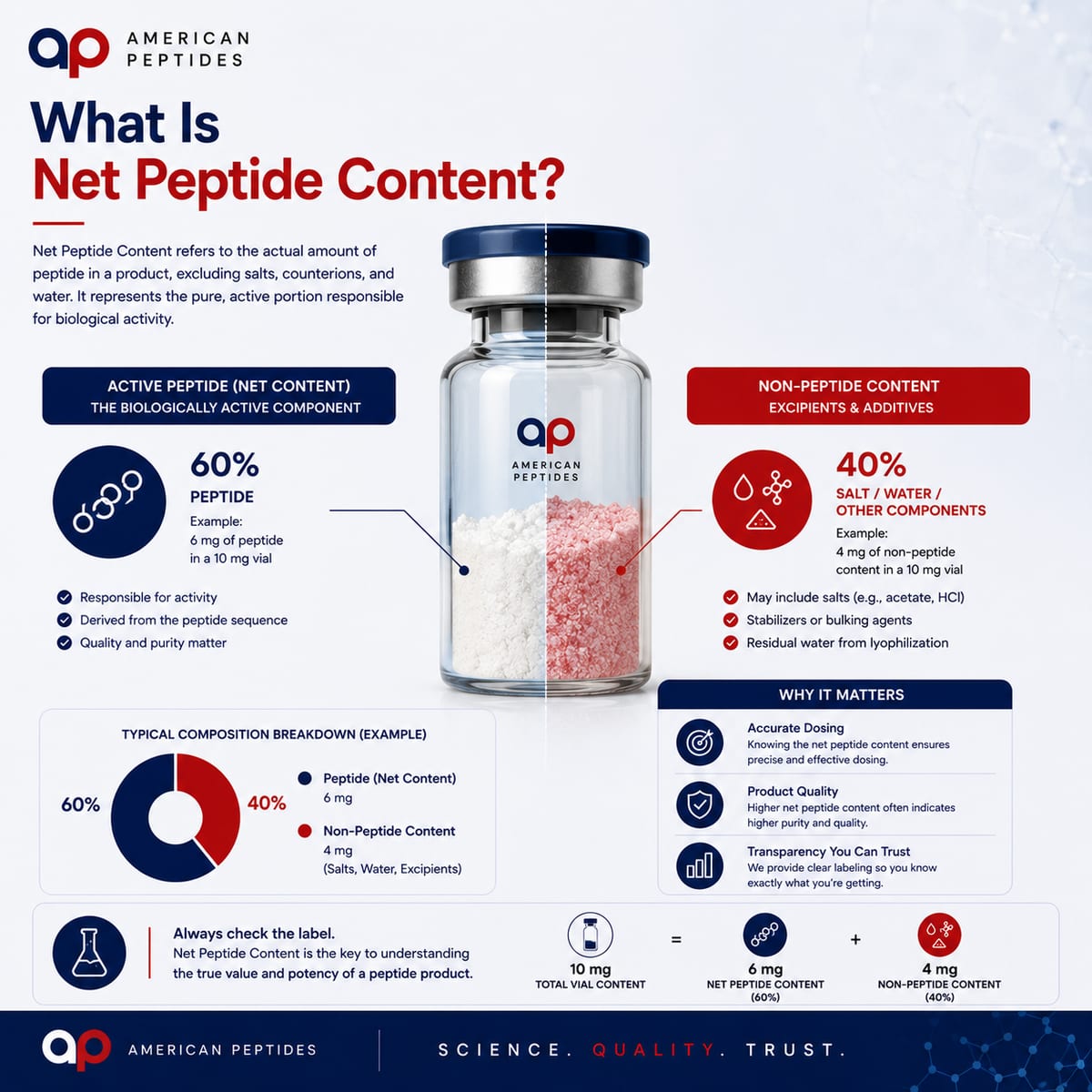
Net peptide content is the fraction of a vial's dry mass that is actually peptide, as opposed to counter-ion salts, residual water, and other non-peptide mass. It is a different question from purity, and confusing the two is one of the most common quantitative errors in peptide research. This is an educational, research-use-only explainer.
Purity and content answer different questions
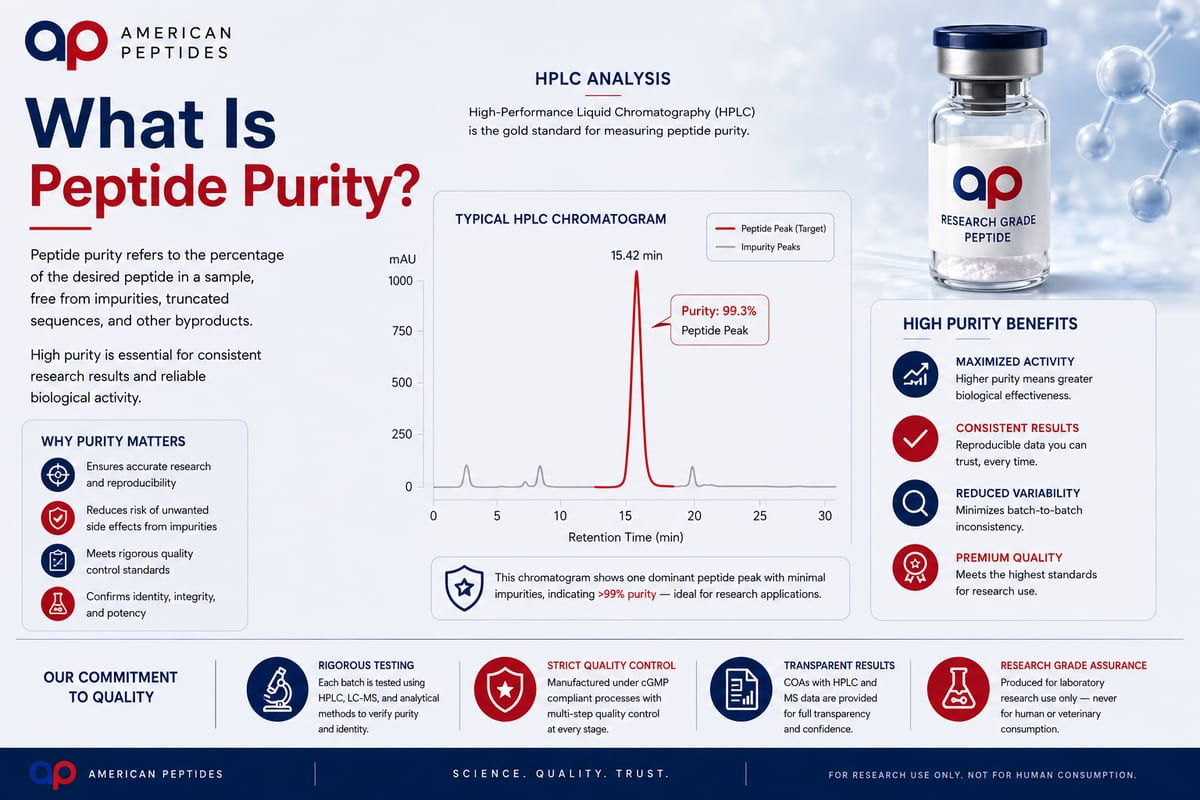
Purity is relative: of the peptide-related material present, what percentage is the target sequence? Net peptide content is absolute: of the total dry mass in the vial, how many milligrams are actually peptide at all? A lot can be 99% pure yet only ~80% peptide by mass, because salts and bound water make up the rest.
| Metric | Question | Affected by |
|---|---|---|
| Purity % | How much of the peptide material is the target? | Impurities, truncations |
| Net peptide content | How much of the dry mass is peptide? | Salts, residual water |
Why the difference exists
Synthetic peptides are typically isolated as salts, and lyophilized material retains some bound water. Both add mass that is not peptide. Two vials labelled the same nominal weight can therefore contain meaningfully different amounts of actual peptide if their net content differs — a real source of irreproducibility.
The quantitative consequence
Concentration after reconstitution is mass divided by volume. If a researcher uses the gross vial weight instead of net peptide mass, every concentration is overstated and every downstream result — a signaling readout, a binding measurement — is systematically off. Using net content corrects this at the source.
Where to find it
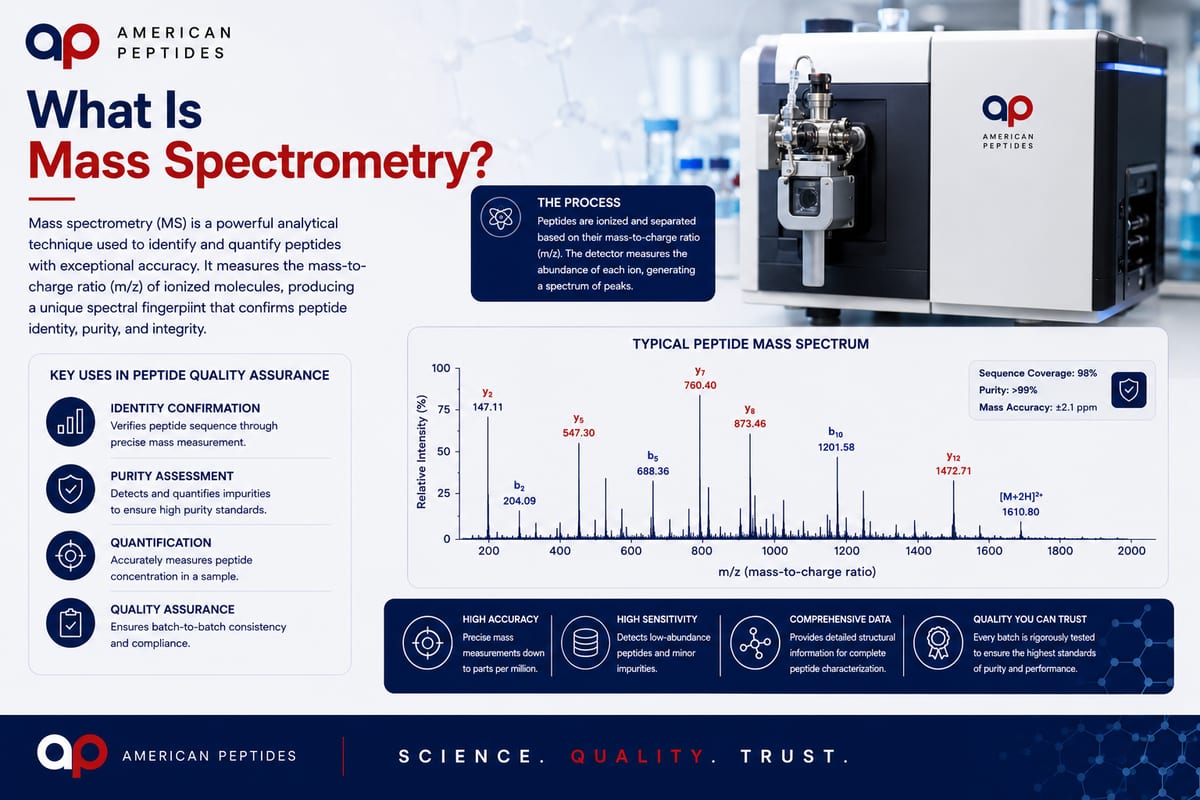
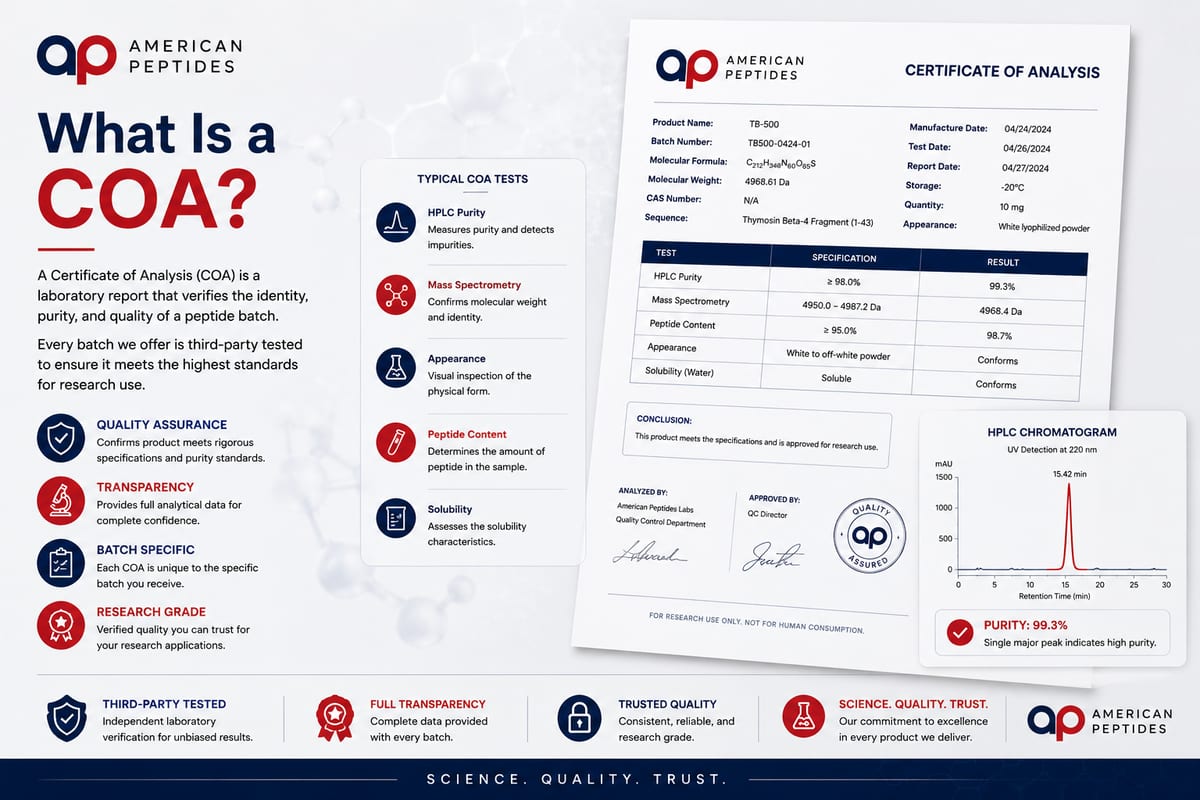
Net peptide content is reported on a thorough lot-specific Certificate of Analysis, alongside HPLC purity and mass-spec identity. A COA that reports only a purity percentage is incomplete for quantitative work because it leaves the actual peptide mass unknown.
Three orthogonal checks
Identity (the right molecule), purity (mostly the target), and net content (how much is peptide) are independent. A lot must pass all three to support reproducible quantitative research; passing one says nothing about the others. This is the same orthogonal-verification logic that underpins the entire research-quality framework, including how to read a COA.
What it does not establish
Net peptide content is a compositional fact for accurate research quantitation. It establishes nothing about safety or efficacy and is not human or animal use guidance.
A worked illustration of the error
Suppose a vial is labelled with a nominal weight and a researcher reconstitutes it assuming the entire mass is peptide. If net peptide content is only around 80%, every concentration is overstated by roughly a fifth, and so is every dose-response axis, EC50, and comparison built on it. Nothing in the assay looks wrong — the data are simply, silently, off. Using the net peptide mass from the Certificate of Analysis when computing reconstitution volume removes this entire class of error.
Why vendors sometimes report only purity
Purity is cheaper to present and looks impressive in isolation, but without net content it leaves the actual peptide mass unknown — which is exactly the number quantitative research needs. A credible source reports identity, purity, and net content together because they are orthogonal checks; a purity-only figure is a marketing number, not a quantitation-ready specification.
The one habit that prevents the error
The durable fix is procedural: always pull the net peptide mass from the lot-specific Certificate of Analysis and use it — never the nominal vial weight — when computing reconstitution volume. Pair that with identity and purity verification and the three orthogonal checks together make a lot quantitation-ready. It is a small discipline that removes an entire silent class of irreproducibility.
Net content and honest specifications
A specification a researcher can actually plan around states three things about a lot: what the molecule is, how pure it is, and how much of the dry mass is peptide. Drop the third and the first two become unusable for quantitation, because no concentration can be computed without the actual peptide mass. This is why net peptide content is a marker of an honest specification rather than an optional extra — it is the number that converts a vial into a usable research reagent. The cost of ignoring it is not a dramatic failure but a quiet, systematic bias: every concentration after reconstitution is overstated, every comparison is shifted, and nothing in the data signals the problem. Pairing net content with identity and purity on a lot-specific COA closes that gap and is the difference between a number that looks reassuring and a specification that supports reproducible work.
Frequently Asked Questions
What is net peptide content?
The fraction of a vial’s dry mass that is actually peptide, excluding counter-ion salts, residual water, and other non-peptide mass.
How is it different from purity?
Purity is relative (what % of peptide material is the target); net content is absolute (how much of the total dry mass is peptide). A lot can be 99% pure but ~80% peptide by mass.
Why does the difference exist?
Synthetic peptides are isolated as salts and retain some bound water; both add non-peptide mass to the vial.
Why does it matter quantitatively?
Concentration is mass over volume. Using gross weight instead of net peptide mass overstates every concentration and corrupts all downstream quantitative results.
Where is net content reported?
On a thorough lot-specific Certificate of Analysis, alongside HPLC purity and mass-spec identity. Purity-only COAs are incomplete for quantitative work.
Are purity and net content interchangeable?
No. They are orthogonal checks; a lot must pass identity, purity, and net content independently for reproducible quantitation.
Does net content indicate safety?
No. It is a compositional fact for research quantitation only and is not human or animal use guidance.
Related Optimization Protocols
Reviewed by the American Peptides Education Team. Educational content only — not medical advice.
For research use only. Sold exclusively for in-vitro laboratory research. Not a drug, supplement, food, or medical product. Not for human or animal consumption, diagnostic, or therapeutic use. Nothing here is dosing, administration, or medical guidance.