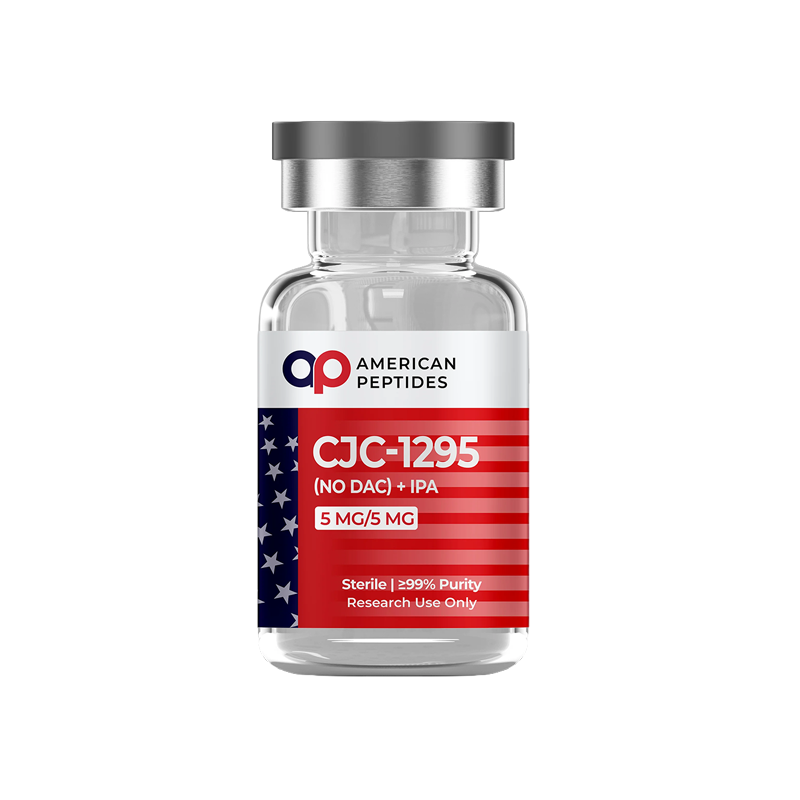


Few research peptides are as badly named as “CJC-1295 without DAC.” The compound sold under that label is not CJC-1295 at all: it is the 29-amino-acid active fragment of growth-hormone-releasing hormone carrying four stabilising substitutions, a molecule the peptide-chemistry literature calls a tetrasubstituted GRF(1-29) analogue and the research community calls modified GRF 1-29. Untangling the name is the first step to reading its evidence properly. This summary covers the receptor pharmacology, what each substitution does and why, and where the literature stops. For the evidence-first format used across this series, see our ipamorelin research review.
Research-use-only context. This article summarizes published third-party scientific literature — the large majority of it conducted in cultured cells or animal models. It is not medical advice, not a therapeutic or performance claim, and not a usage guide. American Peptides products are sold strictly for in vitro laboratory research and are not for human or veterinary use.
What CJC-1295 (no DAC) is
Human GHRH is a 44-residue peptide, but its first 29 residues carry the full receptor activity; GRF(1-29)-NH2 is the minimal fully active fragment and is itself a well-characterised analogue. Modified GRF 1-29 takes that fragment and changes four positions: D-alanine replaces L-alanine at position 2, glutamine replaces asparagine at position 8, alanine replaces glycine at position 15, and leucine replaces methionine at position 27. The result is written [D-Ala2, Gln8, Ala15, Leu27]-hGRF(1-29)-NH2.
The actual CJC-1295 adds one more thing. In 2005, Jétté and colleagues reported in Endocrinology a series of GRF(1-29) analogues fitted with a reactive linker — a “drug affinity complex,” or DAC — that forms a covalent bond with a cysteine on serum albumin after entering circulation, converting a peptide with a half-life of minutes into an albumin-bound conjugate with a half-life of days.4 The tetrasubstituted GRF(1-29) is the peptide portion of that conjugate. “CJC-1295 no DAC” therefore means the peptide without the albumin-binding linker, which restores a short half-life and makes it, pharmacokinetically, a very different molecule from the one the name refers to. Like tesamorelin (reviewed in our tesamorelin research review), it acts at the GHRH receptor, a class B G-protein-coupled receptor on pituitary somatotrophs that signals through Gs and cAMP to drive growth-hormone synthesis and release, with hepatic IGF-1 downstream (see what IGF-1 is).
What the research reports
Why position 2 is modified. Frohman and colleagues showed in 1989, in The Journal of Clinical Investigation, that dipeptidyl peptidase IV in plasma cleaves native GHRH between Ala2 and Asp3, producing an inactive (3-44) fragment within minutes.1 Placing a D-amino acid at position 2 makes that bond a poor substrate for the enzyme. Kubiak and colleagues’ 1993 Journal of Medicinal Chemistry study confirmed the principle in bovine GRF analogues, reporting that position-2 substitutions, alone and combined with Ala15, produced analogues with enhanced metabolic stability in plasma and improved activity in animal assays.2
Why positions 8, 15 and 27 are modified. The other three changes address chemical rather than enzymatic instability. Asparagine at position 8 is prone to deamidation during storage and in solution; glutamine is not. Methionine at position 27 is prone to oxidation; leucine is not. Glycine at position 15 is a helix-breaker, and replacing it with alanine stabilises the amphipathic helix the peptide adopts when it binds the receptor. Izdebski and colleagues’ 1995 PNAS paper systematically evaluated GHRH(1-29) analogues combining substitutions at these positions and reported that the best combinations were “superactive,” with potency exceeding the parent fragment in rat pituitary-cell assays and in rats.3 That paper is the direct scientific ancestor of the tetrasubstituted sequence.
Receptor structure. A 2020 Nature Communications cryo-EM study resolved GHRH bound to its receptor and Gs, showing the peptide’s N-terminal residues inserted into the receptor’s transmembrane core and its helical body cradled by the extracellular domain.5 The structure explains both why the (1-29) fragment suffices — the receptor-contacting region lies within it — and why helix-stabilising and N-terminus-protecting substitutions preserve activity.
The DAC-conjugated compound. Because the literature indexed under “CJC-1295” concerns the albumin-bound conjugate, it should be read as such. Jétté 2005 reported that the conjugate activated the GRF receptor on rat anterior pituitary and produced sustained growth-hormone and IGF-1 elevation in rats.4 Early clinical pharmacokinetic work on the conjugate also exists, and its development was later discontinued. Those findings describe the long-acting conjugate, not the unconjugated peptide sold as “no DAC.”
The human-evidence gap
For modified GRF 1-29 itself there are no controlled human efficacy data for the uses discussed online. The human data that exist are early pharmacokinetic studies of the DAC-conjugated compound, whose development was later discontinued, and they were never efficacy trials for the uses that circulate on forums. Reviewers in the orthopaedic and sports-medicine literature group GHRH analogues among peptides adopted well ahead of evidence and urge caution. Neither modified GRF 1-29 nor CJC-1295 is an approved drug, and GHRH analogues are prohibited in competitive sport under anti-doping rules.
The takeaway
Modified GRF 1-29 is a textbook example of rational peptide stabilisation: four substitutions, each answering a specific degradation route, on the minimal active fragment of a hormone whose receptor structure is solved. The name it is sold under points to a different, albumin-bound molecule whose literature should not be borrowed. American Peptides supplies CJC-1295 (no DAC) and a CJC-1295 (no DAC) + ipamorelin research blend — two compounds acting at different receptors (GHRHR and GHS-R1a) on the same pituitary cell — strictly for in vitro research. Specifications are on the CJC-1295 (no DAC) reference monograph.
Frequently Asked Questions
Is CJC-1295 no DAC the same as CJC-1295?
No. CJC-1295 is a GRF(1-29) analogue fitted with an albumin-binding linker (the DAC) that gives it a multi-day half-life. “No DAC” is the same tetrasubstituted peptide without that linker, so its half-life is minutes, like native GRF(1-29). The research community’s name for it, modified GRF 1-29, is more accurate.
What do the four substitutions do?
D-Ala2 resists dipeptidyl peptidase IV cleavage; Gln8 replaces a deamidation-prone asparagine; Ala15 stabilises the receptor-binding helix; Leu27 replaces an oxidation-prone methionine. Each addresses a specific degradation route described in the peptide-chemistry literature.
What receptor does modified GRF 1-29 act on?
The GHRH receptor on pituitary somatotrophs, a class B G-protein-coupled receptor that signals through Gs and cAMP. A 2020 cryo-EM structure shows the peptide’s N-terminus inserted into the receptor core.
Is CJC-1295 no DAC approved by the FDA?
No. Neither modified GRF 1-29 nor the DAC-conjugated CJC-1295 is an approved drug, and GHRH analogues are prohibited in competitive sport. American Peptides supplies it strictly for in vitro research.
Citations
- Frohman LA, et al. “Dipeptidylpeptidase IV and trypsin-like enzymatic degradation of human growth hormone-releasing hormone in plasma.” J Clin Invest. 1989;83(5):1533–1540. PubMed: PMID 2565342
- Kubiak TM, et al. “Position 2 and position 2/Ala15-substituted analogs of bovine growth hormone-releasing factor (bGRF) with enhanced metabolic stability and improved in vivo bioactivity.” J Med Chem. 1993;36(7):888–897. PubMed: PMID 8464043
- Izdebski J, et al. “Synthesis and biological evaluation of superactive agonists of growth hormone-releasing hormone.” Proc Natl Acad Sci U S A. 1995;92(11):4872–4876. PubMed: PMID 7761415
- Jétté L, et al. “Human growth hormone-releasing factor (hGRF)1-29-albumin bioconjugates activate the GRF receptor on the anterior pituitary in rats: identification of CJC-1295 as a long-lasting GRF analog.” Endocrinology. 2005;146(7):3052–3058. PubMed: PMID 15817669
- Zhou F, et al. “Structural basis for activation of the growth hormone-releasing hormone receptor.” Nat Commun. 2020;11(1):5205. PubMed: PMID 33060564
Related reading
- Ipamorelin Research: What the Studies Actually Show
- Tesamorelin Research: What the Studies Actually Show
- What Is IGF-1? A Science Explainer
This article is for laboratory research reference only. American Peptides products are sold strictly for in vitro research. Not for human consumption.
Related research
Compliance Notice: American Peptides products are sold strictly for laboratory and academic research purposes only. They are not intended for human or veterinary consumption, diagnosis, treatment, or prevention of any disease. All content on this page is educational in nature and does not constitute medical advice or product claims. Researchers are responsible for handling these compounds in accordance with their institution’s safety protocols and applicable laws.