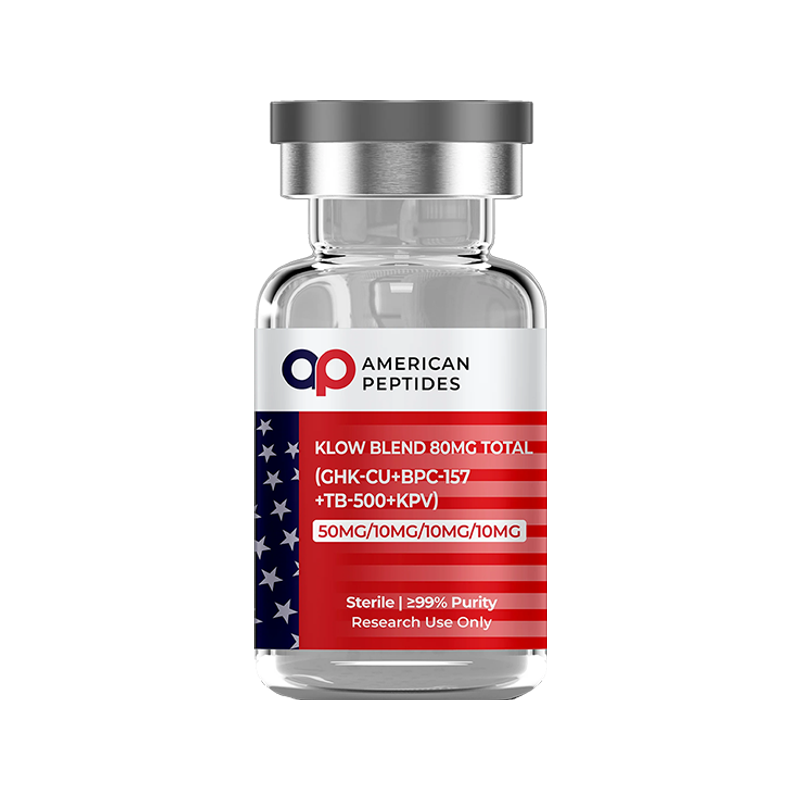


“KLOW” is not a term from the scientific literature. It is a community and vendor label for a four-component research blend — GHK-Cu, BPC-157, TB-500 and KPV — that has become popular enough to deserve an evidence-first look. The honest way to review it is component by component, because that is the only level at which peer-reviewed data exist. This summary covers what each peptide’s cell and animal literature reports, why researchers find the four mechanistically complementary, and what has never been studied. For the format used across this series, see our BPC-157 research review.
Research-use-only context. This article summarizes published third-party scientific literature — the large majority of it conducted in cultured cells or animal models. It is not medical advice, not a therapeutic or performance claim, and not a usage guide. American Peptides products are sold strictly for in vitro laboratory research and are not for human or veterinary use.
What the KLOW blend is
The blend combines four short peptides with distinct origins. GHK-Cu is the tripeptide glycyl-L-histidyl-L-lysine bound to a copper(II) ion, a complex first identified in human plasma. BPC-157 is a synthetic 15-amino-acid fragment of a gastric-juice protein, studied since the early 1990s mainly by one Croatian group and, increasingly, by others. TB-500 is a synthetic peptide corresponding to the actin-binding region of thymosin β4 (Tβ4), a 43-residue protein that regulates the cytoskeleton. KPV is the C-terminal tripeptide (Lys-Pro-Val) of α-melanocyte-stimulating hormone, corresponding to α-MSH(11-13). Each has its own literature, reviewed in more depth in our GHK-Cu, BPC-157 and TB-500 research reviews.
What the research reports
GHK-Cu and the extracellular matrix. The foundational finding is Maquart and colleagues’ 1988 FEBS Letters paper, which reported that the GHK-Cu complex stimulated collagen synthesis in cultured fibroblasts.1 A 2000 study in the Journal of Investigative Dermatology extended this to a rat wound-chamber model, reporting modulation of glycosaminoglycan and small-proteoglycan expression — the non-collagen components of the matrix.2 The copper complex, not the bare tripeptide, is regarded as the active species throughout this literature.
BPC-157 and cell migration. A 2011 study in the Journal of Applied Physiology by Chang and colleagues used rat tendon explants and cultured tendon fibroblasts and reported that BPC-157 increased cell outgrowth from explants, improved cell survival under oxidative stress, and accelerated migration in wound-scratch assays, with phosphorylation of focal adhesion kinase and paxillin implicated as the signaling route.3 The wider BPC-157 literature is overwhelmingly rodent and cell-based, and a 2017 Journal of Molecular Medicine paper linked its pro-angiogenic activity to VEGFR2 activation in endothelial cells.
TB-500 / thymosin β4 and the cytoskeleton. Goldstein and colleagues’ 2005 review in Trends in Molecular Medicine describes Tβ4’s primary biochemical role — sequestering monomeric actin — and how that single mechanism underlies its studied effects on cell migration and angiogenesis.4 A 2003 study in Wound Repair and Regeneration reported that both full-length Tβ4 and a synthetic peptide containing only its actin-binding domain promoted dermal wound repair in db/db diabetic mice and in aged mice, which is the experimental basis for studying the fragment in place of the whole protein.5
KPV and inflammatory signaling. Dalmasso and colleagues’ 2008 Gastroenterology paper reported that KPV enters intestinal epithelial and immune cells through the oligopeptide transporter PepT1 and, once inside, reduces NF-κB activation and pro-inflammatory cytokine output; in mouse colitis models the tripeptide reduced markers of intestinal inflammation.6 A 2008 study in Inflammatory Bowel Diseases independently reported anti-inflammatory activity in murine models of intestinal inflammation. Notably, KPV lacks the melanocortin-receptor pharmacophore of full-length α-MSH, so its studied mechanism is intracellular rather than receptor-mediated.
Why researchers study the four together
The rationale is that the four peptides act on three overlapping but distinct nodes of the same biology. Repair models involve matrix synthesis (where GHK-Cu is studied), cell migration and new-vessel formation (where BPC-157 and Tβ4 are studied), and the inflammatory signaling that surrounds both (where KPV, and GHK’s gene-modulation work, are studied). A blend gives a laboratory a single reference material for asking whether combining these inputs in a cell-migration, matrix-deposition or cytokine assay differs from any one component alone. Copper adds a further layer: it is a cofactor for lysyl oxidase, the enzyme that cross-links collagen, so the GHK-Cu component is studied not only as a signaling input but as a delivery vehicle for a matrix-relevant metal ion. A well-designed experiment along these lines runs each component as its own control arm in the same assay, so that any difference in the combined arm can be attributed rather than assumed. That is a legitimate experimental question. It is also, at present, an unanswered one: there is no peer-reviewed study of the four-compound combination as a unit, and any “synergy” claim is a hypothesis assembled from four separate literatures.
The human-evidence gap
None of the four components has controlled human evidence for the uses discussed online, and the blend has none at all. GHK-Cu appears in cosmetic formulations, which is not an approved therapeutic use. Tβ4 has reached clinical study only in narrow ophthalmic formulations. BPC-157 and KPV have no approved use. Reviewers writing about peptides in musculoskeletal medicine consistently note that the preclinical signal for these compounds has run far ahead of human data and urge caution. Combining four compounds that each lack human evidence does not produce human evidence.
The takeaway
The KLOW blend rests on four coherent but separate preclinical literatures — matrix synthesis, cell migration, actin dynamics and intracellular anti-inflammatory signaling — and on zero studies of the blend itself. American Peptides supplies the KLOW research blend, along with the individual components GHK-Cu, BPC-157, TB-500 and KPV, strictly for in vitro research so that laboratories can run exactly that comparison. Specifications are on the KLOW blend reference monograph.
Frequently Asked Questions
What is in the KLOW blend?
Four research peptides: GHK-Cu (a copper-bound tripeptide), BPC-157 (a 15-residue gastric-protein fragment), TB-500 (the actin-binding region of thymosin β4) and KPV (the C-terminal tripeptide of α-MSH). “KLOW” is a community label, not a scientific term.
Is there published research on the KLOW blend itself?
No. All peer-reviewed data are on the individual components, in cell and animal models. Any claim about the combination is a hypothesis drawn from separate literatures.
What is KPV and how is it studied?
KPV is α-MSH(11-13), the hormone’s C-terminal tripeptide. A 2008 Gastroenterology study reported it enters cells via the PepT1 transporter and reduces NF-κB-driven inflammatory signaling in cell and mouse models.
Is the KLOW blend approved by the FDA?
No. Neither the blend nor any of its four components is approved for the uses discussed online. American Peptides supplies them strictly for in vitro research.
Citations
- Maquart FX, et al. “Stimulation of collagen synthesis in fibroblast cultures by the tripeptide-copper complex glycyl-L-histidyl-L-lysine-Cu2+.” FEBS Lett. 1988;238(2):343–346. PubMed: PMID 3169264
- Siméon A, et al. “Expression of glycosaminoglycans and small proteoglycans in wounds: modulation by the tripeptide-copper complex glycyl-L-histidyl-L-lysine-Cu(2+).” J Invest Dermatol. 2000;115(6):962–968. PubMed: PMID 11121126
- Chang CH, et al. “The promoting effect of pentadecapeptide BPC 157 on tendon healing involves tendon outgrowth, cell survival, and cell migration.” J Appl Physiol. 2011;110(3):774–780. PubMed: PMID 21030672
- Goldstein AL, et al. “Thymosin beta4: actin-sequestering protein moonlights to repair injured tissues.” Trends Mol Med. 2005;11(9):421–429. PubMed: PMID 16099219
- Philp D, et al. “Thymosin beta 4 and a synthetic peptide containing its actin-binding domain promote dermal wound repair in db/db diabetic mice and in aged mice.” Wound Repair Regen. 2003;11(1):19–24. PubMed: PMID 12581423
- Dalmasso G, et al. “PepT1-mediated tripeptide KPV uptake reduces intestinal inflammation.” Gastroenterology. 2008;134(1):166–178. PubMed: PMID 18061177
Related reading
- GHK-Cu (Copper Peptide) Research: What the Studies Actually Show
- BPC-157 Research: What the Published Studies Actually Show
- TB-500 (Thymosin β4) Research: What the Studies Actually Show
This article is for laboratory research reference only. American Peptides products are sold strictly for in vitro research. Not for human consumption.
Related research
Compliance Notice: American Peptides products are sold strictly for laboratory and academic research purposes only. They are not intended for human or veterinary consumption, diagnosis, treatment, or prevention of any disease. All content on this page is educational in nature and does not constitute medical advice or product claims. Researchers are responsible for handling these compounds in accordance with their institution’s safety protocols and applicable laws.