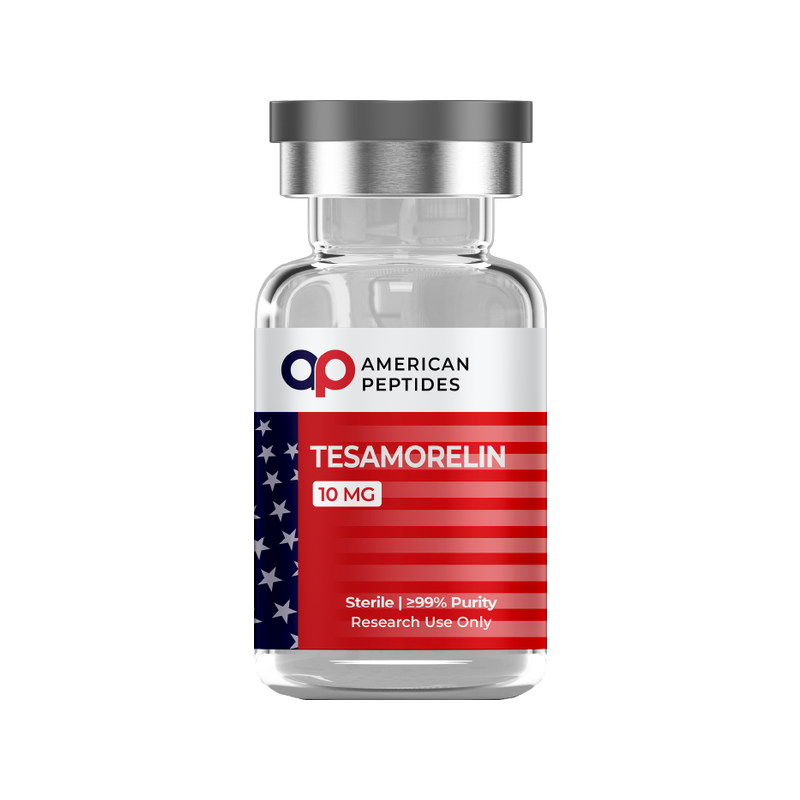


Tesamorelin is unusual among the growth-hormone-axis research peptides in that its chemistry is almost entirely native. It is the full 44-amino-acid sequence of human growth-hormone-releasing hormone (GHRH) with one deliberate change at the front end. That makes its literature a clean case study in why a single modification matters, and in the difference between receptor pharmacology and everything claimed downstream of it. This summary surveys what the peer-reviewed studies report and where the evidence stops. For the evidence-first format used across this series, see our ipamorelin research review.
Research-use-only context. This article summarizes published third-party scientific literature — the large majority of it conducted in cultured cells or animal models. It is not medical advice, not a therapeutic or performance claim, and not a usage guide. American Peptides products are sold strictly for in vitro laboratory research and are not for human or veterinary use.
What tesamorelin is
Tesamorelin — developed under the code TH9507 — is a synthetic analogue of human GHRH(1-44)-NH2 in which a trans-3-hexenoic acid group is attached to the N-terminal tyrosine.1,2 Everything else is the native hormone. GHRH is released by the hypothalamus and acts on the GHRH receptor (GHRHR), a class B G-protein-coupled receptor on pituitary somatotroph cells. Receptor activation couples through Gs to raise intracellular cAMP, which drives growth-hormone synthesis and pulsatile release; growth hormone in turn stimulates hepatic IGF-1 production. Our explainer on what IGF-1 is covers that downstream axis.
The reason for the hexenoyl modification is a specific enzyme. In 1989, Frohman and colleagues showed in The Journal of Clinical Investigation that human GHRH is degraded in plasma by dipeptidyl peptidase IV, which clips the first two residues (Tyr1-Ala2) to yield GHRH(3-44), a fragment with negligible receptor activity; trypsin-like cleavage contributes further.3 Native GHRH therefore has a half-life measured in minutes. Capping the N-terminus with a hydrophobic acyl group sterically hinders that first cleavage, which is the entire design rationale of tesamorelin.
The placement is a constrained choice. The N-terminus that DPP-IV attacks is also the part of the peptide that activates the receptor, so a protecting group has to shield the Tyr1-Ala2 bond without preventing those residues from entering the receptor’s binding core. A small, flexible hexenoyl group is one solution to that problem; a bulkier cap would defeat the enzyme but also the receptor. Tesamorelin also retains the full 1-44 sequence rather than the minimal 1-29 fragment used in many other GHRH analogues, so the two design families — capped full-length hormone versus substituted fragment — are distinct approaches to the same stability problem. Our review of modified GRF 1-29 covers the fragment approach.
What the research reports
Receptor structure. A 2020 Nature Communications cryo-EM study by Zhou and colleagues resolved the structure of GHRH bound to its receptor in complex with Gs.4 The peptide’s N-terminal residues insert deep into the transmembrane core of the receptor, where they trigger the conformational change that activates G-protein signaling, while the helical body of the peptide is held by the receptor’s extracellular domain. This structural picture explains, at atomic resolution, why removing Tyr1-Ala2 inactivates the hormone — and therefore why protecting those residues preserves activity.
Non-clinical pharmacology. The foundational characterisation of TH9507 is a 2007 paper in Basic & Clinical Pharmacology & Toxicology by Ferdinandi and colleagues.1 It reported that the analogue retained GHRH-receptor activity in pituitary-cell assays, showed greater resistance to degradation in plasma than native GHRH, and produced growth-hormone release in animal models, alongside safety-pharmacology and toxicology work in rodents and dogs. These are the in-vitro and animal data on which the compound’s later development rested.
Development reviews. A 2009 review in Expert Opinion on Investigational Drugs traces tesamorelin’s development history and pharmacology and situates it in one narrow, separately regulated clinical program rather than as a general growth-hormone-axis agent.2
Anti-doping analytics. A 2021 review in Drug Testing and Analysis surveys the analytical chemistry developed to detect synthetic GHRH analogues, tesamorelin included, in anti-doping laboratories.5 GHRH analogues are prohibited in competitive sport, and a sizeable slice of the tesamorelin literature is analytical rather than biological for that reason.
The human-evidence gap
Tesamorelin has advanced further than most GHRH analogues in one respect: a separately regulated pharmaceutical formulation of the molecule exists, and the reviews above describe that program. That regulatory status belongs to the pharmaceutical product alone. It does not extend to research-grade material, and it says nothing about the uses discussed online, for which there are no controlled human data. Reviewers in the sports-medicine literature group GHRH analogues among compounds adopted well ahead of evidence and urge caution. Tesamorelin is also prohibited in competitive sport under anti-doping rules.
The takeaway
Tesamorelin is a mechanistically transparent molecule: native GHRH(1-44) with an N-terminal cap that defeats a known protease, acting at a receptor whose activated structure has been solved. The preclinical pharmacology is coherent and well documented. The human evidence is confined to one narrow, regulated program and does not cover the uses that circulate online. American Peptides supplies tesamorelin and a tesamorelin + ipamorelin research blend — two compounds acting at different receptors (GHRHR and the ghrelin receptor GHS-R1a) that converge on the same pituitary cell — strictly for in vitro research. Specifications are on the tesamorelin reference monograph.
Frequently Asked Questions
What is tesamorelin, structurally?
The full 44-amino-acid sequence of human GHRH with a trans-3-hexenoic acid group attached to the N-terminal tyrosine. Apart from that cap, it is the native hormone.
What does the trans-3-hexenoic acid modification do?
It protects the Tyr1-Ala2 bond from dipeptidyl peptidase IV, the plasma enzyme shown in 1989 to inactivate native GHRH within minutes by clipping its first two residues.
What receptor does tesamorelin act on?
The GHRH receptor, a class B G-protein-coupled receptor on pituitary somatotrophs that signals through Gs and cAMP. A 2020 cryo-EM structure shows the peptide’s N-terminus inserted into the receptor core.
Is tesamorelin approved by the FDA?
Research-grade tesamorelin is not an approved drug product. A separately regulated pharmaceutical formulation of the molecule exists; that status belongs to that product alone and does not extend to research material, which is not approved for the uses discussed online. GHRH analogues are prohibited in competitive sport. American Peptides supplies tesamorelin strictly for in vitro research.
Citations
- Ferdinandi ES, et al. “Non-clinical pharmacology and safety evaluation of TH9507, a human growth hormone-releasing factor analogue.” Basic Clin Pharmacol Toxicol. 2007;100(1):49–58. PubMed: PMID 17214611
- Wang Y, et al. “Tesamorelin, a human growth hormone releasing factor analogue.” Expert Opin Investig Drugs. 2009;18(3):303–310. PubMed: PMID 19243281
- Frohman LA, et al. “Dipeptidylpeptidase IV and trypsin-like enzymatic degradation of human growth hormone-releasing hormone in plasma.” J Clin Invest. 1989;83(5):1533–1540. PubMed: PMID 2565342
- Zhou F, et al. “Structural basis for activation of the growth hormone-releasing hormone receptor.” Nat Commun. 2020;11(1):5205. PubMed: PMID 33060564
- Memdouh S, et al. “Advances in the detection of growth hormone releasing hormone synthetic analogs.” Drug Test Anal. 2021;13(11-12):1871–1887. PubMed: PMID 34665524
Related reading
- Ipamorelin Research: What the Studies Actually Show
- What Is IGF-1? A Science Explainer
- CJC-1295 (No DAC) Research: What the Studies Actually Show
This article is for laboratory research reference only. American Peptides products are sold strictly for in vitro research. Not for human consumption.
Related research
Compliance Notice: American Peptides products are sold strictly for laboratory and academic research purposes only. They are not intended for human or veterinary consumption, diagnosis, treatment, or prevention of any disease. All content on this page is educational in nature and does not constitute medical advice or product claims. Researchers are responsible for handling these compounds in accordance with their institution’s safety protocols and applicable laws.