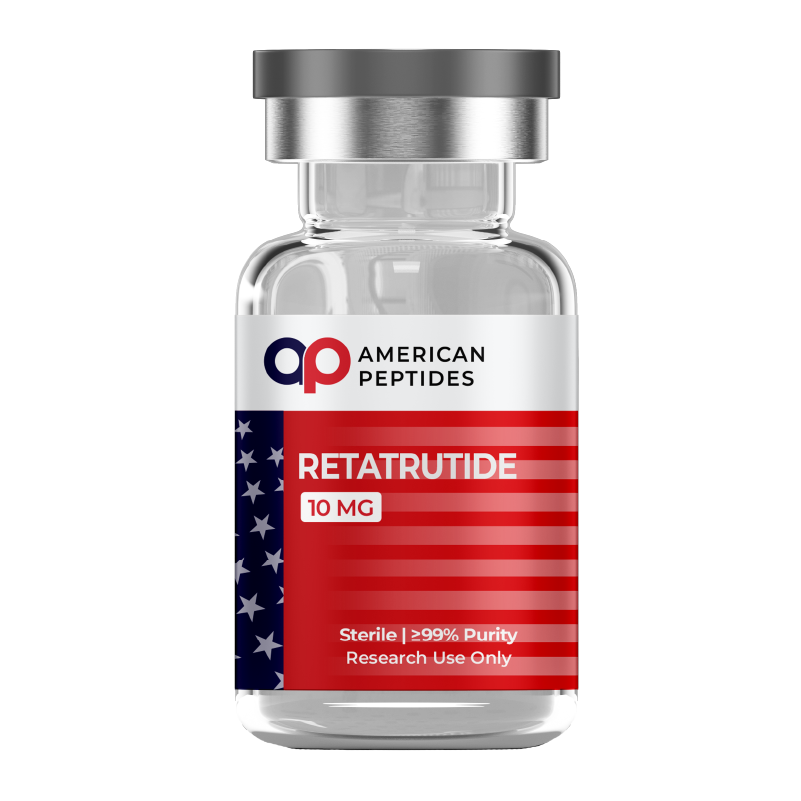


Retatrutide — catalogued in the primary literature as LY3437943 — is the most-discussed member of a new pharmacological class: peptides engineered to activate three incretin-family receptors at once. Its literature is young, and most of what circulates online about it is clinical-trial commentary rather than mechanism. This summary does the opposite. It surveys what the peer-reviewed studies establish about how the molecule is built, how it behaves at each receptor in cell assays, what rodent models report, and where the evidence stops. For the evidence-first format used across this series, see our cagrilintide research review.
Research-use-only context. This article summarizes published third-party scientific literature — the large majority of it conducted in cultured cells or animal models. It is not medical advice, not a therapeutic or performance claim, and not a usage guide. American Peptides products are sold strictly for in vitro laboratory research and are not for human or veterinary use.
What retatrutide is
Retatrutide is a synthetic 39-amino-acid peptide built on a glucose-dependent insulinotropic polypeptide (GIP) backbone and modified so that it also activates the glucagon-like peptide-1 receptor (GLP-1R) and the glucagon receptor (GCGR). Reviews of the next-generation incretin agonists describe the design logic in three parts.3 First, sequence substitutions tune which of the three receptors the peptide engages and how strongly. Second, the unnatural residue α-aminoisobutyric acid (Aib) is placed near the N-terminus, the position where native incretins are cleaved by dipeptidyl peptidase-4 (DPP-4); the substitution blocks that cleavage. Third, a C20 fatty diacid is attached through a hydrophilic linker to a lysine side chain. That lipid chain associates reversibly with serum albumin, which is what extends circulating half-life from the minutes of a native incretin to the days reported in pharmacokinetic literature.
None of these elements is unique to retatrutide. Aib substitution and fatty-diacid acylation are the same tools used to build dual GIP/GLP-1 agonists and long-acting GLP-1 analogues; our receptor-level comparison sets the three classes side by side with the reported cAMP values. What is distinctive is the receptor profile: one molecule that is a potent GIP-receptor agonist, a somewhat less potent GLP-1-receptor agonist, and a glucagon-receptor agonist at the same time. Reviewers describe the intended balance as GIPR-weighted, with GLP-1R and GCGR activity deliberately held lower so that glucagon-receptor signaling does not dominate.3 For the biology of the incretin receptors themselves, see What is a GLP-1 receptor agonist?
What the research reports
Receptor pharmacology. The core in-vitro characterisation of retatrutide is cAMP accumulation in recombinant cell lines expressing each receptor individually. The peptide produces concentration-dependent cAMP signaling at GIPR, GLP-1R and GCGR, which is the operational definition of a triple agonist. A 2025 literature review in Nutrition, Metabolism & Cardiovascular Diseases places those values in the context of the wider dual- and triple-agonist pipeline and cautions that cross-study potency comparisons are approximate, because cell lines, receptor expression levels and readouts differ between laboratories.3 The mechanistic premise, as a 2023 Journal of Hepatology review frames it, is pathway crosstalk: GLP-1R and GIPR signaling are insulinotropic in islet models, while GCGR signaling in hepatocyte and rodent models is associated with lipid-oxidation and energy-expenditure pathways, and the hypothesis under test is that the three signals compound rather than simply add.4
Rodent models. A 2026 study in Obesity examined retatrutide in diet-induced obese mouse and hamster models of metabolic dysfunction-associated steatohepatitis (MASH) and reported changes across metabolic and liver-histology readouts relative to vehicle-exposed animals.1 Separately, a 2026 Molecular Metabolism paper by Perez-Tilve and colleagues dissected the glucagon-receptor contribution by studying GIPR:GCGR co-agonism — the two “non-GLP-1” arms of the triple mechanism — in obese rodents, and reported that the pairing affected energy balance and body composition in those animals.2 These are animal findings that help researchers interpret the three-receptor design. They are not statements about outcomes in any other setting.
Where retatrutide sits in the literature. Every review in this area describes the compound as investigational.3,4 Clinical-development publications exist and later-phase programs have followed; this article deliberately does not summarise their outcomes. Those data belong to a regulated pharmaceutical program, and they are not what a laboratory characterising the peptide is measuring.
The human-evidence gap
Reviewers are explicit that retatrutide is investigational and not approved for any use. The receptor characterisation is in vitro; the mechanistic work on the glucagon arm is in rodents; and the clinical-development program is ongoing and industry-run. None of that supports the uses discussed on fitness forums, for which there are no controlled human data at all. It also matters that the triple-agonist premise is itself still being tested. Adding glucagon-receptor activity to an incretin agonist is a hypothesis about signaling balance, and reviewers note that the optimal ratio of the three activities is not settled.3,4 Research-grade retatrutide is a reference compound for studying that question in cells and animals, not a shortcut around it.
The takeaway
Retatrutide is a well-characterised molecule at the receptor level: a lipidated, DPP-4-resistant, GIP-backbone peptide with measurable agonism at GIPR, GLP-1R and GCGR, and a growing rodent literature on what that combination does to metabolic signaling. What it is not is a compound with an established human evidence base for the uses that made it popular online. American Peptides supplies retatrutide and a retatrutide + cagrilintide research blend strictly for in vitro research (see the full GLP-1 research peptide collection); sequence, formula and handling specifications are on the retatrutide reference monograph.
Frequently Asked Questions
What receptors does retatrutide activate?
In recombinant-cell cAMP assays it is an agonist at the GIP receptor, the GLP-1 receptor and the glucagon receptor — the definition of a triple agonist. Reviewers describe the profile as GIPR-weighted, with lower GLP-1R and GCGR activity.
How is retatrutide different from tirzepatide?
Both are 39-residue, lipidated, GIP-backbone peptides. Tirzepatide is a dual GIP/GLP-1 receptor agonist with minimal glucagon-receptor activity; retatrutide adds measurable glucagon-receptor agonism. Our receptor comparison lists the reported cAMP values side by side.
Why does retatrutide carry a fatty-acid chain?
A C20 fatty diacid on a lysine side chain lets the peptide bind reversibly to serum albumin, which slows clearance. It is the same half-life-extension chemistry used across the long-acting incretin class, alongside an Aib substitution that blocks DPP-4 cleavage.
Is retatrutide approved by the FDA?
No. It is an investigational compound in clinical development and is not approved for any use. American Peptides supplies it strictly for in vitro research.
Citations
- Briand F, et al. “Retatrutide Shows Multiple Metabolic Benefits in Diet-Induced Obese MASH Mouse and Hamster Models.” Obesity (Silver Spring). 2026;34(Suppl 1):43–53. PubMed: PMID 41741376
- Perez-Tilve D, et al. “GIPR:GCGR co-agonism restores normal weight in obese rodents.” Mol Metab. 2026;108:102365. PubMed: PMID 41997446
- Wen J, et al. “Next generation dual GLP-1/GIP, GLP-1/glucagon, and triple GLP-1/GIP/glucagon agonists: a literature review.” Nutr Metab Cardiovasc Dis. 2025;35(12):104213. PubMed: PMID 40685266
- Newsome PN, et al. “Incretins (GLP-1 receptor agonists and dual/triple agonists) and the liver.” J Hepatol. 2023;79(6):1557–1565. PubMed: PMID 37562748
Related reading
- Retatrutide vs Tirzepatide vs Semaglutide: A Receptor-Level Comparison
- What Is a GLP-1 Receptor Agonist? A Science Explainer
- Cagrilintide Research: What the Studies Show
This article is for laboratory research reference only. American Peptides products are sold strictly for in vitro research. Not for human consumption.
Related research
Compliance Notice: American Peptides products are sold strictly for laboratory and academic research purposes only. They are not intended for human or veterinary consumption, diagnosis, treatment, or prevention of any disease. All content on this page is educational in nature and does not constitute medical advice or product claims. Researchers are responsible for handling these compounds in accordance with their institution’s safety protocols and applicable laws.