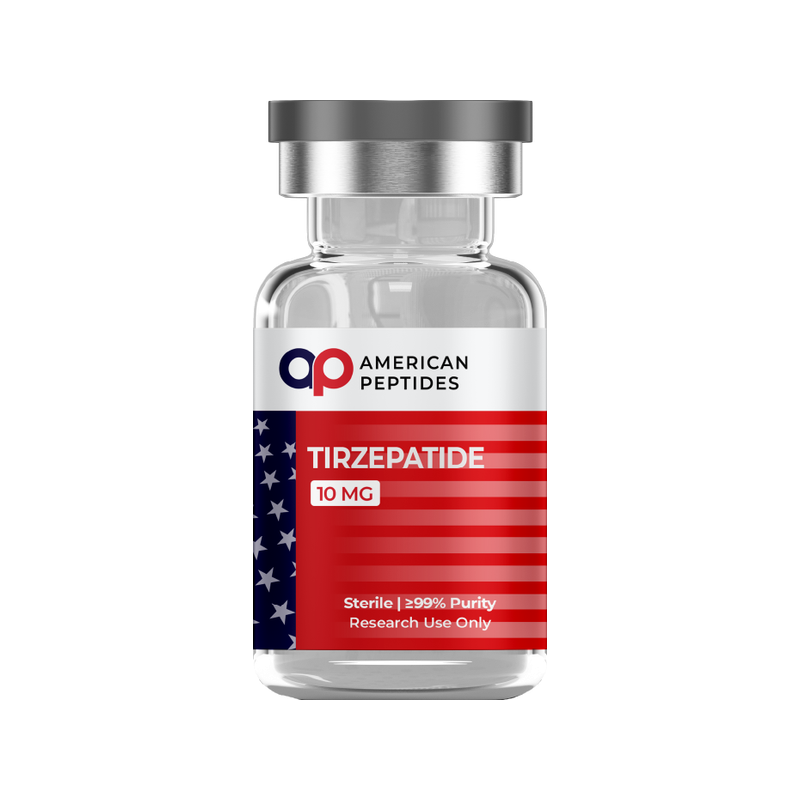


Tirzepatide has a deeper receptor-level literature than almost any other peptide discussed in research circles. There are cryo-electron-microscopy structures of it bound to both of its receptors, a formal biased-agonism characterisation, and ex-vivo work in isolated human islets. That depth is precisely why it is worth separating mechanism from everything else written about the molecule. This summary surveys what the peer-reviewed pharmacology actually establishes, which models it comes from, and where the evidence stops. For the evidence-first format used across this series, see our cagrilintide research review.
Research-use-only context. This article summarizes published third-party scientific literature — the large majority of it conducted in cultured cells or animal models. It is not medical advice, not a therapeutic or performance claim, and not a usage guide. American Peptides products are sold strictly for in vitro laboratory research and are not for human or veterinary use.
What tirzepatide is
Tirzepatide is a synthetic 39-amino-acid peptide whose sequence is derived from native glucose-dependent insulinotropic polypeptide (GIP) but engineered to also activate the glucagon-like peptide-1 receptor (GLP-1R). Structural work describes the design as a hybrid: residues that GIP and GLP-1 share are preserved, several positions are borrowed from GLP-1 or from the lizard peptide exendin-4 to enable GLP-1R engagement, and the unnatural residue α-aminoisobutyric acid (Aib) is placed at positions 2 and 20.2,3 The Aib at position 2 blocks cleavage by dipeptidyl peptidase-4, the enzyme that inactivates native incretins within minutes. A C20 fatty diacid is attached to the lysine at position 20 through a hydrophilic linker; the lipid chain binds reversibly to serum albumin, and that albumin association is the chemistry behind the multi-day half-life reported in pharmacokinetic literature.
Pharmacologically, tirzepatide is a dual agonist: it activates GIPR and GLP-1R, with minimal reported activity at the glucagon receptor. Our receptor-level comparison lists the reported binding and cAMP values next to the single- and triple-agonist classes, and How GLP-1 receptor signaling works covers the underlying receptor biology.
What the research reports
Imbalanced and biased agonism. The defining pharmacology paper is Willard and colleagues’ 2020 study in JCI Insight, which characterised tirzepatide in recombinant cell assays and described it with two precise words.1 It is imbalanced because its affinity and potency at GIPR are comparable to native GIP while its potency at GLP-1R is lower than native GLP-1. It is biased because, at GLP-1R, it drives cAMP production more efficiently than it recruits β-arrestin or triggers receptor internalisation, relative to the native ligand. Reduced β-arrestin engagement means the receptor is desensitised and internalised less readily in those cell systems. The authors proposed that this bias could help sustain receptor availability — a hypothesis generated in cells, and framed as such.
Cryo-EM structures. Two 2022 structural papers explain how one peptide fits two receptor pockets. Sun and colleagues, in PNAS, resolved tirzepatide bound to both GIPR and GLP-1R and mapped which residues drive activation at each; the N-terminal region inserts into the transmembrane core while the mid-peptide helix docks against each receptor’s extracellular domain.2 Zhao and colleagues, in Nature Communications, compared tirzepatide with a triple-agonist reference peptide across GIPR, GLP-1R and the glucagon receptor and described the conformational adjustments that let closely related sequences produce different receptor profiles.3 These structures are the physical basis for the “dual agonist” label.
Human islets, ex vivo. A 2023 Nature Metabolism study by El and colleagues used isolated human pancreatic islets to ask which receptor carries tirzepatide’s effect on hormone secretion. Blocking GIPR substantially reduced the response, indicating that the GIP-receptor arm is functionally engaged in human islet tissue and is not a passenger.4 This is laboratory work on donated tissue, not a clinical result, but it is the closest the mechanistic literature comes to human biology.
Receptor variants. A 2024 Frontiers in Pharmacology paper reported that tirzepatide, GIP(1-42) and GIP(1-30) show distinct signaling profiles at two common GIP-receptor variants, E354 and Q354, in cell assays — a reminder that receptor genetics can shift ligand pharmacology at the bench.5 A 2020 review in Trends in Endocrinology & Metabolism lays out the candidate mechanisms, drawn mainly from rodent and cell models, by which GIPR activity might complement GLP-1R signaling.6
The human-evidence gap
Tirzepatide has been studied extensively in clinical development, and reviewers regard its receptor pharmacology as well established. Two distinctions still matter for anyone reading the literature. First, the mechanistic findings above — bias, structure, islet dependence — come from recombinant cells, cryo-EM and ex-vivo tissue; they describe how the molecule behaves at a receptor, not what happens in an organism. Second, the clinical-development record belongs to a regulated pharmaceutical program and does not transfer to research-grade material. Research-grade tirzepatide is a reference chemical for laboratory assays; it is not a pharmaceutical product and is not approved for the uses discussed online, for which there are no controlled data in any case. Reviewers also note that the field is still working out why GIPR co-agonism matters, which is exactly the kind of question in-vitro work is suited to.6
The takeaway
Tirzepatide’s literature offers something rare among research peptides: a complete receptor-level account, from atomic structure to biased signaling to ex-vivo human tissue. That makes it a useful reference compound for laboratories studying incretin-receptor pharmacology. It does not make the research-grade material anything other than a laboratory reagent. American Peptides supplies tirzepatide strictly for in vitro research; specifications are on the tirzepatide reference monograph.
Frequently Asked Questions
What does it mean that tirzepatide is a “biased agonist”?
In recombinant-cell assays it favours cAMP signaling over β-arrestin recruitment at the GLP-1 receptor, relative to native GLP-1. The 2020 JCI Insight characterisation also called it “imbalanced,” because its GIPR potency resembles native GIP while its GLP-1R potency is lower.
Which receptors does tirzepatide activate?
The GIP receptor and the GLP-1 receptor, confirmed by cryo-EM structures of the peptide bound to each. Reported glucagon-receptor activity is minimal.
Has tirzepatide been studied in human tissue?
Yes, ex vivo. A 2023 Nature Metabolism study in isolated human islets found the GIP-receptor arm was required for the full hormone-secretion response. That is laboratory tissue work, not a clinical finding.
Is tirzepatide approved by the FDA?
Research-grade tirzepatide is a laboratory reagent and is not an approved drug product. Its clinical-development history belongs to a separately regulated pharmaceutical program and does not extend to research material, which is not approved for the uses discussed online. American Peptides supplies it strictly for in vitro research.
Citations
- Willard FS, et al. “Tirzepatide is an imbalanced and biased dual GIP and GLP-1 receptor agonist.” JCI Insight. 2020;5(17):e140532. PubMed: PMID 32730231
- Sun B, et al. “Structural determinants of dual incretin receptor agonism by tirzepatide.” Proc Natl Acad Sci U S A. 2022;119(13):e2116506119. PubMed: PMID 35333651
- Zhao F, et al. “Structural insights into multiplexed pharmacological actions of tirzepatide and peptide 20 at the GIP, GLP-1 or glucagon receptors.” Nat Commun. 2022;13(1):1057. PubMed: PMID 35217653
- El K, et al. “The incretin co-agonist tirzepatide requires GIPR for hormone secretion from human islets.” Nat Metab. 2023;5(6):945–954. PubMed: PMID 37277609
- Rees TA, et al. “Tirzepatide, GIP(1-42) and GIP(1-30) display unique signaling profiles at two common GIP receptor variants, E354 and Q354.” Front Pharmacol. 2024;15:1463313. PubMed: PMID 39464637
- Samms RJ, et al. “How May GIP Enhance the Therapeutic Efficacy of GLP-1?” Trends Endocrinol Metab. 2020;31(6):410–421. PubMed: PMID 32396843
Related reading
- Retatrutide vs Tirzepatide vs Semaglutide: A Receptor-Level Comparison
- How GLP-1 Receptor Signaling Works: A Science Explainer
- What Is a GLP-1 Receptor Agonist? A Science Explainer
This article is for laboratory research reference only. American Peptides products are sold strictly for in vitro research. Not for human consumption.
Related research
Compliance Notice: American Peptides products are sold strictly for laboratory and academic research purposes only. They are not intended for human or veterinary consumption, diagnosis, treatment, or prevention of any disease. All content on this page is educational in nature and does not constitute medical advice or product claims. Researchers are responsible for handling these compounds in accordance with their institution’s safety protocols and applicable laws.