

Peptide Lyophilization: The Science of Freeze-Drying Research Compounds
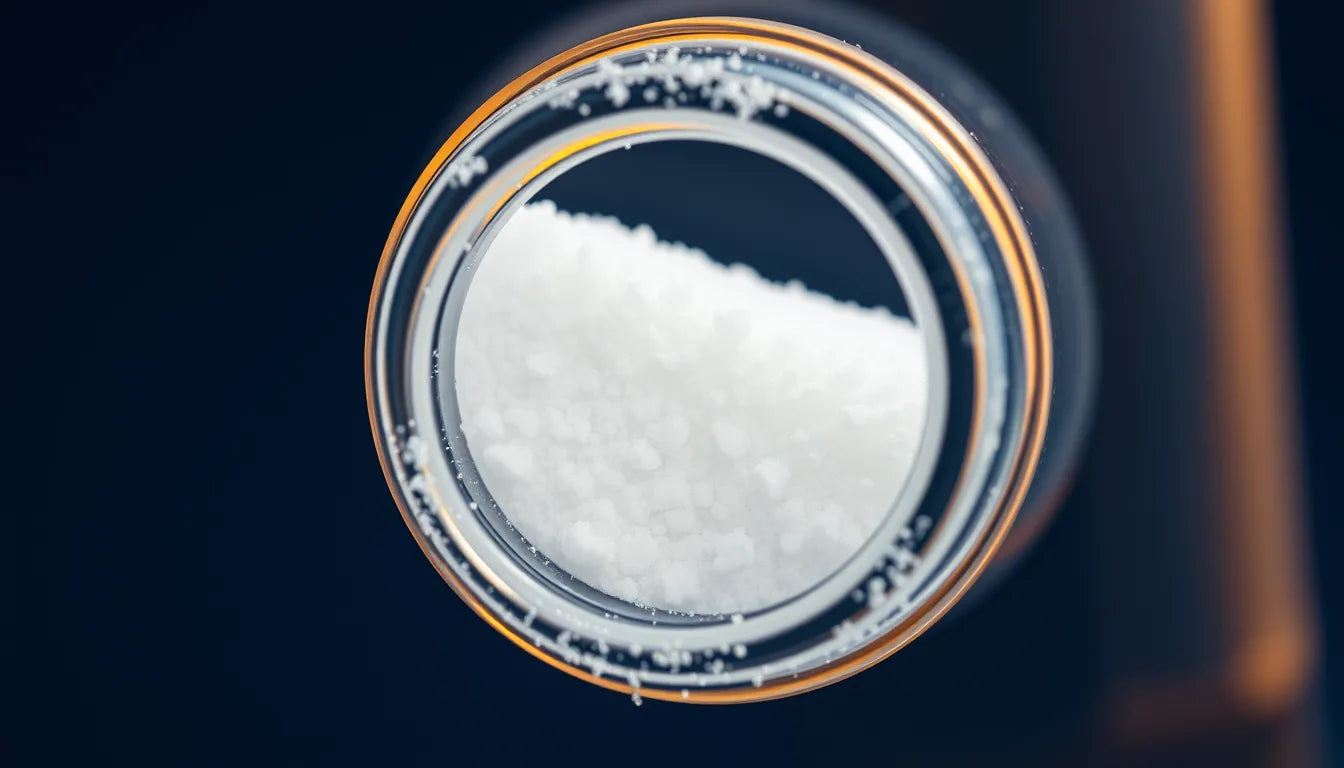
What is peptide lyophilization? Peptide lyophilization, also called freeze-drying, is a controlled dehydration process that removes water from a frozen peptide solution by sublimation — converting ice directly to vapor without passing through the liquid phase. The result is a porous solid "cake" of peptide that is dramatically more stable than the original solution, enabling long-term storage at modest temperatures and shipping without cold-chain refrigeration.
What is lyophilization?
Lyophilization is the controlled removal of water from a frozen sample through sublimation. The process exploits a thermodynamic property of water: under sufficiently low pressure, ice converts directly to water vapor without passing through the liquid phase. By freezing a peptide solution and then applying vacuum, water leaves the sample as vapor while the peptide stays behind as a porous solid.
The term lyophilization comes from the Greek for "solvent-loving" — a reference to how readily the dried product re-dissolves on contact with solvent. Freeze-drying preserves the chemical structure of the peptide while removing the water that would otherwise drive hydrolytic degradation. For peptides intended to be stored for months or years, the difference between an aqueous solution and a lyophilized powder is the difference between hours of stability and decades.
Why peptides are freeze-dried
Three properties of water explain why lyophilization is the dominant preservation method for research peptides:
Water drives chemical degradation. Hydrolysis of peptide bonds, deamidation of asparagine and glutamine, and many oxidation pathways all require water as a participant or a mobile-phase carrier. Removing water dramatically slows these reactions.
Water enables microbial growth. Even trace bacterial contamination in an aqueous peptide solution can amplify into visible growth over weeks. A dry powder presents no growth substrate.
Water adds mass and instability for shipping. A peptide solution must be shipped cold to prevent degradation. A lyophilized powder can be shipped at ambient temperature with brief excursions tolerated without significant loss.
The trade-off is the lyophilization process itself: it requires specialized equipment, careful method development, and adds a step that itself can damage sensitive peptides if mismanaged. For most research peptides, the trade-off favors lyophilization decisively.
The three phases of lyophilization
Lyophilization is conceptually a three-phase process, each phase with distinct equipment requirements and risk profiles:
   Phase 1: FREEZING
   Solution → solid ice + concentrated solute
   Temperature: -40 to -50°C
   Goal: convert all water to ice without damaging peptide
         │
         ▼
   Phase 2: PRIMARY DRYING (sublimation)
   Ice → water vapor
   Temperature: -30 to -10°C, pressure: 50–200 mTorr
   Goal: remove ~95% of water as vapor without melting
         │
         ▼
   Phase 3: SECONDARY DRYING (desorption)
   Bound water → water vapor
   Temperature: 20 to 40°C, pressure: 50–100 mTorr
   Goal: remove residual moisture to target ~1–3%
Phase 1 — Freezing. The peptide solution is loaded into vials, the vials are placed on shelves in a lyophilizer, and the shelf temperature is brought down to -40°C or lower. The freezing rate is a method-development variable: slow freezing produces large ice crystals (and a more porous, more easily reconstituted cake); fast freezing produces small ice crystals (and a denser cake with more uniform morphology). For most peptide work, controlled cooling at 0.5–2°C per minute strikes a reasonable balance.
Phase 2 — Primary drying. Once the sample is fully frozen, the chamber pressure is reduced and the shelf temperature is raised. The combination drives sublimation: ice converts directly to vapor and leaves the sample. Primary drying is the longest phase — typically 12–48 hours — and removes the bulk of the water. The shelf temperature during primary drying must stay below the sample's collapse temperature; exceeding it causes the cake to lose structure and collapse into a glassy mass.
Phase 3 — Secondary drying. After primary drying removes the free ice, residual water remains bound to peptide functional groups by hydrogen bonds. Removing it requires raising the shelf temperature substantially while maintaining vacuum. Secondary drying lowers residual moisture from ~5–10% after primary drying to the target ~1–3%. Insufficient secondary drying leaves the cake hygroscopic and vulnerable to stability loss during storage.
The physics of sublimation
The physics that makes lyophilization possible is the phase diagram of water. At normal atmospheric pressure (1 atm), water transitions between solid, liquid, and gas at familiar temperatures. Below the triple point of water — 0.01°C and 6.1 mbar (4.58 Torr) — the liquid phase ceases to exist as a stable state. At pressures below this triple point, ice in contact with vapor will sublime: water molecules at the ice surface jump directly into the gas phase.
Lyophilization exploits this directly. By maintaining chamber pressure well below the triple point — typically 50–200 mTorr (~0.07–0.27 mbar) — the lyophilizer creates conditions in which ice is thermodynamically unstable and water vapor is the favored phase. Heat supplied to the sample (from the shelf, through the vial wall, into the frozen plug) becomes the energy of sublimation, removing roughly 670 calories per gram of ice converted.
The vapor produced travels from the sample, through the chamber, to a condenser held at -50 to -80°C, where it refreezes as ice on the condenser surface. The condenser is the engine that maintains low chamber pressure during the run — without it, the chamber would saturate with vapor and sublimation would stop.
Eutectic temperature and glass transition temperature
Two temperatures govern whether a lyophilization method will succeed: the eutectic temperature (Teu) for crystalline samples and the glass transition temperature of the maximally freeze-concentrated solution (Tg′) for amorphous samples.
Eutectic temperature is the temperature below which all components of a solution are completely frozen as crystalline solids. Above the eutectic temperature, a liquid phase coexists with the ice. For lyophilization, primary drying must proceed below Teu — otherwise the residual liquid will flow, the cake will collapse, and the sample will be damaged.
Glass transition temperature (Tg′) applies to amorphous (non-crystalline) frozen solutions, which describes most peptide formulations. Below Tg′, the freeze-concentrated solute is a rigid glass; above Tg′, it softens into a viscous rubber. Primary drying must occur below Tg′ to maintain cake structure.
Peptide formulations are typically amorphous, so Tg′ is the operative temperature. For pure peptide solutions, Tg′ varies by sequence and concentration; common values fall between -30°C and -20°C. Method development for a new peptide formulation typically includes Tg′ determination by differential scanning calorimetry before the first production run.
Reading cake morphology
The visual appearance of the lyophilized cake — its morphology — is a quick quality signal that experienced analysts use to judge process success.
An ideal cake fills the vial uniformly with the same height and footprint as the original liquid, has a uniform color (typically white to off-white for most peptides), and shows a fine, porous texture. Reconstitution is rapid: the cake dissolves within seconds of adding solvent.
A collapsed cake appears glassy, dense, or shrunken. The cake may pull away from the vial wall or sink to the bottom. Collapse usually indicates that primary drying exceeded Tg′ or that the cake softened during a chamber pressure excursion. A collapsed cake can still be chemically intact, but it reconstitutes slowly and is a process-control warning.
A shrunken cake that retains porosity but has visibly receded from the original volume indicates over-drying or freezing-rate problems.
Cracked or fissured cakes are common and usually do not indicate a problem; cracks arise from thermal stress during drying and rarely affect reconstitution or stability.
A COA documenting cake morphology — or attaching a vial photo — is documenting attention to process quality. Most COAs do not include this, but the underlying observation is real.
Residual moisture and Karl Fischer titration
The single most informative quality attribute of a lyophilized peptide is the residual moisture content — the mass percentage of water remaining in the dried cake. Standard target for research peptides is 1–3% by mass; pharmaceutical-grade products often target < 1%.
The standard method is Karl Fischer titration, a chemical titration named for the German chemist Karl Fischer who developed it in 1935. The method is specific for water and works across a wide concentration range. A small mass of lyophilized cake is dissolved in dry methanol, the methanol is titrated with Karl Fischer reagent (iodine + sulfur dioxide + base + alcohol), and the water content is calculated from the titrant consumed.
Why moisture content matters:
- High moisture (> 5%) indicates incomplete drying and is associated with shorter shelf life, faster hydrolytic degradation, and risk of microbial amplification.
- Optimal moisture (1–3%) balances stability against the practical limits of drying time and energy.
- Very low moisture (< 0.5%) can actually destabilize some peptides by stripping water of hydration that contributes to native folding.
Excipients and lyoprotectants
Pure peptides in solution often do not lyophilize cleanly. The freezing process can drive aggregation, the freeze-concentrated solution can damage the peptide before sublimation begins, and the dried cake can be too fragile to handle. Excipients are added to peptide formulations to address these problems.
Common lyophilization excipients:
| Excipient class | Examples | Function |
|---|---|---|
| Bulking agents | Mannitol, sucrose, glycine | Provide cake structure when peptide concentration is low |
| Lyoprotectants | Trehalose, sucrose | Replace water in peptide hydrogen-bond network during drying |
| Buffers | Phosphate, citrate, histidine | Maintain pH during freezing concentration |
| Surfactants | Polysorbate 20/80 | Prevent aggregation at solution-air interfaces |
Reconstitution chemistry
The lyophilized cake is not the final form for research use — it must be reconstituted in solvent before measurement. Reconstitution chemistry matters for retaining the peptide's analytical and biochemical properties.
For most research peptides, the reconstitution solvent is bacteriostatic water for injection (BWFI) containing 0.9% benzyl alcohol as a preservative, or sterile water for injection (WFI) for short-term use. The choice depends on the application and the expected duration of solution use.
Best practices:
- Add solvent slowly down the side of the vial rather than directly onto the cake, to minimize foaming and aggregation
- Allow the cake to dissolve passively for 30–60 seconds before swirling
- Avoid vigorous shaking, which introduces air bubbles and can drive aggregation at the air-liquid interface
- Inspect the resulting solution for clarity; cloudy solutions indicate aggregation or precipitation
Reconstituted peptide solutions have dramatically shorter stability than the lyophilized cake. Most peptides retain integrity for 24–72 hours at 4°C reconstituted; freeze-thaw cycles of reconstituted solutions accelerate degradation.
Common lyophilization failures
The recurring failure modes that produce subpar lyophilized peptide product:
Cake collapse from primary drying above Tg′. Visible as a glassy, shrunken residue. Affects reconstitution speed and can affect stability.
Insufficient secondary drying producing residual moisture > 5%. Shortens shelf life and increases hydrolytic degradation rate.
Freezing damage to the peptide from ice crystal formation, especially for larger peptides or those with disulfide bonds. Often manageable with cryoprotectants but requires formulation work.
Vial breakage during freezing from rapid temperature changes. Rare in modern systems but historically a problem.
Stopper venting failures that admit air during the run. Causes loss of vacuum and incomplete drying.
A research peptide that arrives as a clean white cake, reconstitutes within seconds, and shows low residual moisture has likely been through a well-controlled lyophilization cycle. A peptide that arrives as a yellowed, glassy residue or that takes minutes to dissolve has likely been through a method that needs revisiting.
Frequently asked questions
Why are peptides freeze-dried instead of just stored in solution?
Water drives hydrolytic degradation, enables microbial growth, and complicates shipping. Removing water through lyophilization slows degradation by orders of magnitude and allows ambient shipping. Solution peptides typically retain integrity for hours to days; lyophilized peptides can retain integrity for years.
What is the difference between primary and secondary drying?
Primary drying removes free ice by sublimation under vacuum, typically at sub-zero shelf temperatures. Secondary drying removes residual bound water by desorption, typically at warmer shelf temperatures (20–40°C). Primary drying takes most of the cycle time; secondary drying determines the final moisture content.
What is a good residual moisture content for a lyophilized peptide?
Standard targets are 1–3% by mass for research peptides and < 1% for pharmaceutical-grade products. The optimal range balances long-term stability against the diminishing returns of extreme drying.
Why does my reconstituted peptide solution look cloudy?
Cloudiness usually indicates aggregation or precipitation. Common causes: reconstitution solvent incompatibility (peptide insoluble at the chosen pH), peptide concentration above the solubility limit, agitation that introduced air bubbles, or pre-existing damage from the lyophilization process itself.
Can a lyophilized peptide be re-lyophilized after reconstitution?
In principle yes, but each lyophilization cycle adds process stress. Most research peptides are supplied for single reconstitution. Re-lyophilization is rare in practice.
Why are some peptide cakes white and others off-white or yellow?
White cakes are characteristic of pure, well-lyophilized peptide. Slight off-white tones can be normal for peptides with aromatic residues at high concentrations. Yellow or brown color suggests oxidative damage during drying or storage and warrants further analytical inspection.
What does Karl Fischer titration measure?
Karl Fischer titration is a chemical titration specific for water content. It works by reacting water with a reagent containing iodine and sulfur dioxide, producing a measurable end point proportional to the water present. It is the standard method for measuring residual moisture in lyophilized samples.
Key takeaways
- Lyophilization removes water from a frozen peptide solution by sublimation, producing a porous solid cake that is dramatically more stable than the original solution.
- The three phases of the process — freezing, primary drying, secondary drying — each have distinct temperature and pressure regimes and risk profiles.
- Sublimation occurs only below the triple point of water (0.01°C, 6.1 mbar); the entire process is conducted below this pressure threshold.
- Glass transition temperature (Tg′) governs primary drying for amorphous peptide formulations; exceeding Tg′ causes cake collapse.
- Cake morphology — uniform, white, porous — is a visual quality indicator that experienced analysts use to judge process success.
- Karl Fischer titration measures residual moisture; the standard target is 1–3% for research peptides.
- Excipients (bulking agents, lyoprotectants, buffers, surfactants) are often added to peptide formulations to manage freezing damage and cake integrity.
- Reconstitution chemistry matters; gentle addition of clean solvent followed by passive dissolution preserves peptide integrity.