
Peptide Stability: Temperature, Light, and Reconstitution Chemistry
What affects peptide stability? Peptide stability is governed by four primary degradation pathways: oxidation (of methionine, tryptophan, and cysteine residues), deamidation (of asparagine and glutamine), aggregation (driven by hydrophobic and electrostatic interactions), and hydrolysis (cleavage of peptide bonds, particularly at aspartate-proline sites). Temperature, light, oxygen, humidity, and reconstitution chemistry all modulate the rate at which these reactions proceed. Lyophilized storage at -20°C or colder maximizes shelf life for most research peptides.
What is peptide stability?
Peptide stability is the capacity of a peptide to retain its intended chemical structure, biological activity, and physical state over time. A stable peptide today is the same molecule tomorrow — same sequence, same conformation, same purity profile. An unstable peptide degrades along one or more chemical pathways, producing impurities that can be subtly different (a single oxidation, a single deamidation) or grossly different (truncation, aggregation into insoluble particulates).
For research applications, instability is a silent confounder. A peptide that loses 10% of its active material to oxidation between manufacturing and use will produce signaling responses that look 10% weaker than the intended concentration — without any indication on the vial or in the analytical record. The researcher attributes the weaker response to biology rather than to chemistry.
Understanding stability is therefore essential for two purposes: choosing storage conditions that minimize degradation, and recognizing when a stored peptide may no longer be representative of its original specification.
The four degradation pathways
Most peptide degradation falls into four chemical mechanisms, each affecting specific residues or structural features:
   PEPTIDE DEGRADATION PATHWAYS
   ────────────────────────────
   1. OXIDATION         → Met, Trp, Cys
   2. DEAMIDATION       → Asn, Gln
   3. AGGREGATION       → hydrophobic clustering, β-sheet formation
   4. HYDROLYSIS        → peptide bond cleavage, esp. Asp-Pro
Any individual peptide may be vulnerable to one, several, or all of these depending on its sequence. A peptide with no methionine, no asparagine, no aspartate, and a clean linear hydrophilic structure may be remarkably stable. A peptide rich in methionine, asparagine, and hydrophobic stretches is vulnerable on multiple fronts simultaneously.
Oxidation: methionine, tryptophan, cysteine
Three amino acids account for nearly all peptide oxidation chemistry.
Methionine (Met). The sulfur in methionine's thioether side chain is the most readily oxidized site in most peptides. Oxidation produces methionine sulfoxide (MetO), which adds 16 Da to the peptide mass. Further oxidation to methionine sulfone (MetO₂, +32 Da) is slower but possible under aggressive conditions. Methionine oxidation is catalyzed by dissolved oxygen, hydrogen peroxide contamination, transition metal ions (Fe²⁺, Cu²⁺), and light exposure.
Tryptophan (Trp). The indole ring of tryptophan oxidizes more slowly than methionine but produces more complex degradation products — N-formylkynurenine, kynurenine, hydroxytryptophan, and oxindolylalanine variants. Each adds different mass increments and can be identified by mass spectrometry.
Cysteine (Cys). The thiol side chain of cysteine oxidizes to form disulfide bonds (intra- or intermolecular) or higher oxidation products (sulfenic, sulfinic, sulfonic acids). For peptides intended to have free cysteines, oxidation can dimerize the peptide or change its conformation. For peptides intended to have disulfide bonds, oxidation is part of the synthesis design rather than a degradation pathway.
A COA with high-resolution mass spec analysis often shows small +16 Da peaks alongside the major peak — these are the methionine oxidation impurities. Their abundance is a measure of how much methionine oxidation occurred during synthesis, purification, and storage to the test date.
Deamidation: asparagine and glutamine
Deamidation is the loss of an amide group from asparagine (Asn) or glutamine (Gln), converting them to aspartate (Asp) or glutamate (Glu) and releasing ammonia. The reaction proceeds through a cyclic succinimide intermediate that can rearrange to either Asp or isoAsp — both products have the same mass (–1 Da relative to Asn, +1 Da relative to Gln considering the net change), but isoAsp introduces a backbone shift that can disrupt peptide conformation.
The rate of deamidation depends strongly on:
- The amino acid C-terminal to the Asn or Gln. Asn-Gly is the most deamidation-prone sequence in peptide chemistry; the small glycine residue allows easy formation of the cyclic succinimide intermediate. Asn-Pro is far more resistant.
- Solution pH. Deamidation accelerates above pH 7 and is fastest in mildly alkaline solutions.
- Temperature. As with most chemical reactions, rate roughly doubles per 10°C increase.
Aggregation: from monomer to insoluble mass
Peptide aggregation is the association of peptide molecules into multi-molecule complexes through non-covalent (hydrophobic, electrostatic, hydrogen-bonding) or covalent (disulfide, intermolecular cross-linking) interactions. Aggregates range in size from soluble dimers and trimers — invisible to the eye — to large insoluble particulates that cloud or precipitate from solution.
The driving forces for peptide aggregation:
- Hydrophobic association. Peptides with significant hydrophobic surface area cluster to minimize water exposure. Concentration increases drive aggregation roughly proportionally.
- β-sheet formation. Some peptide sequences are conformationally biased toward intermolecular β-sheet formation, producing fibrillar aggregates that are exceptionally stable once formed.
- Surface effects. Vial walls, air-liquid interfaces, syringe surfaces all provide hydrophobic surfaces that nucleate aggregation. Surfactants in formulations exist to compete with peptide for these surfaces.
- Freeze-thaw cycles. Each freeze-thaw cycle exposes the peptide to high concentrations in the freeze-concentrate phase, where aggregation is favored.
Hydrolysis: peptide bond cleavage
Peptide bonds — the C–N amide bonds linking adjacent amino acids — are generally chemically robust but can be cleaved by hydrolysis under acidic, basic, or extended aqueous conditions. The vulnerable sites:
- Aspartate-proline (Asp-Pro) bonds are unusually labile to acid hydrolysis. The combination of an electron-withdrawing aspartate carboxyl side chain and a nitrogen with no NH bond produces a cleavage rate orders of magnitude faster than typical peptide bonds.
- C-terminal amides can hydrolyze to free C-terminal carboxylic acids, adding 1 Da and changing peptide charge.
- General aqueous hydrolysis at extended exposure (months in solution at room temperature) eventually affects all peptide bonds.
Temperature dependence and storage rules
Peptide degradation rates follow the Arrhenius equation: rate increases exponentially with temperature. As a practical guideline, most peptide degradation reactions roughly double or triple per 10°C increase in storage temperature. This translates to dramatic differences in expected shelf life:
| Storage condition | Typical research peptide shelf life |
|---|---|
| Room temperature (20–25°C), reconstituted | Hours to days |
| Refrigerated (4°C), reconstituted | Days to weeks |
| Refrigerated (4°C), lyophilized | Months |
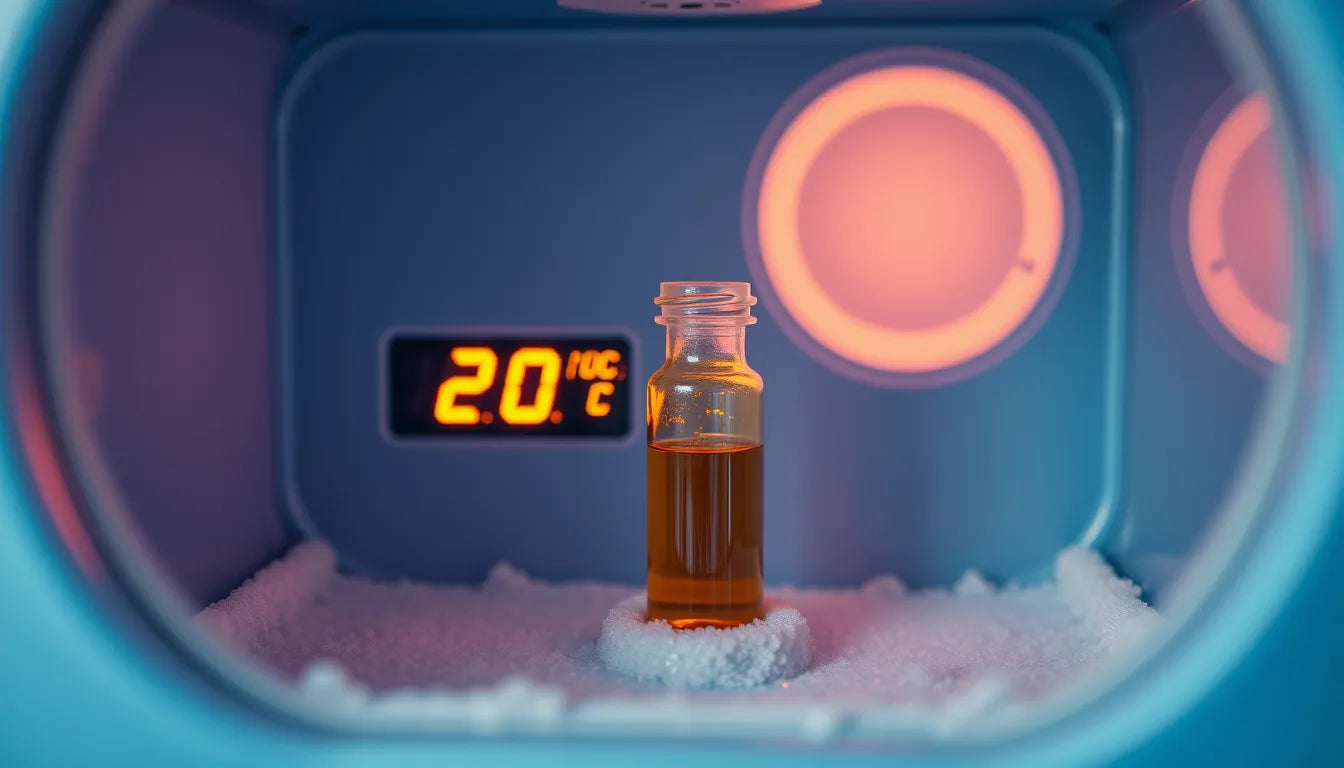
| Frozen (-20°C), lyophilized | Years |
| Deep frozen (-80°C), lyophilized | Years to decades |
A common practical mistake is storing reconstituted aliquots at -20°C with the expectation that they will remain stable indefinitely. Frozen aqueous solutions still experience some degradation through freeze-concentration effects at the ice-solution interface. Aliquoting and freezing reconstituted peptide buys substantially more time than refrigeration, but it does not match the stability of the original lyophilized cake.
Light, oxygen, and humidity
Three environmental factors beyond temperature affect peptide stability:
Light. UV and short-wavelength visible light catalyze oxidation reactions, particularly for tryptophan, tyrosine, cysteine, and methionine residues. Amber vials, foil-wrapped packaging, and dark storage all reduce light exposure. Most lyophilized peptides are sold in clear glass vials because the cake itself absorbs little light and the protective effect of amber glass is modest at -20°C; for solutions held at warmer temperatures, light protection becomes more important.
Oxygen. Dissolved oxygen is the immediate oxidant for methionine, tryptophan, and cysteine. Headspace nitrogen or argon filling reduces oxidation during long-term storage. Some research peptide vials are sealed under nitrogen for this reason.
Humidity. A lyophilized cake at 1–3% residual moisture can absorb additional water from a humid environment, increasing the local water activity at the peptide surface and accelerating hydrolytic degradation. Vials with intact stoppers are sealed against atmospheric humidity; once a vial is opened, exposure to ambient humidity begins to compromise the cake. Best practice is to reconstitute the entire vial at once and aliquot the resulting solution, rather than repeatedly opening a vial to remove portions of the cake.
Reconstitution chemistry and freeze-thaw
Once a peptide is reconstituted, three additional variables affect stability.
Reconstitution solvent. Most research peptides reconstitute cleanly in bacteriostatic water for injection (BWFI) or sterile water for injection (WFI). Some hydrophobic peptides require small amounts of acetic acid or DMSO for full dissolution; once dissolved, the solution can be diluted into aqueous buffer. The choice of solvent affects both initial solubility and downstream stability.
Solution pH. Most peptides are most stable in slightly acidic conditions (pH 4–5), where deamidation is slow and proteolytic enzyme contamination (if any) is suppressed. Neutral to slightly alkaline solutions accelerate deamidation. Strongly acidic or alkaline solutions accelerate hydrolysis. The specific pH optimum is sequence-dependent.
Freeze-thaw cycles. Each freeze-thaw cycle subjects the peptide to mechanical and chemical stress: ice crystal formation can damage the peptide directly, and the freeze-concentrated solution at the ice interface exposes the peptide to high local concentrations that favor aggregation. The best practice for reconstituted peptide solutions is to aliquot immediately into single-use portions, freeze once, and thaw each aliquot only as needed. Repeated freeze-thaw of a single tube can degrade a peptide more in a few cycles than weeks of refrigerated storage would.
Stability study design (ICH Q1A)
The pharmaceutical framework for stability studies is ICH Q1A — Stability Testing of New Drug Substances and Products. While research peptides are not bound by ICH compliance, the framework defines the gold-standard approach to characterizing how long a compound retains its specifications.
ICH Q1A defines three storage conditions:
- Long-term: 25°C / 60% relative humidity for a stated period (typically 12–24 months for research peptides)
- Intermediate: 30°C / 65% RH
- Accelerated: 40°C / 75% RH for 6 months
Accelerated stability data is used to estimate long-term shelf life through Arrhenius extrapolation: if a peptide degrades 5% in 6 months at 40°C, the projected degradation at 25°C is calculable from the temperature dependence of the dominant degradation pathway.
A research peptide vendor that maintains stability programs and references them on COAs (e.g., "stable 24 months at -20°C per stability study SP-2024-017") is documenting evidence behind its shelf-life claims. A vendor stating "store at -20°C" without an underlying study is guessing.
Frequently asked questions
How long do lyophilized peptides last in storage?
For typical research peptides stored at -20°C in their original sealed vials, shelf life of 2–5 years is common, with many peptides retaining specifications for substantially longer. Sequence-specific factors (oxidation-prone residues, deamidation-prone sequences) shorten this range; clean linear hydrophilic peptides extend it.
Can I store reconstituted peptide solutions long-term?
Reconstituted solutions are much less stable than lyophilized cakes. For most research peptides, reconstituted solutions hold for 24–72 hours at 4°C and weeks to a few months frozen in aliquots at -20°C. Repeated freeze-thaw of the same tube degrades the peptide faster than continuous refrigeration.
Why does my peptide solution look cloudy after thawing?
Cloudiness usually indicates aggregation, often driven by freeze-concentration during freezing or by ice crystal damage during thaw. Aggregates may partially redissolve with gentle warming or low-energy sonication, but stable aggregates are largely irreversible.
What is the most common peptide degradation pathway?
Methionine oxidation is the most common single degradation pathway because it is fast, requires only ambient oxygen, and produces an easily detectable +16 Da impurity. Asn-Gly deamidation is the most common conformation-altering pathway in peptides containing that sequence.
Does freezing damage peptides?
Freezing can damage peptides through ice crystal formation and freeze-concentration effects. For lyophilized peptides, this risk is essentially zero because there is no aqueous phase to freeze. For solutions, freezing damage is real but typically minor compared to the degradation that would occur at warmer temperatures over the same time period.
Should I store peptides under nitrogen?
For long-term storage of oxidation-prone peptides, nitrogen or argon headspace reduces oxidative degradation. Most lyophilized research peptides are not stored under inert gas because the cake itself excludes most oxygen and the cold storage temperature already slows oxidation dramatically.
Can a degraded peptide be repurified?
In principle yes — analytical HPLC can resolve degraded variants and preparative HPLC can recover the intact peptide. In practice, the cost of repurification typically exceeds the cost of fresh material, and the recovered fraction may have lost more than analytical methods show. Repurification is rare for routine research applications.
Key takeaways
- Peptide stability is governed by four major degradation pathways: oxidation, deamidation, aggregation, and hydrolysis.
- Methionine, tryptophan, and cysteine residues drive oxidation; asparagine and glutamine drive deamidation; Asp-Pro bonds drive selective hydrolysis.
- Lyophilization slows all major degradation pathways by removing the water that drives or carries them.
- The standard storage recommendation for lyophilized research peptides is -20°C in sealed vials.
- Reconstituted peptide solutions have dramatically shorter stability than lyophilized cakes — hours to days at room temperature, days to weeks refrigerated.
- Freeze-thaw cycles compound degradation; single-use aliquots are the best practice for reconstituted solutions.
- Light, oxygen, and humidity all accelerate degradation; amber vials, nitrogen headspace, and dry storage extend shelf life.
- ICH Q1A defines the pharmaceutical framework for stability studies; research vendors that reference stability data on their COAs are documenting evidence behind shelf-life claims.
Related reading
- How to read a peptide Certificate of Analysis (COA)
- Peptide lyophilization: the science of freeze-drying research compounds
- Glossary: 50 peptide and analytical chemistry terms
Related research
- Peptide Lyophilization: The Science of Freeze-Drying Research Compounds
- Reconstitution Chemistry for Research Peptides: Solvents, Solubility, and Accuracy
- Glossary: 50 Peptide & Analytical Chemistry Terms
- Peptide Storage and Handling Guide for Research Labs
- What Is HPLC? A Researcher's Guide to Peptide Purity Verification