

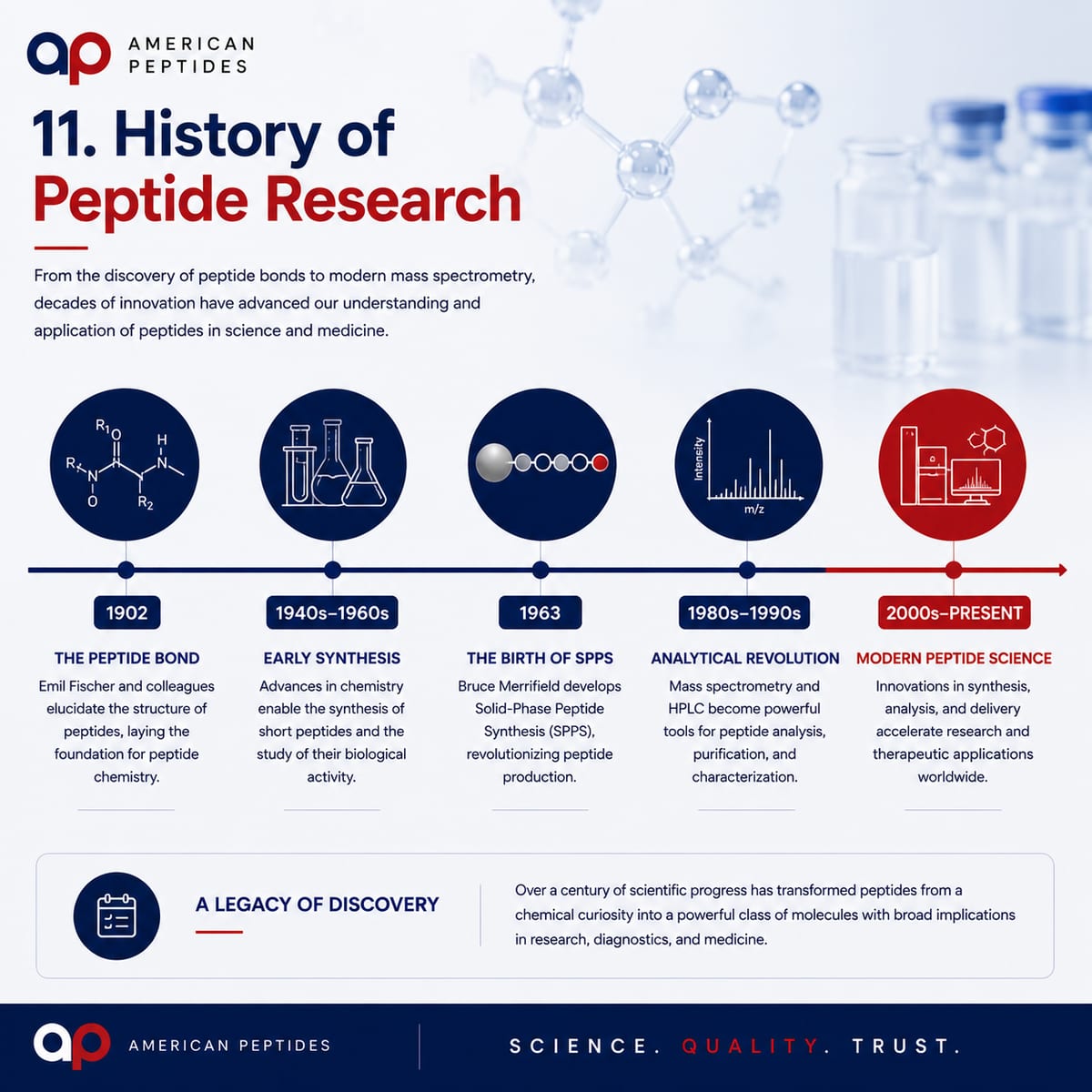
Peptide research progressed from understanding the peptide bond, to chemically synthesizing peptides, to automated solid-phase synthesis, to today's analytics-driven quality control — each step making defined, reproducible peptides possible. This is an educational history of how the field reached its modern standards.
The foundation: the peptide bond
The field begins conceptually with recognizing that amino acids link through a covalent peptide bond to form chains — the structural idea behind every peptide. Establishing this gave chemists a target: if the bond could be understood, it could be made deliberately.
Era milestones
| Era | Advance | Why it mattered |
|---|---|---|
| Foundational chemistry | Peptide-bond concept; early solution synthesis | Proved peptides could be built deliberately |
| Mid-century | Synthesis of biologically active peptides | Linked sequence to function |
| Solid-phase revolution | Resin-anchored stepwise synthesis | Made longer, purer peptides routine |
| Modern era | Automation + HPLC + mass spectrometry QA | Made identity and purity verifiable |
Early solution-phase synthesis
The first deliberate syntheses were done in solution — powerful in principle but laborious, with purification needed at every step. It proved the concept but could not scale to longer, reliably pure sequences, which limited how rigorously sequence-function questions could be asked.
The solid-phase revolution
Anchoring the growing chain to an insoluble resin transformed the field: reagents could be added and washed away in cycles, each amino acid coupled stepwise, and the finished chain cleaved at the end. This made longer, purer peptides routine and is the conceptual basis of modern synthesis — the reason a defined research sequence such as BPC-157 or TB-500 can be produced consistently.
The analytics era
Synthesis alone is not enough — you must prove what you made. HPLC purity analysis and mass spectrometry identity confirmation turned “we synthesized it” into “here is the lot-specific evidence,” formalized today in the Certificate of Analysis. This shift from assertion to verification is arguably the most important modern milestone.
Why the history matters now
Every modern best practice — defined sequences, lyophilized stable supply, lot-matched COA, independent testing — is the accumulated answer to a problem an earlier era couldn’t solve. Knowing the timeline makes it obvious why reproducible peptide research depends on verification, not trust, and frames the rest of the literature, including longevity-adjacent work.
Protecting groups: the unsung enabler
One reason controlled synthesis was historically hard is selectivity: amino acids carry several reactive groups, and without a way to mask the ones you do not want to react, coupling produces a mixture. The development of reliable protecting-group chemistry — temporarily blocking side chains and termini, then removing the blocks in a defined order — is what made stepwise, high-fidelity assembly possible. It is a quiet milestone, but every modern defined sequence depends on it, and it pairs naturally with the resin chemistry of amino-acid assembly.
From scale-up to standardized documentation
As synthesis matured, the field’s attention shifted from “can we make it” to “can we prove what we made, lot after lot.” That shift produced today’s norm: a documented, lot-specific Certificate of Analysis pairing HPLC purity with mass-spec identity. The historical arc — concept, synthesis, scale, verification — is exactly why reproducible peptide research now treats documentation as part of the material, not an afterthought.
Why the timeline still shapes today's standards
The progression from concept to synthesis to verification was not academic — each era’s limitation is the reason a modern best practice exists. Solution synthesis could not scale, so solid-phase methods were developed; synthesis claims could not be trusted, so analytical verification became mandatory; lots varied, so lot-specific documentation became the norm. Reading the field’s history this way makes its present rigor legible: a defined sequence, a stable lyophilized form, a lot-matched Certificate of Analysis, and independent testing are not arbitrary requirements but the accumulated answer to specific historical failures. It is also why credible educational writing about peptides keeps mechanism separate from outcome — the same discipline of verification over assertion that drove the science forward in the first place, and that frames adjacent work such as longevity research.
The throughline in one sentence
The history of peptide research is the story of moving from assertion to verification: from “we believe this chain exists” to “we synthesized it deliberately” to “here is the lot-specific evidence of exactly what it is.” That throughline is why modern reproducible research treats a verified purity figure and a lot-matched Certificate of Analysis as part of the material itself — and why credible educational writing about peptides, including cellular-signaling science, holds to the same standard of evidence over claim.
Frequently Asked Questions
What was the foundational idea in peptide research?
That amino acids link through covalent peptide bonds to form defined chains — the structural basis that made deliberate synthesis a goal.
What was early peptide synthesis like?
Done in solution, it proved peptides could be built deliberately but was laborious and hard to scale to longer, reliably pure sequences.
What was the solid-phase synthesis revolution?
Anchoring the growing chain to a resin allowed stepwise, cyclic coupling and washing, making longer and purer peptides routine — the basis of modern synthesis.
Why did analytical QA change the field?
HPLC purity and mass-spec identity turned synthesis claims into lot-specific evidence, formalized in the Certificate of Analysis — a shift from assertion to verification.
Why does this history matter today?
Modern best practices — defined sequences, stable lyophilized supply, lot-matched independent COA — are the accumulated solutions to problems earlier eras couldn’t solve.
How does history relate to reproducibility?
It shows reproducible research depends on verification rather than trust, which is why identity and purity documentation are now standard.
Is this history medical guidance?
No. It is an educational scientific overview. It makes no treatment, dosing, or health-outcome claims.
Related Optimization Protocols
Reviewed by the American Peptides Education Team. Educational content only — not medical advice.
For research and educational use only. Not a drug, supplement, food, or medical product. Nothing here is medical advice, a treatment claim, or a health outcome claim.
Related research
- What Is a Peptide? A Complete Plain-English Guide
- Why Peptides Are Studied in Aging-Related Research (Complete Guide)
- Peptide Lyophilization: The Science of Freeze-Drying Research Compounds
- How Signaling Peptides Work: A Complete Science Explainer
- What Is IGF-1? Complete Guide to Insulin-Like Growth Factor 1