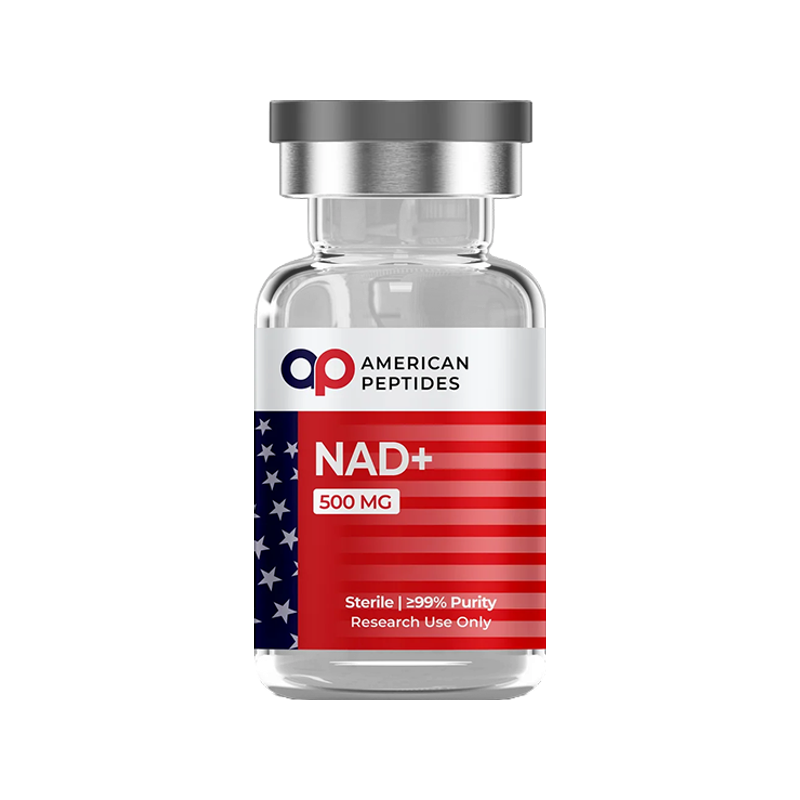

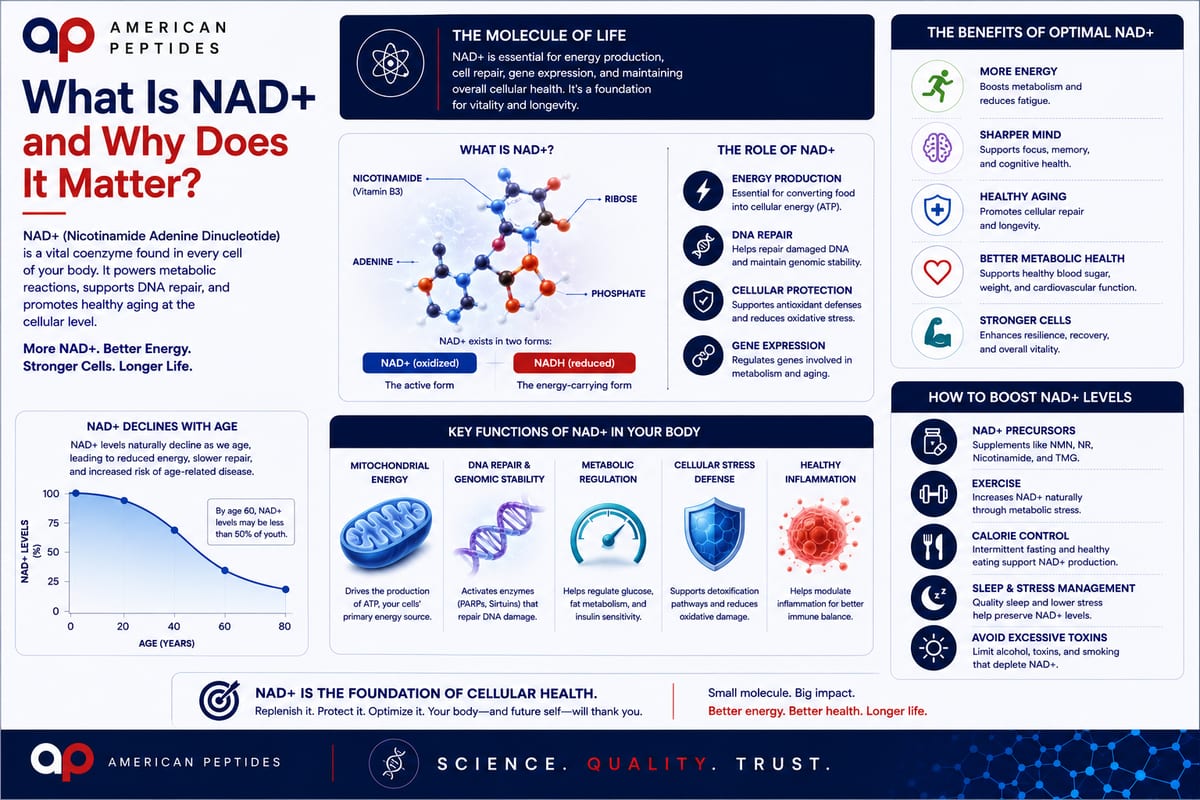
NAD+ (nicotinamide adenine dinucleotide) is a coenzyme found in every living cell that is central to energy metabolism and redox chemistry. It shuttles electrons in the reactions that convert nutrients into usable cellular energy and is a co-substrate for several classes of signaling enzymes. NAD+ is one of the most heavily studied molecules in longevity and cellular-biology research.
The molecule and its two forms
NAD+ is a dinucleotide: a nicotinamide moiety and an adenine moiety joined through two ribose sugars and a phosphate bridge. It exists in two interconverting states — the oxidized form (NAD+) and the reduced form (NADH). The “+” denotes the positive charge on the oxidized nicotinamide ring. Together the NAD+/NADH couple is one of the cell’s primary electron carriers, and the ratio between the two forms is itself a tightly regulated cellular variable studied in metabolism research.
Role in energy metabolism
The NAD+/NADH couple participates in glycolysis, the citric-acid cycle, and oxidative phosphorylation — the pathways that produce ATP. In simplified terms, NAD+ accepts electrons (becoming NADH) during nutrient breakdown, then donates them in the mitochondrial electron-transport chain, regenerating NAD+ so the cycle can continue. Because mitochondria are where much of this occurs, NAD+ biology and mitochondrial science are tightly linked in the literature.
Beyond metabolism: NAD+ as a signaling co-substrate
NAD+ is also consumed (not just recycled) as a co-substrate by enzyme families such as sirtuins, PARPs, and CD38, which connects it to research on DNA-repair signaling, gene regulation, and calcium signaling in model systems. This dual role — electron carrier and signaling substrate — means cellular NAD+ is constantly being both used and replenished, and is why NAD+ appears so often in cellular-aging literature. The general concept of how molecules relay signals inside cells is covered in the science behind cellular signaling.
The NAD+ salvage and biosynthesis pathways
Cells maintain NAD+ through de novo synthesis (from tryptophan) and, more prominently, a salvage pathway that recycles nicotinamide back into NAD+. Research uses biosynthetic precursors as tools to manipulate the intracellular NAD+ pool in controlled experiments — this is studied biochemistry, not a product recommendation.
| Precursor / pathway | Research role |
|---|---|
| De novo (tryptophan) | Baseline biosynthetic route studied in metabolism models |
| Salvage (nicotinamide recycling) | Primary route maintaining the cellular NAD+ pool |
| Nicotinic acid / ribosides / mononucleotides | Inputs used to raise intracellular NAD+ in experiments |
Why longevity researchers study it
Published research describes a general decline in cellular NAD+ availability with age in model organisms, and a body of in-vitro and animal work investigates the NAD+ pool as a variable in mitochondrial function and DNA-repair signaling. This is an active area of scientific investigation — not a settled clinical conclusion, and nothing in that literature constitutes guidance for human use. It connects to the broader healthspan-versus-lifespan distinction and to why precise molecular tools are used to probe these pathways.
Common misconceptions
NAD+ is an endogenous coenzyme studied as biochemistry; describing its role in energy or repair pathways in model systems is not a health, anti-aging, or treatment claim. “Associated with aging research” means it is a studied variable — not that manipulating it produces any outcome in a person. Personal health questions belong with a licensed provider.
Why material quality matters in NAD+ research
Because NAD+ sits at the intersection of energy metabolism and signaling, experiments probing it are sensitive to the quality of any compounds introduced into the system. Off-target impurities or misidentified material can confound redox and signaling readouts, which is why defined research inputs are verified the same way peptides are — identity by mass spectrometry and a lot-specific Certificate of Analysis. The same reproducibility logic that governs peptide purity applies to any tool used to perturb the NAD+ pool, and is part of why rigorous longevity work emphasizes characterized materials over generic labels.
Frequently Asked Questions
What does NAD+ stand for?
NAD+ stands for nicotinamide adenine dinucleotide. The “+” denotes the oxidized form, which carries a positive charge on its nicotinamide ring; NADH is the corresponding reduced form.
What does NAD+ do in the cell?
It functions primarily as an electron carrier in energy-producing metabolic pathways and as a co-substrate for signaling enzymes such as sirtuins, PARPs, and CD38. It is essential to normal cellular redox chemistry.
What is the difference between NAD+ and NADH?
They are the two redox states of the same coenzyme. NAD+ is the oxidized form that accepts electrons; NADH is the reduced form that carries them. Cells continuously cycle between the two, and the ratio is a regulated variable.
How does the cell make and recycle NAD+?
Through de novo synthesis from tryptophan and, predominantly, a salvage pathway that recycles nicotinamide. Because NAD+ is consumed by signaling enzymes, continuous replenishment is required.
Why is NAD+ studied in longevity research?
Published model-organism research describes an age-associated decline in cellular NAD+ availability and investigates the pool in relation to mitochondrial function and DNA-repair signaling. It is an active research question, not a clinical conclusion.
How does NAD+ relate to mitochondria?
NAD+ is central to the electron-transfer reactions mitochondria run to produce ATP, so NAD+ biology and mitochondrial function are closely connected topics in the research literature.
Are NAD+ precursors drugs or supplements?
In this educational context they are discussed only as biochemical inputs used to manipulate NAD+ in experimental systems. Nothing here is a product recommendation or health claim.
Related Optimization Protocols
Reviewed by the American Peptides Education Team. Educational content only — not medical advice.
For research and educational use only. Not a drug, supplement, food, or medical product. Nothing here is medical advice, a treatment claim, or a health outcome claim. Any laboratory compounds referenced are for in-vitro research only.