

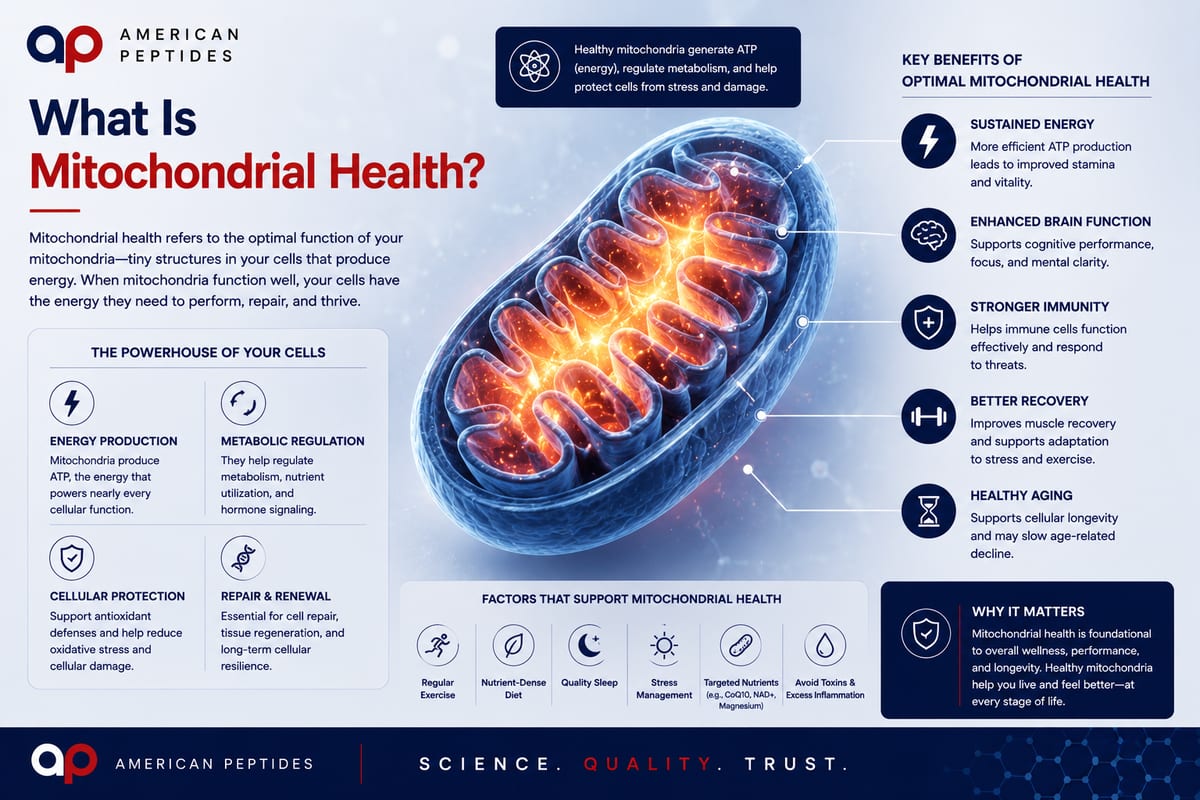
Mitochondria are the organelles that generate most of a cell's usable energy; "mitochondrial health" is a research shorthand for how well these organelles perform and maintain that energy-producing function. It is studied as a window into cellular function, not as a clinical diagnosis. This is an educational cell-biology explainer with no health, treatment, or outcome claims.
What mitochondria do
Mitochondria convert nutrients into ATP, the cell’s energy currency, through a series of electron-transfer steps. They also participate in signaling, calcium handling, and regulated cell death. Because energy availability underlies nearly every cellular process, mitochondrial function is a recurring theme across cell biology and longevity research.
What "health" means here
As a research concept, mitochondrial health bundles several measurable properties: efficiency of energy production, integrity of the organelle, turnover (the cell’s ability to recycle damaged mitochondria), and resilience to stress. None of these is a single clinical number; together they describe how well the energy system is working in a studied model.
| Aspect | What it describes |
|---|---|
| Energy efficiency | How effectively nutrients become ATP |
| Integrity | Structural soundness of the organelle |
| Turnover | Recycling of damaged mitochondria |
| Stress resilience | Function maintained under challenge |
Why it is studied
Energy biology intersects with the cofactor pathways covered in NAD biology and with cellular signaling generally. Researchers study mitochondrial parameters as readouts of cellular state in model systems — a way to ask precise questions about how cells produce and manage energy, not as a basis for health claims.
How it is measured in research
In the lab, mitochondrial function is assessed with assays of respiration, membrane potential, and related markers in cells or tissue. These are controlled, in-vitro or model-system measurements. They describe behavior in that system and do not translate directly to statements about a person’s health.
The interpretation boundary
This is essential: "supports mitochondrial health" is a marketing phrase, not a scientific finding, and nothing in this article should be read that way. Research describes what is observed in models. Whether any intervention affects mitochondrial function in humans is a separate, rigorous question that mechanistic or model data alone do not answer.
Why the concept is still useful
As a framework, mitochondrial health organizes a set of related, measurable cellular properties and connects energy biology to the broader signaling literature — including peptide research tools used to probe these pathways. Understanding it makes energy-focused research easier to read critically.
Mitochondrial quality control
Cells do not just run mitochondria; they maintain them. Damaged organelles are tagged and recycled, and the network can divide and fuse to redistribute components — collectively, mitochondrial quality control. Researchers study these processes as readouts of cellular state because a system that maintains its energy machinery behaves differently from one that cannot. These are observations in model systems, tied conceptually to NAD-related energy biology, not statements about a person’s health.
Reading energy-biology claims critically
The phrase “supports mitochondrial health” appears constantly in marketing and almost never in rigorous research, because research reports specific, measured endpoints in defined systems. The useful skill is to ask: what was measured, in what model, and what is the gap to human biology? Framing mitochondrial health as a structured set of signaling-linked properties — rather than a benefit — is what keeps the concept scientifically honest.
The throughline to remember
Mitochondrial health is best held as a structured research concept — energy efficiency, integrity, turnover, and stress resilience — measured in defined systems and connected to cofactor biology and cellular signaling. Keep mechanism and model findings separate from human outcomes, and the energy-biology literature, including the peptide tools used to probe these pathways, becomes readable rather than hype-prone. The concept is a lens for asking precise questions, never a benefit claim.
From organelle biology to honest research framing
Pulling the threads together: mitochondria supply cellular energy and participate in signaling, and “mitochondrial health” usefully bundles efficiency, integrity, turnover, and stress resilience into a structured way of describing how that system performs in a studied model. The discipline is in the framing. Research reports specific endpoints measured in defined systems; it does not license the phrase “supports mitochondrial health” as applied to people. The productive questions are always what was measured, in what model, and how large the gap is to human biology — the same critical reading that cellular-signaling science and NAD biology demand. Treated as a precise research lens rather than a benefit, mitochondrial health connects energy biology to the broader literature, including the peptide tools used to interrogate these pathways, without drifting into claims the evidence does not support.
Frequently Asked Questions
What are mitochondria?
Organelles that generate most of a cell’s usable energy (ATP) and also participate in signaling, calcium handling, and regulated cell death.
What does "mitochondrial health" mean?
A research shorthand bundling energy efficiency, organelle integrity, turnover, and stress resilience — how well the energy system works in a studied model.
Why is it studied?
Because energy availability underlies nearly every cellular process; mitochondrial parameters serve as readouts of cellular state in research models.
How is it measured?
With controlled assays of respiration, membrane potential, and related markers in cells or tissue — in-vitro or model-system measurements.
Does any product improve mitochondrial health?
This article makes no such claim. "Supports mitochondrial health" is a marketing phrase, not a scientific finding. Research describes models, not human outcomes.
How does this relate to NAD or signaling?
Energy biology intersects with NAD cofactor pathways and cellular signaling; mitochondrial parameters are studied as part of that broader research.
Is this a medical diagnosis?
No. It is an educational cell-biology concept, not a diagnosis, treatment, or health-outcome claim.
Related Optimization Protocols
Reviewed by the American Peptides Education Team. Educational content only — not medical advice.
For research and educational use only. Not a drug, supplement, food, or medical product. Nothing here is medical advice, a diagnosis, a treatment claim, or a health outcome claim.