
Mass spectrometry is an analytical technique that confirms a research peptide's identity by precisely measuring its molecular mass and comparing it to the expected value for the intended sequence. It answers the question “is this the correct molecule?” — the identity half of peptide quality assurance. This is an educational, research-use-only explainer.
Identity versus purity
Quality assurance asks two distinct questions. HPLC purity asks “how much of the sample is the target versus impurities?” Mass spectrometry asks “is the dominant component actually the molecule we intended?” A sample can be highly pure yet be the wrong peptide; only mass spectrometry catches that. The two are complementary, which is why a credible Certificate of Analysis reports both.
How it works, conceptually
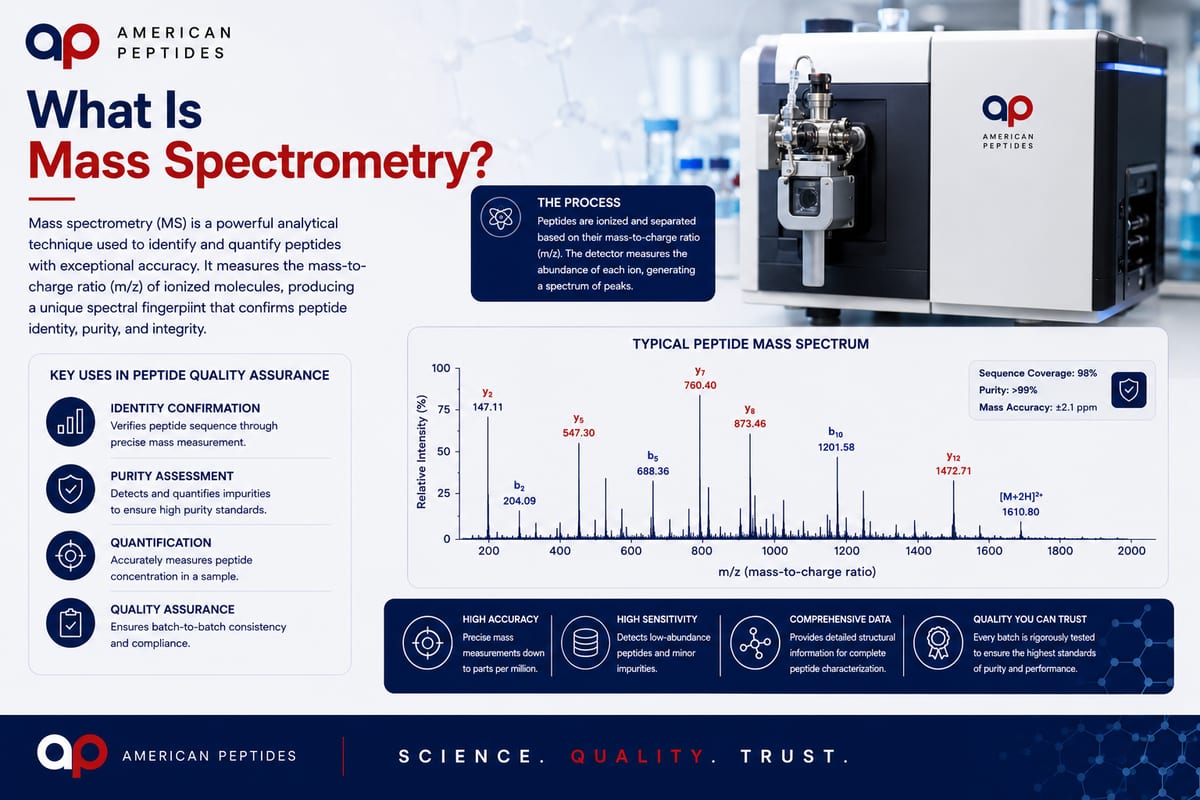
The instrument ionizes the peptide, separates ions by their mass-to-charge ratio, and detects them, producing a spectrum. The measured molecular mass is compared to the theoretical mass computed from the intended amino-acid sequence. A match within tight tolerance confirms identity; a mismatch flags a wrong, modified, or truncated sequence.
| Question | Method | What a pass means |
|---|---|---|
| Is it the right molecule? | Mass spectrometry | Measured mass matches theoretical mass |
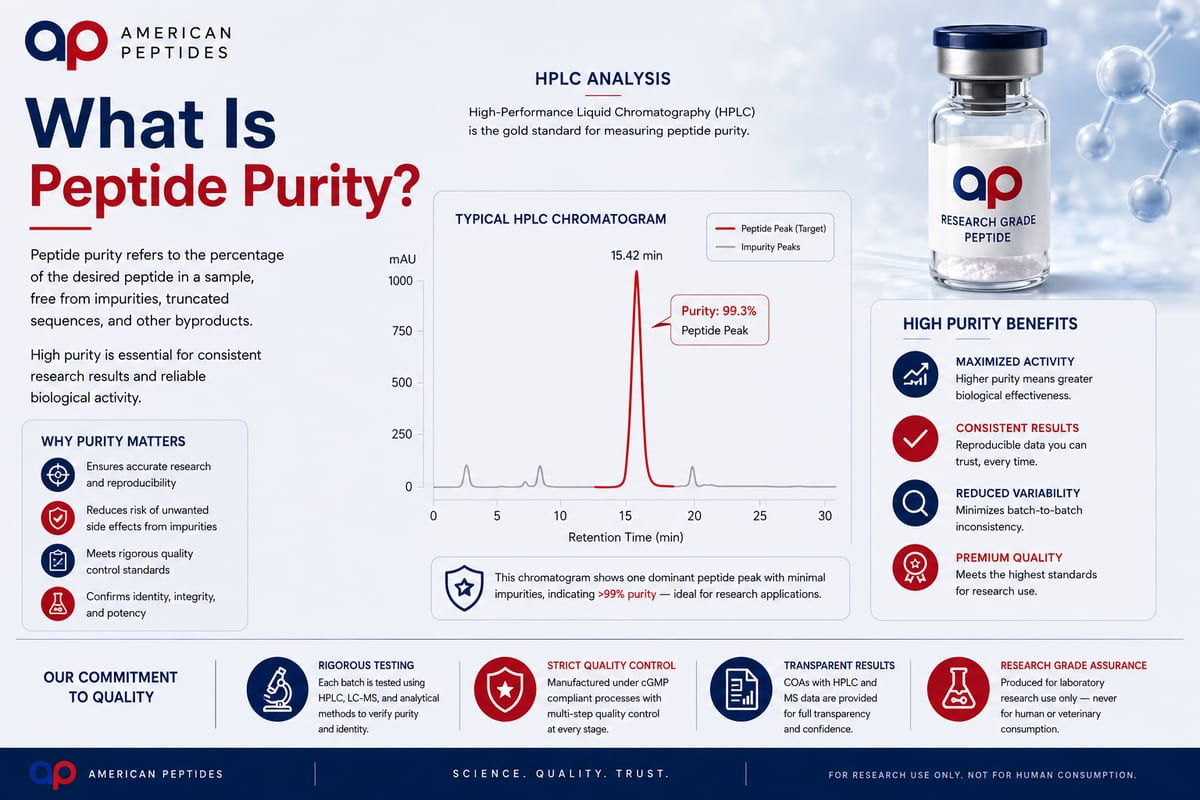
| How pure is it? | HPLC | Dominant peak is a high % of the total |
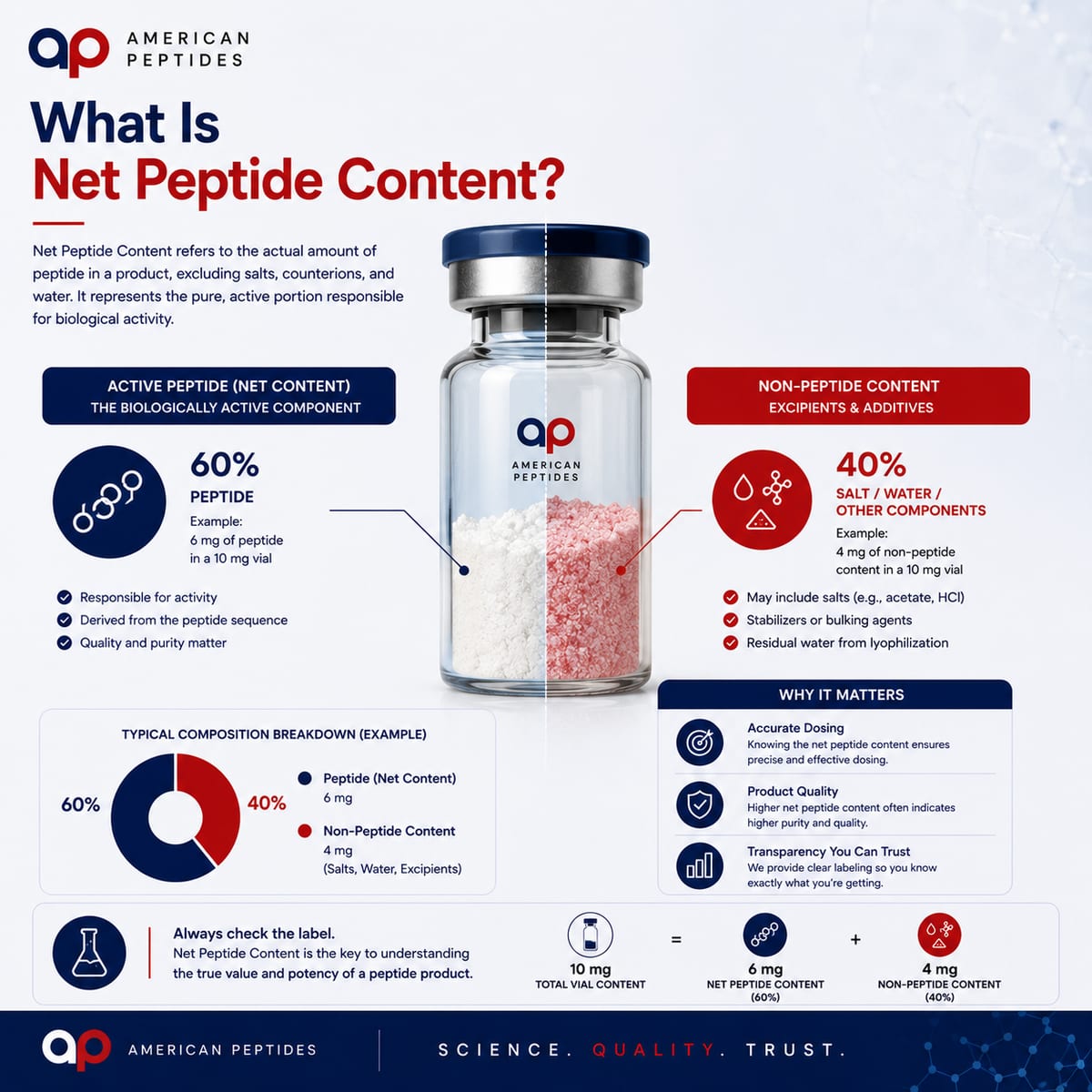
| How much is peptide? | Content assay | Net peptide vs salts/water is known |
What mass spectrometry can reveal
Beyond a simple yes/no on identity, the spectrum can indicate truncated sequences (missing residues), deletion or addition products, and certain modifications — each shifting the mass in a characteristic way. This makes it a powerful check on synthesis fidelity, the property that ultimately determines whether a signaling experiment is interpretable.
Why it belongs on every COA
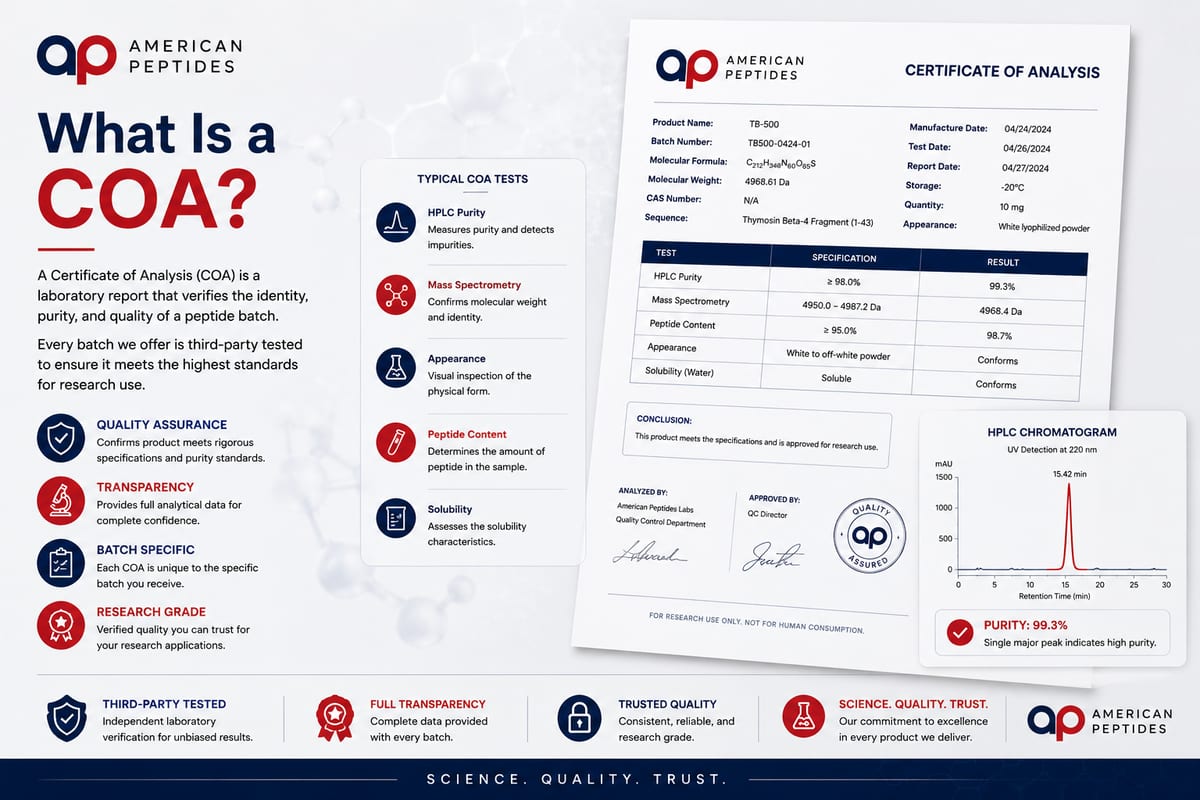
A purity percentage without an identity confirmation is incomplete: it tells you the sample is homogeneous, not that it is correct. Pairing HPLC with mass spectrometry on a lot-specific COA closes that gap. The strongest documentation shows the actual spectrum and chromatogram, not just headline numbers, so a researcher can judge the evidence directly.
How researchers use the result
In practice a researcher confirms the reported measured mass against the expected molecular weight for the sequence, checks that the lot number matches the vial, and only then trusts the material for quantitative work. Identity verification is the gate; everything downstream — concentration math after reconstitution, assay readouts — assumes it passed.
What it does not establish
Mass spectrometry establishes molecular identity for research QA. It says nothing about safety or efficacy for any use and is not a license for human or animal use. It is an analytical fact about composition, consistent with the rest of the research-quality framework.
Theoretical vs measured mass: the core comparison
The decisive step is comparing the measured molecular mass against the theoretical mass calculated from the intended amino-acid sequence. A match within tight tolerance is strong evidence the molecule is correct; a defined offset can point to a specific defect — a missing residue lowers the mass by that residue’s contribution, an oxidation raises it characteristically. This is why the raw spectrum is more informative than a yes/no statement: it shows how the sample relates to the target, not merely that it passed.
Where identity sits in the QA stack
Identity is the gate the rest of quality assurance depends on. Purity and net peptide content only mean something once you know the dominant species is the intended molecule. A complete lot-specific COA therefore reports mass-spec identity alongside HPLC and content, and the strongest documentation shows the underlying data so a researcher can judge it rather than trust a summary line.
The bottom line for researchers
Mass spectrometry is the identity gate: it tells you the molecule is the one you intended, which every downstream purity figure and concentration calculation silently assumes. Insist on a lot-specific COA that pairs it with HPLC and shows the underlying data — identity verified, not asserted, is the foundation of reproducible peptide work.
Why identity verification cannot be skipped
It is tempting to treat a high purity number as sufficient, but purity and identity are logically independent: a sample can be exquisitely homogeneous and still be the wrong molecule, a truncated variant, or a modified form. Only an identity method resolves that ambiguity, and mass spectrometry is the standard because it reads the molecule’s mass directly and compares it to the value computed from the intended sequence. Skipping it means trusting that synthesis produced the right chain — an assumption, not evidence. In reproducible research, assumptions about the input are exactly what destroy interpretability, because a signaling or binding readout is only meaningful if the ligand is genuinely the intended one. This is also why the strongest lot-specific Certificates of Analysis show the spectrum and chromatogram rather than only headline figures: visible data lets a researcher confirm identity independently instead of taking a summary line on faith. Identity first, then purity and net content — that ordering is the backbone of trustworthy peptide QA.
Frequently Asked Questions
What does mass spectrometry confirm?
A peptide’s identity — that its measured molecular mass matches the theoretical mass for the intended sequence. It is the identity half of QA.
How is it different from HPLC?
HPLC measures purity (how much is the target vs impurities); mass spectrometry measures identity (whether the molecule is the correct one). Both are needed.
Can a pure peptide still fail identity?
Yes. A sample can be highly pure but be the wrong or a modified sequence. Only an identity method like mass spectrometry detects that.
What can the spectrum reveal?
A correct or incorrect molecular mass, and characteristic shifts indicating truncations, deletions, additions, or certain modifications — a check on synthesis fidelity.
Why should a COA include mass spectrometry?
Because purity alone shows homogeneity, not correctness. Pairing it with HPLC on a lot-specific COA verifies both identity and purity.
How does a researcher use the result?
By confirming the reported mass against the expected molecular weight and the lot against the vial before trusting the material for quantitative work.
Does it establish safety or efficacy?
No. It establishes molecular identity for research QA only and is not human or animal use authorization.
Related Optimization Protocols
Reviewed by the American Peptides Education Team. Educational content only — not medical advice.
For research use only. Sold exclusively for in-vitro laboratory research. Not a drug, supplement, food, or medical product. Not for human or animal consumption, diagnostic, or therapeutic use. Nothing here is dosing, administration, or medical guidance.