
Research-use-only context. This article is an educational reference on formulation and materials chemistry. It provides no instructions for human or animal use and makes no therapeutic or efficacy claims. American Peptides research peptides are sold strictly for in vitro laboratory research only; American Peptides Melts™ are dietary supplements (see the label and disclaimer).
A dissolving film is a thin polymer matrix — usually a water-soluble film former such as hypromellose, pullulan, or polyvinyl alcohol — in which a payload is dispersed before the sheet is dried and cut into individually sealed units. The chemistry of interest is the matrix itself: how the film is cast, how much residual moisture it retains, how uniformly the payload is distributed through the sheet, and how quickly the matrix disperses in aqueous media under laboratory conditions. This article covers those properties and how each is measured.
How a film matrix is built
Two manufacturing routes dominate the literature. In solvent casting, the film former is hydrated into a viscous solution, the payload and excipients are dispersed into it, the mixture is de-aerated, drawn down onto a liner at a controlled wet-film thickness, and dried in a temperature- and airflow-controlled oven before being slit and cut. In hot-melt extrusion, the same components are compounded thermally with no solvent and drawn into a sheet. Each route imposes different constraints — solvent casting requires a payload stable in the wet phase through drying, while extrusion requires thermal stability at process temperature.
Beyond the film former, the formulation carries plasticizers such as glycerol or polyethylene glycol, which control brittleness and handling; disintegrants or superdisintegrants, which govern how fast the matrix breaks apart in aqueous media; and taste-masking and stabilizing excipients. Every one of these shifts the mechanical and dispersion behavior of the finished film, which is why film formulation is characterized empirically rather than predicted.
How films disperse in aqueous media
When a dried film contacts an aqueous medium, water penetrates the polymer network, the chains hydrate and relax, the matrix swells, and the network loses cohesion and disperses, releasing the payload into solution. The rate-limiting step depends on the film former: hydrophilic, fast-hydrating polymers disperse by rapid chain relaxation, while higher-molecular-weight grades first form a gel layer that then erodes. Film thickness, polymer grade and molecular weight, plasticizer level, and residual moisture all move that rate.
Dissolution and disintegration testing
These behaviors are quantified with standard apparatus, not by observation. Disintegration testing records the time for a film unit to lose structural integrity in a defined volume of aqueous medium at controlled temperature. Dissolution testing — using paddle-over-disk or small-volume apparatus so a thin film cannot float free of the medium — samples the medium over time and quantifies the released payload by HPLC or UV, producing a release profile rather than a single number. Method development is a real part of the work: the medium volume, agitation rate, and the way the film is retained all change the curve, so a film's release profile is only meaningful alongside the method that produced it.
Content uniformity across the cast sheet
A vial's accuracy is set by fill tolerance. A film's accuracy is set by how evenly the payload was dispersed in the casting solution and how uniform the wet-film thickness was across the sheet. Because units are cut from a large cast area, the standard check is content uniformity: individual units are sampled across the sheet, assayed against label claim, and evaluated for both mean and unit-to-unit variability. Weight uniformity and thickness mapping are run alongside as process controls, since a thickness gradient in the cast layer shows up directly as an assay gradient in the finished units.
Moisture and light protection
Residual moisture is the film's master stability variable. Too little and the matrix turns brittle and cracks; too much and it becomes tacky, blocks in the roll, and provides the water activity that drives hydrolysis of a peptide payload. Films are therefore dried to a target moisture window, and each unit is sealed in a moisture- and light-barrier foil laminate. Stability programs hold sealed units at defined temperature and relative humidity and track assay, related substances, disintegration time, and mechanical properties over the study.
Film matrix versus lyophilized powder: a handling comparison
| Property | Thin-film matrix | Lyophilized powder in a vial |
|---|---|---|
| Physical state | Dried polymer sheet with payload dispersed in the matrix | Amorphous freeze-dried cake under vacuum or inert headspace |
| Preparation before study | None — units are supplied individually sealed | Solvent selection, volume accuracy, and gentle mixing to reconstitute |
| Unit accuracy governed by | Casting uniformity and wet-film thickness control | Fill tolerance at the vial |
| Primary stability risk | Moisture ingress and light exposure through the seal | Moisture ingress once the stopper is pierced; freeze-thaw of the prepared solution |
| Dispersion characterization | Disintegration and dissolution testing in aqueous media | Reconstitution time and clarity, then solution-phase stability |
| Verification | HPLC assay against label claim, content uniformity, COA | HPLC purity, mass spectrometry identity, COA |
In-vitro permeation models in the literature
Where researchers want to compare formats beyond dispersion behavior, they use bench permeation models. Franz diffusion cells mount a synthetic or excised membrane between donor and receptor chambers and quantify how much analyte transfers over time. Epithelial cell monolayers such as TR146 and Caco-2, grown on permeable supports with transepithelial electrical resistance as a barrier-integrity control, are used the same way and report apparent permeability coefficients for cells in culture. These are laboratory assays on membranes and cultured cells, described here strictly as methods the research literature reports.
The film format in practice
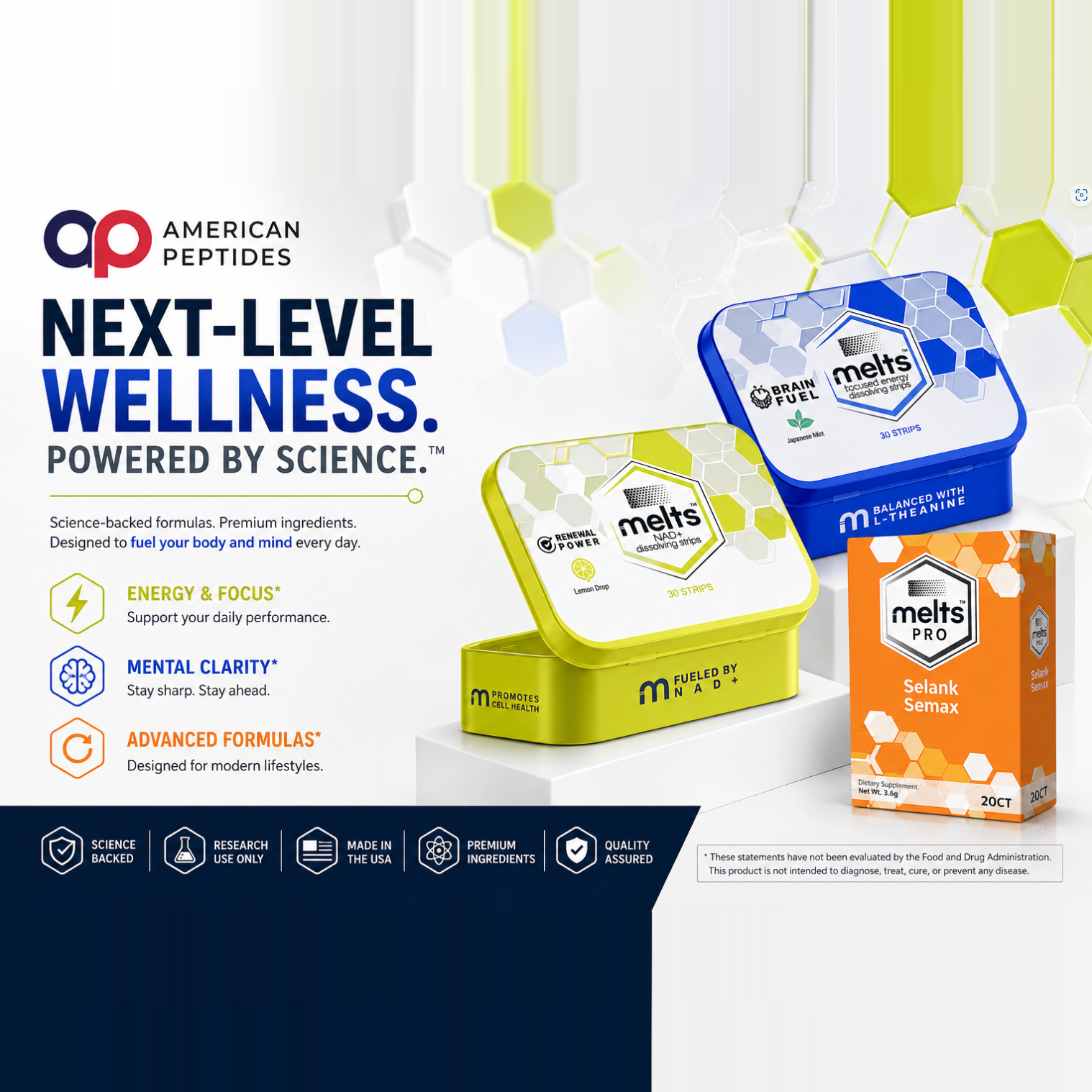
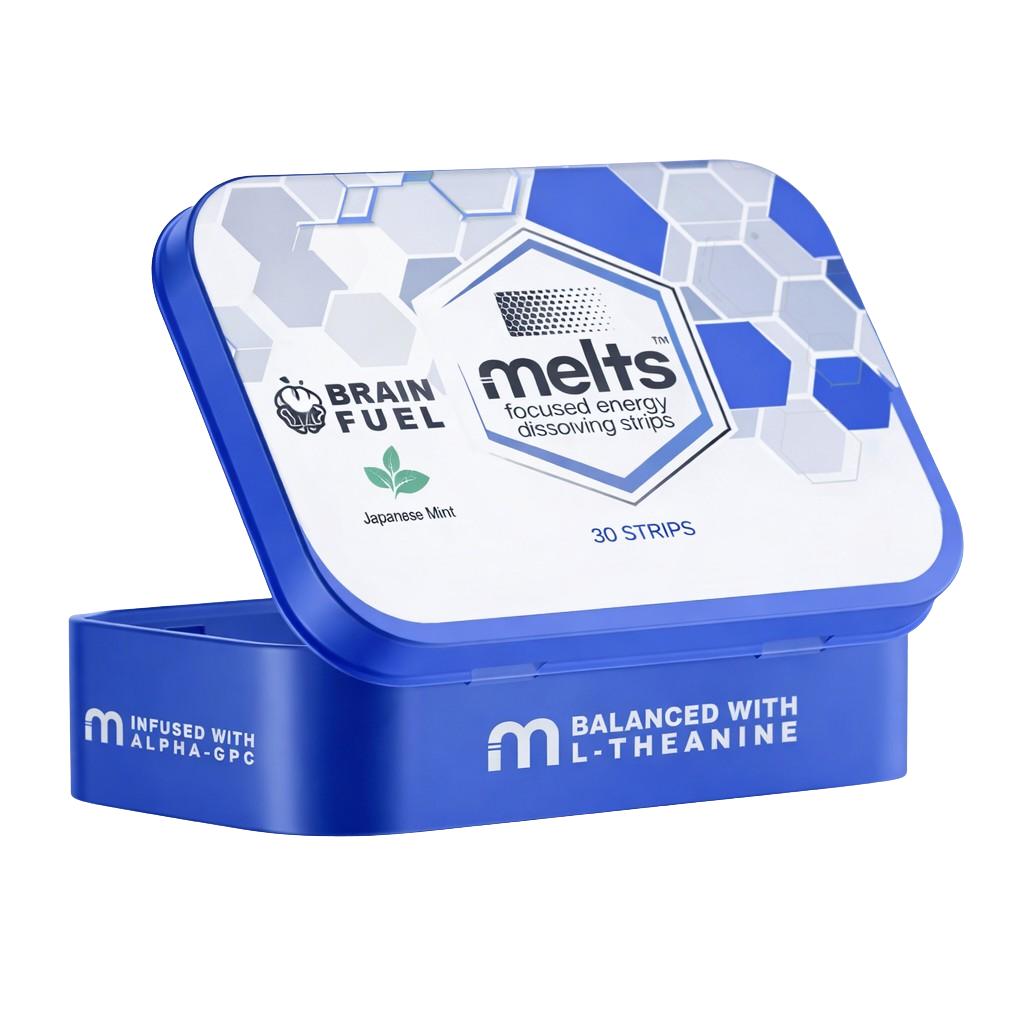
American Peptides Melts™ use this format as a fast-dispersing, individually sealed film. They are dietary supplements supplied ready to handle, with no reconstitution step:
- Melts™ Brain-Fuel Dissolving Strips — a dietary-supplement film matrix containing L-Theanine.*
- Melts™ NAD+ Dissolving Strips — an NAD+ dietary-supplement film matrix.*
- Melts Pro™ Selank + Semax Dissolving Strips — a combined-payload film format.
Where does the film sit against the other formats? It shares the low-residual-water advantage of a lyophilized vial while requiring no bench preparation, in the same way a pre-mixed spray solution does — but without keeping the payload in the solution phase for its whole shelf life. For the full comparison across every physical format, see Peptide Research Formats Explained.
Browse the pre-mixed lineup: Ready-to-Use Peptide Formats & Dissolving Films →
Frequently Asked Questions
What is a dissolving-film format?
It is a thin, water-soluble polymer matrix — commonly hypromellose, pullulan, or polyvinyl alcohol — in which a payload is dispersed before the sheet is dried and cut into individually sealed units. The format is characterized by its film former, plasticizer level, residual moisture, and dispersion behavior in aqueous media.
How is a film matrix manufactured?
Either by solvent casting — hydrating the film former, dispersing the payload, de-aerating, drawing the mixture down at a controlled wet-film thickness, then drying, slitting, and cutting — or by hot-melt extrusion, which compounds the same components thermally without solvent. The route chosen depends on whether the payload is more stable in the wet phase or at process temperature.
How is film dispersion measured in the laboratory?
Disintegration testing records the time for a unit to lose structural integrity in a defined aqueous medium at controlled temperature. Dissolution testing, typically with paddle-over-disk or small-volume apparatus, samples the medium over time and quantifies released payload by HPLC or UV to build a release profile.
Why does residual moisture matter so much in a film?
It is the master stability variable. Below the target window the matrix becomes brittle and cracks; above it the film turns tacky, blocks in the roll, and carries enough water activity to drive hydrolysis of a peptide payload. Films are dried to a defined window and sealed in moisture- and light-barrier foil laminate.
What are American Peptides Melts?
Melts™ are American Peptides' line of fast-dispersing thin-film dietary supplements, including the Brain-Fuel and NAD+ formats. They are supplied as individually sealed film units requiring no reconstitution. These statements have not been evaluated by the FDA.
Related reading: Spray-Format Peptides: Formulation Chemistry and Stability · Peptide Research Formats Explained. Verify identity and purity for any format on the COA library.
Reviewed by the American Peptides Education Team. Educational content only — not medical advice.
This article is for laboratory research reference only. American Peptides research peptides are sold strictly for in vitro research and are not for human consumption. American Peptides Melts™ are dietary supplements; those statements have not been evaluated by the FDA and are not intended to diagnose, treat, cure, or prevent any disease.
Related research
- Peptide Research Formats Explained: Lyophilized Vials, Solutions, Sprays, and Films
- Thin Films vs Capsules vs Powders: Comparing Solid Research Formats
- Spray-Format Peptides: Formulation Chemistry and Stability
- Spray Solutions vs Reconstituted Vials: A Research Format Comparison
- Peptide Lyophilization: The Science of Freeze-Drying Research Compounds
Compliance Notice: American Peptides research peptides are sold strictly for laboratory and academic research purposes only and are not intended for human or veterinary consumption. Dietary-supplement products are separately labeled as such. All content on this page is educational and does not constitute medical advice or product claims.