
Research-use-only context. This article compares the physical formats research peptides are supplied in as an analytical, materials-chemistry reference for laboratory work. It provides no instructions for human or animal use and makes no therapeutic or efficacy claims. American Peptides research peptides are for in vitro research only; American Peptides Melts™ are dietary supplements (see the label and the disclaimer at the end).
Research peptides are supplied in four physical formats: lyophilized powder sealed in a vial, the reconstituted solution prepared from that powder, pre-mixed spray-solution formats, and dissolving thin-film matrices. The formats differ mainly in stability — how long the intact molecule survives on the shelf under defined storage conditions — and in preparation effort, content uniformity, and the analytics used to verify them. This guide explains those differences and where each format fits in a laboratory workflow.
For years, the default format for a research peptide was a freeze-dried cake in a glass vial, redissolved into a working solution at the bench. That format is still the workhorse of the field. But two pre-mixed formats have become far more common in the research and supplement catalog — spray solutions and dissolving films — and understanding why the physical format changes the chemistry is the difference between choosing a format on habit versus choosing it on evidence.
The four formats in the research catalog
Every format is a trade-off between shelf stability and how much bench preparation it requires before an experiment can begin. The comparison below summarizes how each is characterized in the formulation literature.
| Format | Physical state | Stability characterization | Preparation at the bench | Key limiting factor |
|---|---|---|---|---|
| Lyophilized vial | Amorphous freeze-dried cake or powder under vacuum or inert headspace | Highest — low residual water slows hydrolysis and aggregation | Requires weighing, solvent selection, and reconstitution | Moisture ingress once the stopper is pierced |
| Reconstituted solution | Aqueous solution prepared from the vial | Limited — measured in days to weeks under refrigeration | Prepared fresh; concentration calculated from fill mass | Hydrolysis, adsorption to container surfaces, freeze-thaw cycles |
| Spray-solution format | Pre-mixed buffered solution in a metered atomizer | Moderate — governed by buffer, preservation, and cold storage | None; supplied ready for laboratory reference work | Solution-phase degradation over the labeled shelf life |
| Dissolving film | Thin polymer matrix with the payload dispersed in the cast film | High for a dried format — the solid matrix restricts molecular mobility | None; individually foil-sealed units | Moisture and light sensitivity of the film matrix |
The single biggest driver in that table is water. Peptides are chains of amino acids, and water is the reagent that drives hydrolysis, deamidation, and aggregation. Any format that keeps residual water low — a lyophilized cake, a dried film matrix — preserves more of the intact molecule on the shelf, which is why solid-state formats dominate long-term storage in peptide research.
The lyophilized vial and the reconstituted solution
The traditional research format is a freeze-dried peptide in a vial, redissolved into a working solution. Its appeal is chemical: lyophilization removes the bulk of the water under vacuum from the frozen state, leaving an amorphous solid in which molecular mobility — and therefore degradation chemistry — is very slow. The trade-offs are workflow-related. The vial has to be reconstituted correctly from its lyophilized cake, with attention to solvent choice, gentle swirling rather than vigorous shaking (which shears and aggregates peptide chains), and cold storage of the resulting solution. Concentration is calculated from the labeled fill mass and the solvent volume, so accuracy depends on both the fill tolerance and the pipetting technique of whoever prepares it.
For a laboratory that already runs this workflow, the vial remains the reference standard: it is the format with the longest shelf life and the one most analytical methods were validated against. For everyone else, the preparation burden of reconstitution is exactly what the pre-mixed formats remove.
Pre-mixed spray-solution formats
A spray-solution format is a peptide dissolved in a buffered aqueous vehicle and packaged in a metered atomizing pump. Three formulation properties define it: the buffer system, which holds pH in the range where the specific sequence is most stable; the preservation strategy, which controls microbial growth in a multi-actuation container; and the atomization profile, meaning the droplet-size distribution and volume the pump delivers per actuation, which is what makes each actuation reproducible as a measured quantity.
Because the peptide sits in the solution phase for the whole shelf life, this format is characterized by a shorter stability window than a sealed lyophilized vial, offset by the fact that it requires no bench preparation. Cold, dark storage and a labeled expiry are the controls that matter. American Peptides supplies this format pre-mixed:
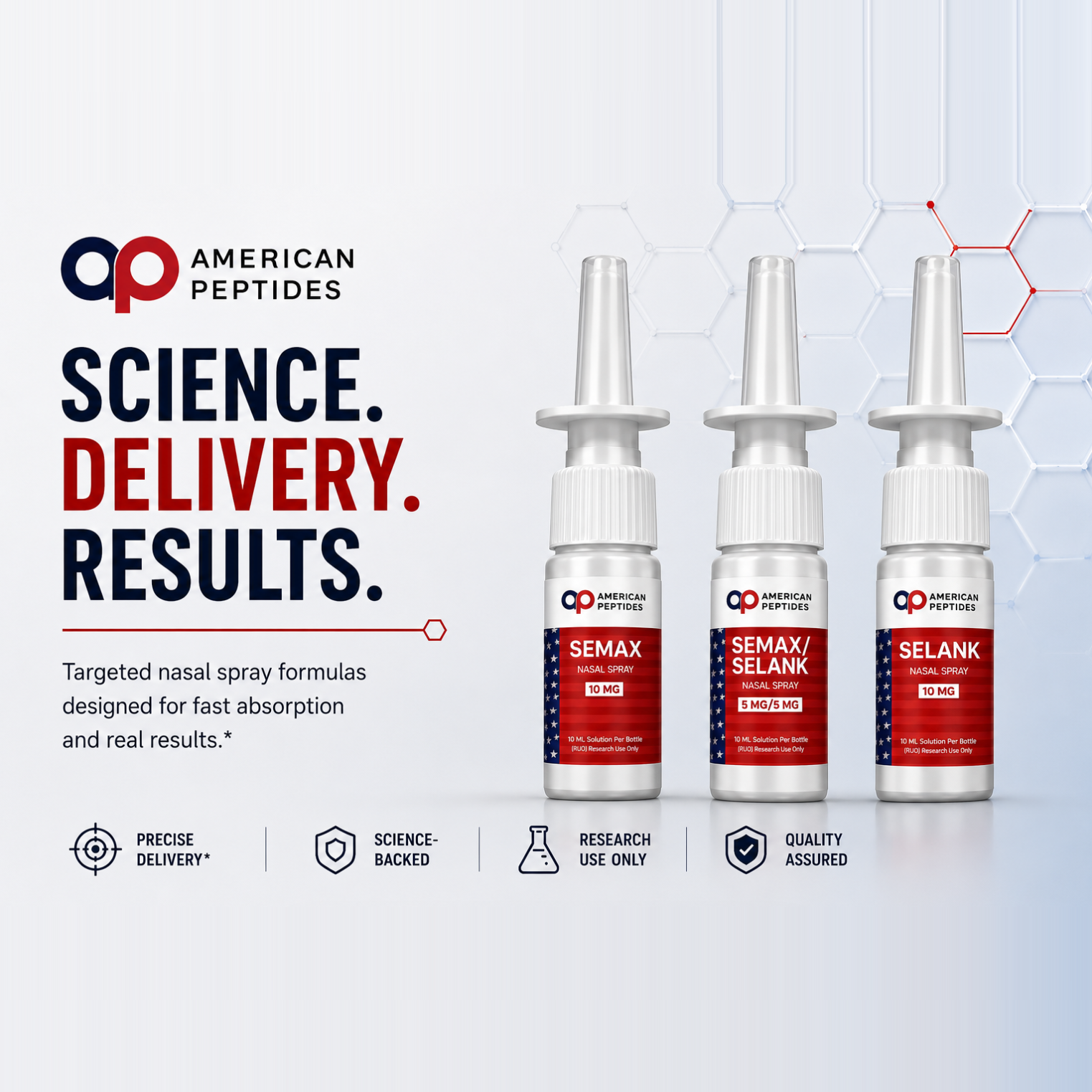
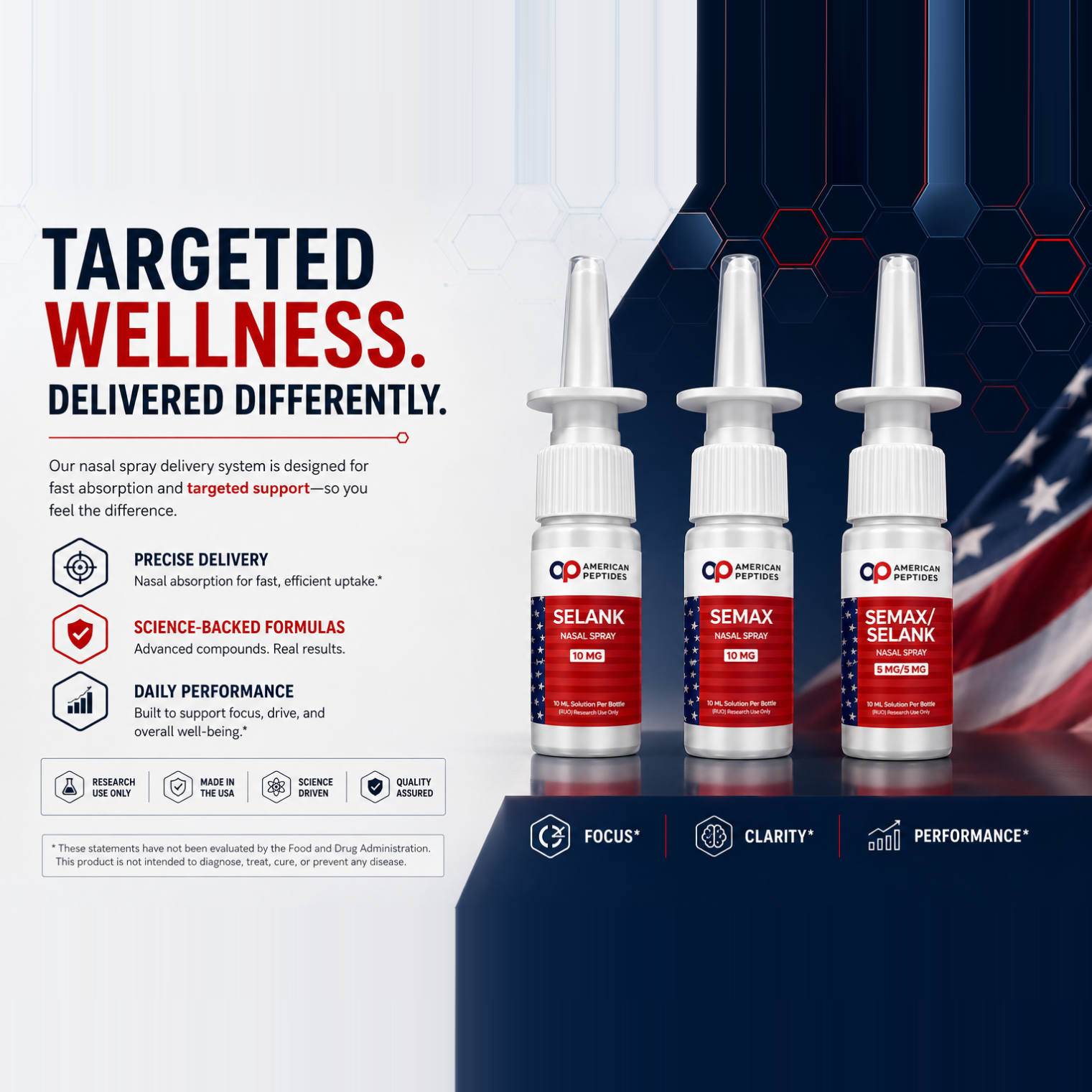
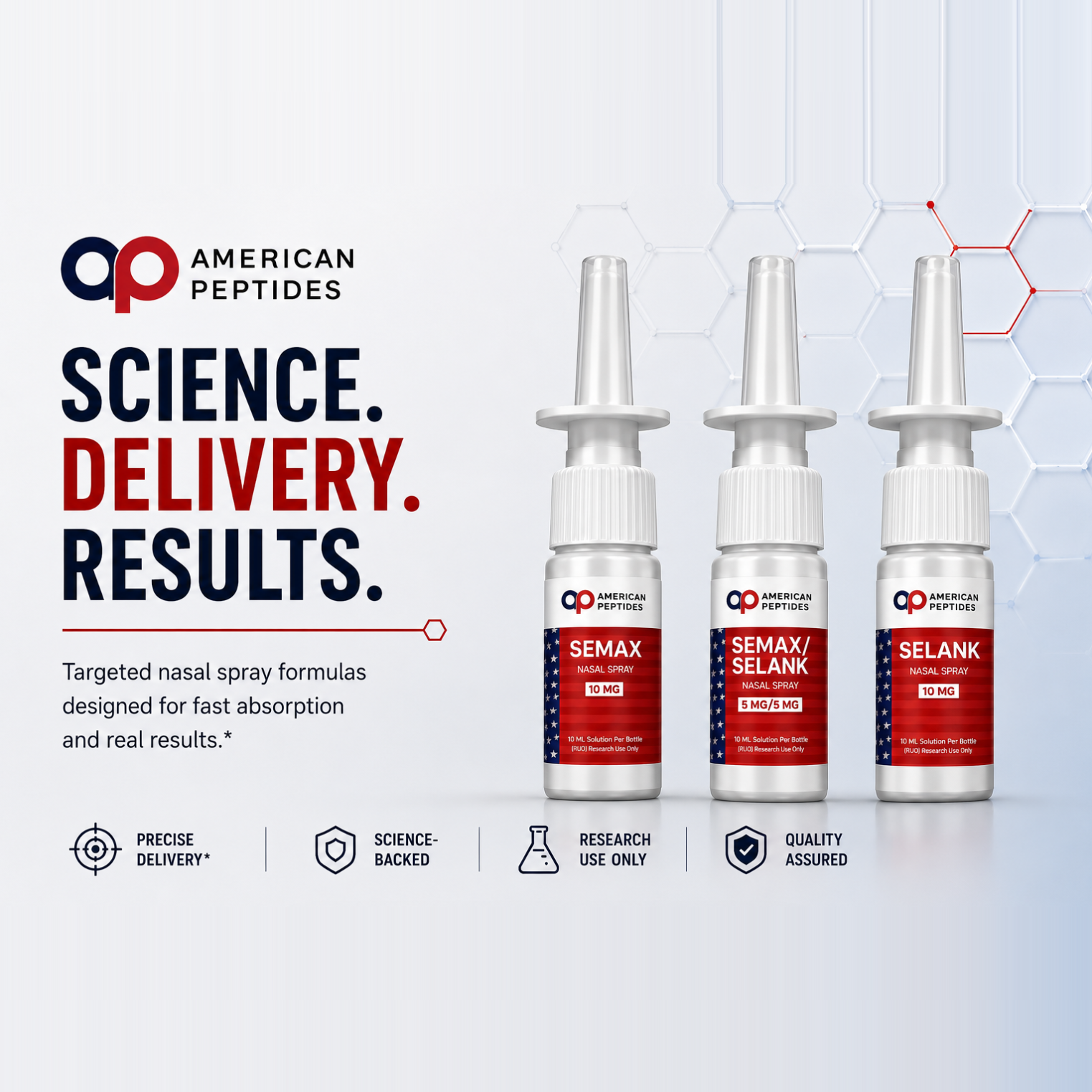
- Selank Nasal Spray — a synthetic heptapeptide studied in the research literature for GABAergic and anxiolytic-pathway signaling in laboratory models.
- Semax Nasal Spray — an ACTH-fragment-derived peptide studied for BDNF and neurotrophic-pathway interactions in laboratory models.
- Selank + Semax Nasal Spray — a combined-sequence spray-solution format.
A fuller treatment of buffer chemistry, preservation, and droplet-size characterization is in Spray-Format Peptides: Formulation Chemistry and Stability.
Dissolving thin-film matrices
A dissolving film is a solvent-cast or hot-melt-extruded polymer matrix — typically a water-soluble film former such as hypromellose, pullulan, or polyvinyl alcohol — in which the payload is dispersed before the film is dried and cut into individual units. The chemistry of interest is the matrix itself: film thickness, residual moisture after drying, plasticizer content, and the uniformity with which the payload is distributed through the cast sheet.
Two laboratory measurements characterize a film. Disintegration and dissolution testing records how quickly the matrix disperses in a defined volume of aqueous medium at controlled temperature and agitation. Content uniformity assays individual units against the label claim, which is the film equivalent of fill-tolerance testing on a vial. Because the matrix is dried and foil-sealed, the format is comparatively stable, with moisture and light as the two variables that most affect it.
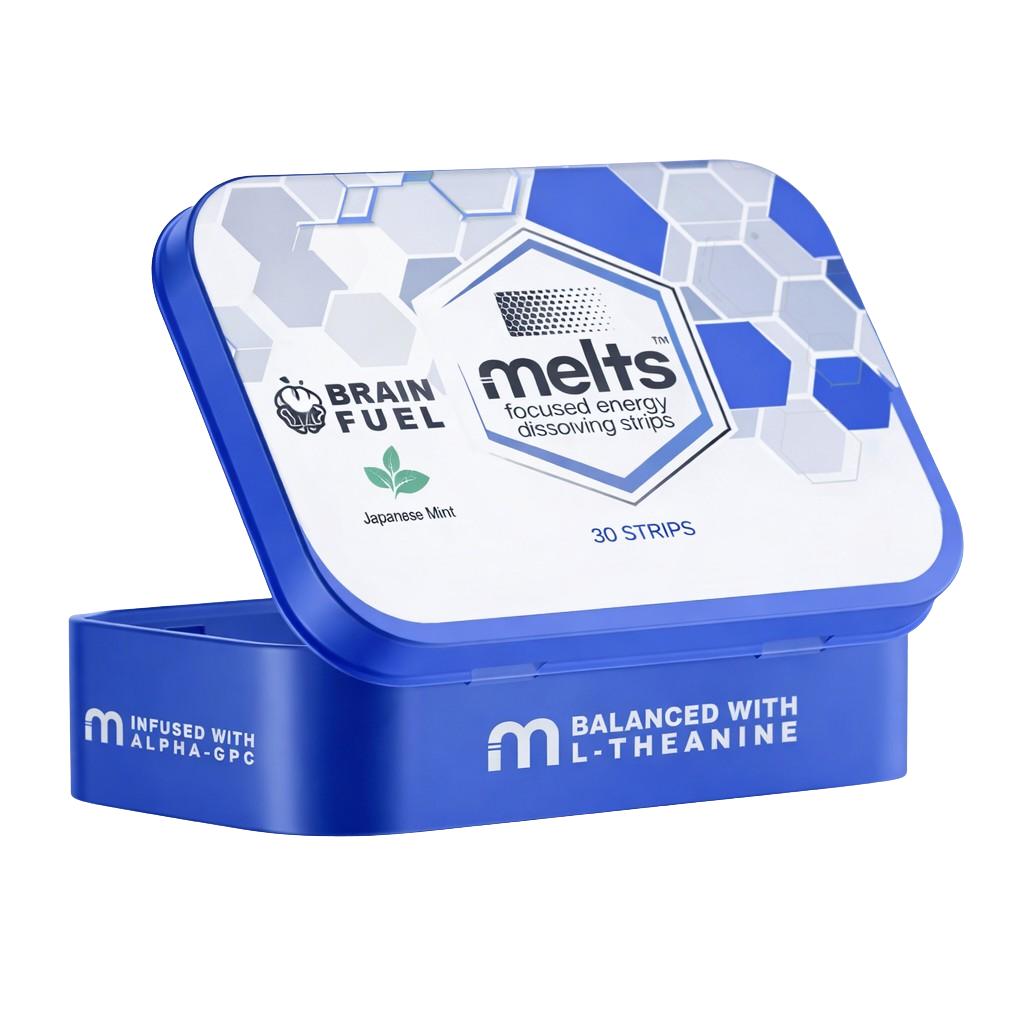
American Peptides Melts™ use this format as a fast-dispersing film — supplied sealed, with no reconstitution step:
- Melts™ Brain-Fuel Dissolving Strips — a dietary-supplement film format containing L-Theanine.
- Melts™ NAD+ Dissolving Strips — an NAD+ dietary-supplement film format.
- Melts Pro™ Selank + Semax Dissolving Strips — a combined-payload film format.
The film-casting chemistry is covered in depth in Dissolving-Film Peptide Formats: The Science of Thin-Film Matrices.
Why the format changes the chemistry
Choosing a format is really choosing a set of physical-chemical conditions. Four properties move with the format:
- Residual water — the master variable. Lowest in a lyophilized cake and a dried film, highest in a pre-mixed solution, and it sets the rate of hydrolysis and deamidation.
- Molecular mobility — an amorphous solid held below its glass transition temperature immobilizes the peptide; a solution does not, which is why solid formats hold their assay values longer.
- Content uniformity — vials are governed by fill tolerance, films by casting uniformity, and spray solutions by the reproducibility of the metered pump.
- Preparation burden — reconstitution introduces operator variance (solvent choice, volume accuracy, mixing energy) that pre-mixed formats simply do not have.
None of these makes one format universally "better." They make each format appropriate for different questions — which is exactly why a modern peptide catalog carries all of them.
How researchers characterize formats in vitro
The formulation literature evaluates these formats with bench models, not with people. Dissolution and disintegration apparatus quantify how a film or a lyophilized cake disperses in aqueous media. Franz diffusion cells mount a synthetic or excised membrane between a donor and receptor chamber and measure how much analyte crosses over time, which is the standard in vitro permeation model reported in the literature. Epithelial cell monolayer assays — Caco-2 and RPMI 2650 monolayers grown on permeable supports — are used the same way, with transepithelial electrical resistance recorded as a barrier-integrity control. All of these are laboratory measurements on cells and membranes in culture, described here strictly as methods researchers report.
Format verification: HPLC and the COA
Whatever the format, identity and purity are established the same way. Reverse-phase HPLC separates the target sequence from process-related impurities and reports purity as a percentage of total peak area. Mass spectrometry confirms the molecular weight matches the intended sequence. For solution and film formats, an assay against label claim and a content-uniformity result are added, and stability-indicating methods are run on samples held at defined temperature and humidity. Every research peptide ships with a third-party Certificate of Analysis, so purity and identity are verifiable regardless of format. The full pre-mixed lineup is on the American Peptides ready-to-use format catalog.
Frequently Asked Questions
What formats are research peptides supplied in?
Four: a lyophilized powder sealed in a vial, the aqueous solution reconstituted from it at the bench, a pre-mixed buffered spray solution in a metered atomizer, and a dissolving thin-film matrix. They differ in residual water content, shelf stability, preparation effort, and the analytics used to verify each unit.
What is a peptide spray-solution format?
It is a peptide dissolved in a buffered aqueous vehicle and packaged in a metered atomizing pump. The formulation is defined by its buffer and pH, its preservation system, and its atomization profile — the droplet-size distribution and volume the pump emits per actuation. Selank and Semax are commonly supplied in this format.
How is a dissolving-film format made and tested?
The payload is dispersed in a water-soluble polymer solution, cast as a thin sheet, dried to a controlled residual moisture, and cut into foil-sealed units. In the laboratory it is characterized by disintegration and dissolution testing in aqueous media and by content-uniformity assays of individual units against label claim.
Which format is the most stable on the shelf?
The sealed lyophilized vial is characterized in the literature as the most stable, because very low residual water and restricted molecular mobility slow hydrolysis and aggregation. Dried film matrices are also comparatively stable; pre-mixed solutions have the shortest characterized window, since the peptide remains in the solution phase for the whole shelf life.
Are pre-mixed research peptides still research-use only?
Yes. American Peptides research peptides — including the spray-solution format — are sold strictly for laboratory research use only, regardless of physical format. The Melts™ dissolving films are a separate category of dietary supplements. Always check the individual product label and its disclaimer.
To go deeper on the fundamentals, start with What Are Research Peptides?, then review Lyophilized Peptides Explained and the reconstitution chemistry guide. Verify identity and purity for any format on the COA library.
Reviewed by the American Peptides Education Team. Educational content only — not medical advice.
This article is for laboratory research reference only. American Peptides research peptides are sold strictly for in vitro research and are not for human consumption. American Peptides Melts™ are dietary supplements; those statements have not been evaluated by the FDA and are not intended to diagnose, treat, cure, or prevent any disease.
Related research
- Spray-Format Peptides: Formulation Chemistry and Stability
- Spray Solutions vs Reconstituted Vials: A Research Format Comparison
- Dissolving-Film Peptide Formats: The Science of Thin-Film Matrices
- Thin Films vs Capsules vs Powders: Comparing Solid Research Formats
- What Is Selank? A Research Overview of the Peptide and Its Studied Pathways
Compliance Notice: American Peptides research peptides are sold strictly for laboratory and academic research purposes only. They are not intended for human or veterinary consumption, diagnosis, treatment, or prevention of any disease. Dietary-supplement products are separately labeled as such. All content on this page is educational in nature and does not constitute medical advice or product claims. Researchers are responsible for handling these compounds in accordance with their institution's safety protocols and applicable laws.