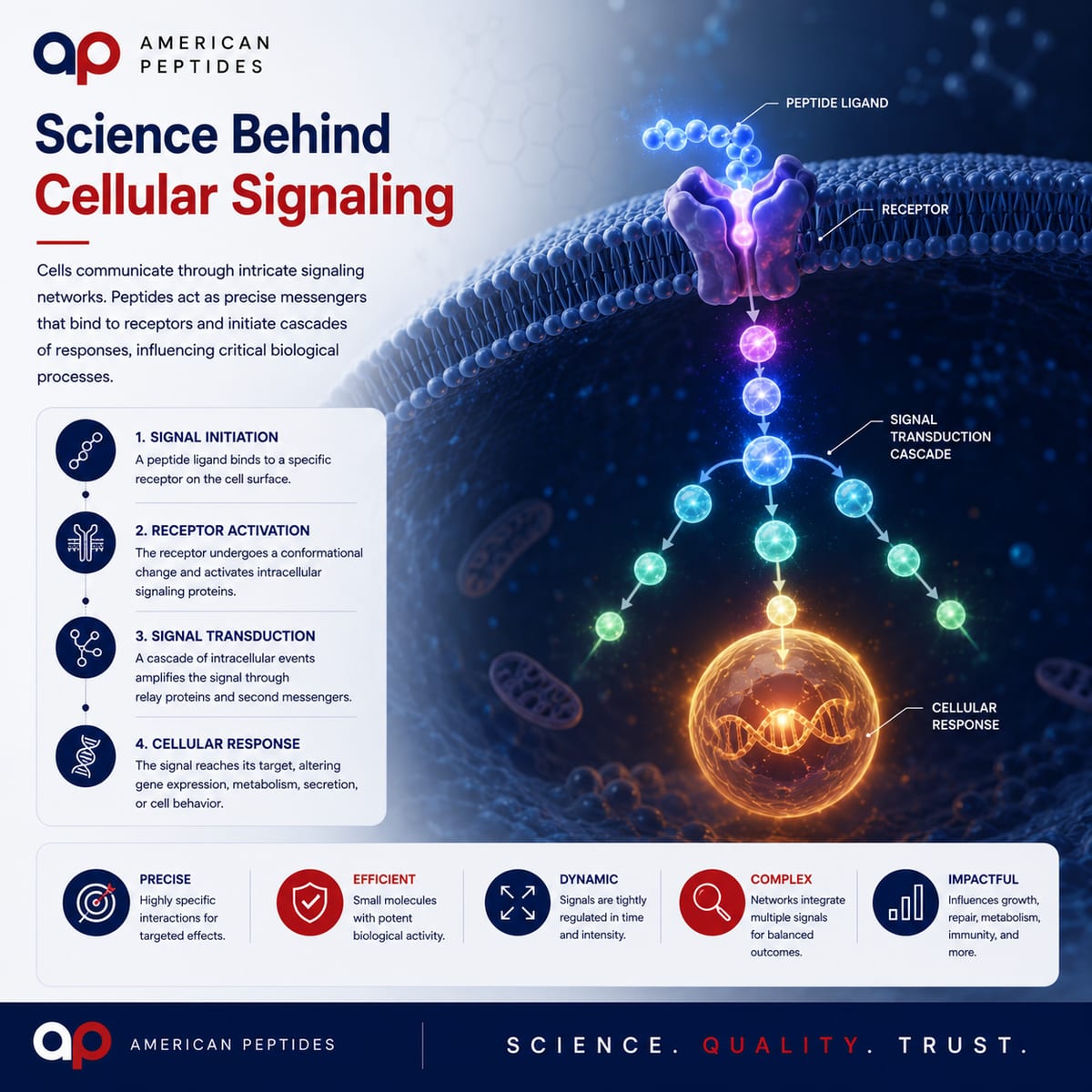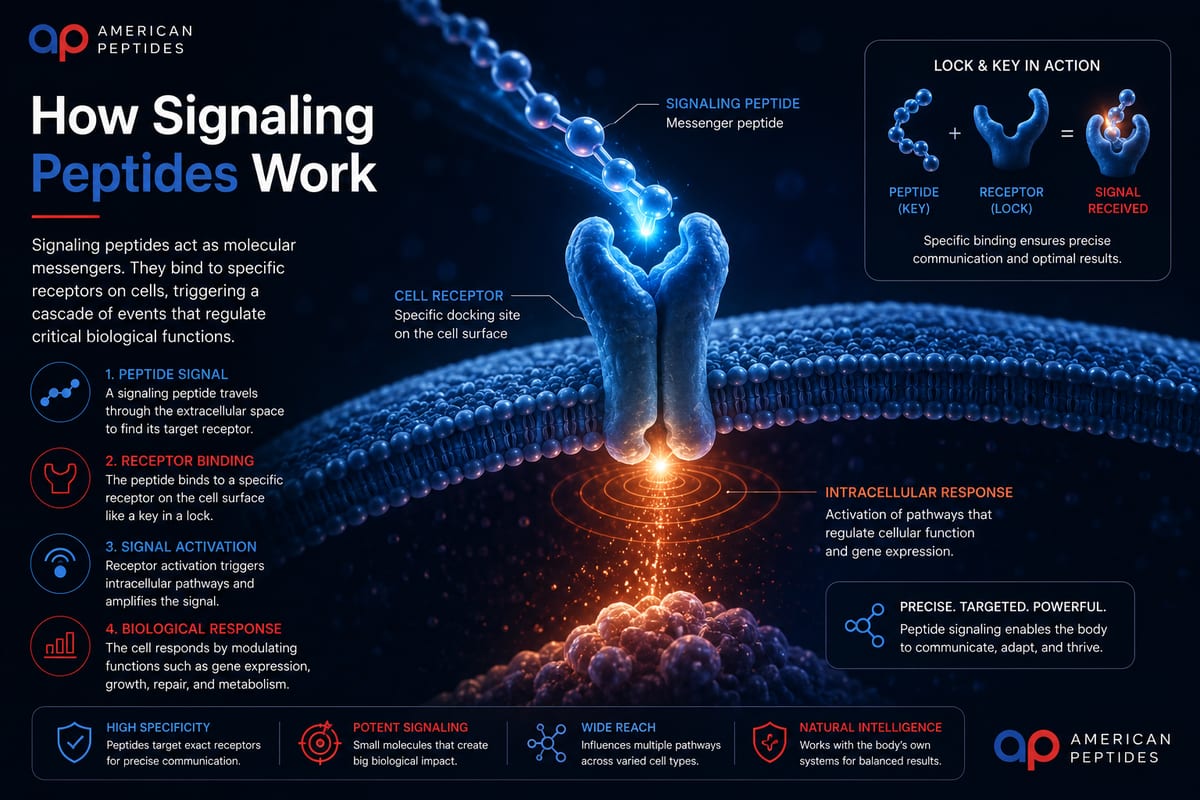

A receptor pathway is the chain of molecular events that begins when a ligand binds a cell receptor and ends in a change in cell behavior; understanding the major receptor classes is the foundation for reading the peptide-signaling literature. This primer maps the pathways researchers reference most. It is an educational science summary.
What a receptor pathway is
A receptor is a protein that detects a specific signal (a ligand) and converts it into an intracellular event — signal transduction. A signaling peptide is one such ligand; its amino-acid sequence determines which receptor it fits. The pathway is everything downstream of that binding event.
The major receptor classes
| Class | Mechanism | Typical second messenger | Studied example |
|---|---|---|---|
| GPCR (7-transmembrane) | Ligand binding activates a G-protein | cAMP, calcium, IP3 | GLP-1 receptor |
| Receptor tyrosine kinase | Dimerization → autophosphorylation | MAPK / PI3K cascades | IGF-1 receptor |
| Cytokine / JAK-STAT | Receptor-associated kinases | STAT transcription factors | Growth-signaling research |
| Nuclear / intracellular | Ligand enters cell, binds receptor directly | Direct gene transcription | Steroid-class study models |
GPCRs in depth
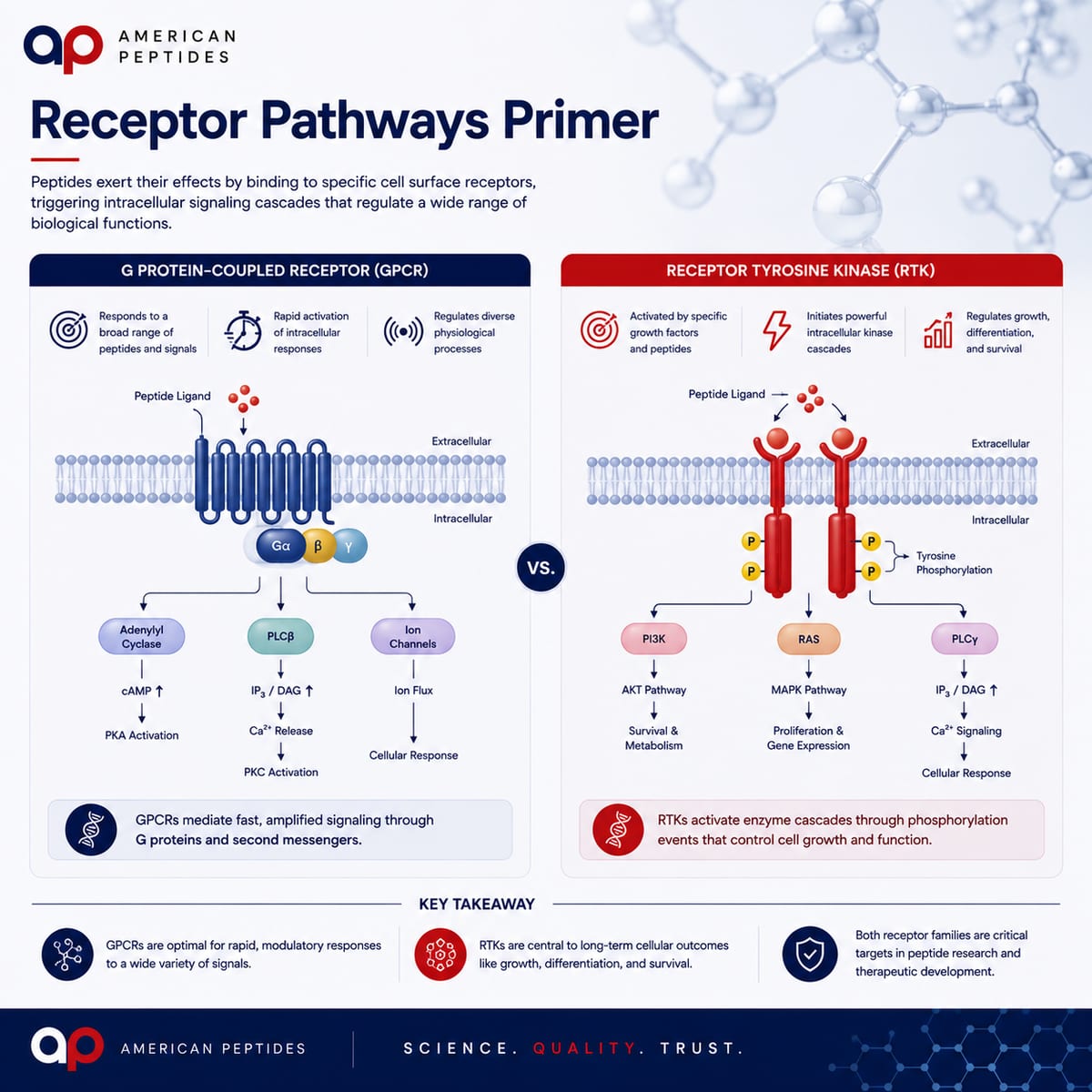
G-protein-coupled receptors are the largest receptor family and a dominant subject in peptide research. Ligand binding shifts the receptor’s conformation, the associated G-protein exchanges GDP for GTP, and its subunits modulate effectors like adenylyl cyclase (changing cAMP) or phospholipase C (releasing calcium). The result is rapid, amplifiable, and tunable — properties that make GPCRs ideal experimental readouts.
Receptor tyrosine kinases in depth
RTKs bind their ligand, pair up (dimerize), and phosphorylate each other’s intracellular tails. Those phosphorylated sites recruit adaptor proteins that launch the MAPK and PI3K/AKT cascades — pathways central to growth and metabolic signaling research, which is why sequences studied alongside the IGF-1 axis draw so much attention.
Second messengers and amplification
One bound receptor can generate thousands of second-messenger molecules — the amplification that lets a faint signal produce a robust cellular response. cAMP, calcium, and kinase cascades are the workhorses; each is measurable, which is exactly why researchers use defined peptides as precise pathway probes.
Desensitization and signal termination
Pathways must switch off as cleanly as they switch on. Receptors are phosphorylated, internalized, and recycled or degraded; second messengers are enzymatically cleared. Desensitization kinetics are themselves a research subject, because a pathway’s dynamics — not just whether it fires — shape the experimental readout.
Why specificity governs reproducibility
Which pathway a peptide engages depends on precise shape-and-charge complementarity. A truncated or impure sequence can bind the wrong receptor or none at all, confounding results. This is the practical reason a lot-specific Certificate of Analysis, verified purity, and mass-spec identity are inseparable from credible pathway work. Specific sequences such as BPC-157 and TB-500 are studied for distinct receptor interactions in model systems.
What pathway findings do and do not mean
A pathway result in cell culture or an animal model describes behavior in that system. It is not a statement about effects in people and is not use guidance. Keeping mechanism separate from outcome is the core of compliant interpretation — the same discipline behind cellular-signaling science and longevity research.
Agonists, antagonists, and partial responses
Not every ligand that binds a receptor activates it the same way. A full agonist drives the maximal conformational change and downstream response; a partial agonist produces a submaximal one; an antagonist binds but does not activate, and can block the agonist. Research peptides are studied across this spectrum precisely because comparing them dissects how a receptor works. Interpreting such experiments correctly depends on the test ligand being exactly the intended sequence, linking pathway pharmacology to the purity and COA discipline.
Pathway dynamics: timing carries information
A pathway is not just on or off — how it turns on matters. A transient spike and a sustained plateau of the same second messenger can drive different cellular outcomes, so researchers measure kinetics, not only endpoints. This is why defined, stable inputs are essential: a degraded or impure ligand distorts the time course and corrupts exactly the dynamic information the experiment is designed to read, a theme shared with cellular-signaling science.
Putting the primer to work
The practical payoff of a receptor-pathway map is that it lets you read a study critically. Knowing whether a sequence is reported as acting through a GPCR or a receptor tyrosine kinase, whether the readout is an endpoint or a time course, and whether the effect is full or partial tells you what the result can and cannot support. It also tells you where error hides: in a connected, amplifying, dynamically timed system, an unverified input distorts exactly the measurements the experiment exists to make. That is why this primer keeps returning to the same foundation — verified purity, mass-spec identity, and a lot-specific COA — and why pathway findings stay statements about model systems, never about people.
Frequently Asked Questions
What is a receptor pathway?
The full chain of molecular events from a ligand binding a receptor to a change in cell behavior — reception, transduction, amplification, and response within the studied system.
What are the main receptor classes?
G-protein-coupled receptors, receptor tyrosine kinases, cytokine/JAK-STAT receptors, and intracellular/nuclear receptors. GPCRs and RTKs are the most studied in peptide research.
How do GPCRs signal?
Ligand binding activates an associated G-protein, which modulates effectors that change second messengers like cAMP or calcium — a fast, amplifiable response.
What do receptor tyrosine kinases do?
They dimerize and autophosphorylate on ligand binding, recruiting adaptors that trigger MAPK and PI3K/AKT cascades involved in growth and metabolic signaling.
Why are second messengers important?
They amplify and propagate the signal — one receptor event can generate thousands of second-messenger molecules — and they are measurable, making them useful experimental readouts.
What is receptor desensitization?
The mechanisms that terminate signaling: receptor phosphorylation, internalization, recycling or degradation, and enzymatic clearance of second messengers. Its kinetics are a research subject in their own right.
Do receptor-pathway findings apply to humans?
No. Findings in cell or animal models describe those systems only. They are educational mechanism, not human outcomes or use guidance.
Related Optimization Protocols
Reviewed by the American Peptides Education Team. Educational content only — not medical advice.
For research use only. Sold exclusively for in-vitro laboratory research. Not a drug, supplement, food, or medical product. Not for human or animal consumption, diagnostic, or therapeutic use. Nothing here is dosing, administration, or medical guidance.
Related research