
An amino acid is a small molecule containing an amino group, a carboxyl group, and a variable side chain; amino acids are the building blocks that link together to form peptides and proteins. Twenty standard amino acids, in different orders, encode essentially all of biology’s molecular diversity. This is an educational science explainer.
The structure
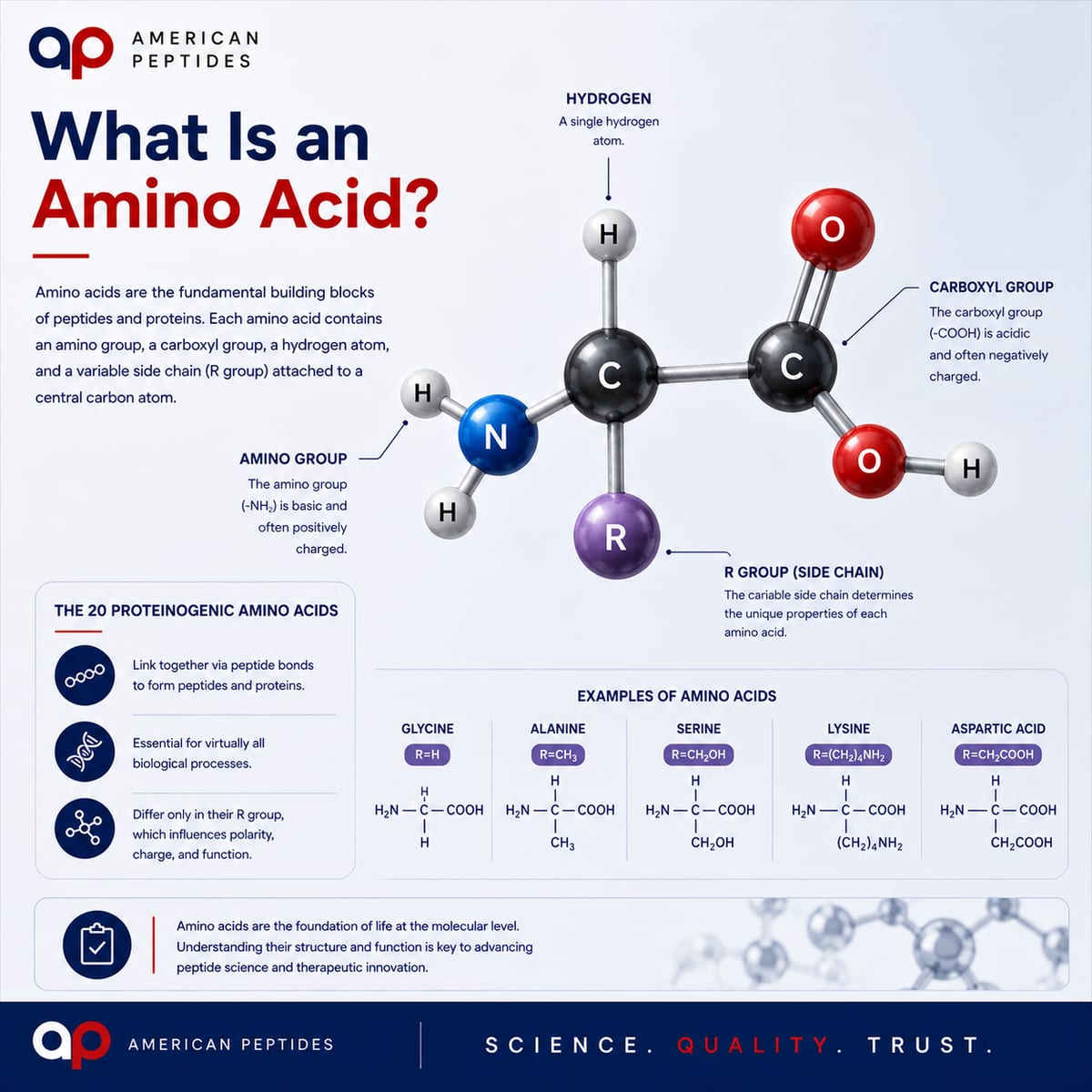
Every standard amino acid shares a common backbone: a central (alpha) carbon bonded to an amino group (−NH2), a carboxyl group (−COOH), a hydrogen, and a variable side chain (the “R group”). The side chain is what differs between the twenty and what gives each its chemistry — charge, polarity, hydrophobicity, size, and special features like sulfur (cysteine) or a ring (proline).
How side chains define behavior
| Side-chain class | Examples | Why it matters |
|---|---|---|
| Nonpolar / hydrophobic | Ala, Val, Leu, Ile | Drive folding, membrane interaction |
| Polar uncharged | Ser, Thr, Asn, Gln | Hydrogen bonding, solubility |
| Charged | Lys, Arg, Asp, Glu | Electrostatic interactions, binding |
| Special | Cys, Gly, Pro | Disulfides, flexibility, kinks |
Because the side chains determine chemistry, the order of amino acids dictates how a chain folds and what it can interact with — the basis of signaling specificity.
How amino acids become peptides
The carboxyl group of one amino acid reacts with the amino group of the next, releasing water and forming a covalent peptide bond. A chain has a free amino terminus (N-terminus) and a free carboxyl terminus (C-terminus), giving it direction (written N→C). Chains of these bonds are peptides; longer folded chains are proteins.
From sequence to three-dimensional shape
A peptide is not a floppy string. Backbone hydrogen bonding produces local structure (helices and sheets), and side-chain interactions fold the chain into a specific three-dimensional shape. Because that shape is what a receptor recognizes, the sequence indirectly encodes function — the conceptual bridge to cellular signaling. Change one residue and you can change the fold, and therefore the behavior.
Stereochemistry, briefly
Most biological amino acids are the L-enantiomer (a specific 3-D handedness at the alpha carbon). Stereochemistry can affect how a synthetic peptide behaves and is one of the subtle quality variables that high-resolution analysis — mass spectrometry alongside HPLC purity — helps characterize on a Certificate of Analysis.
Why this matters for research
Because sequence drives behavior, synthesis fidelity is everything: a single wrong or missing residue changes the molecule. That is why research peptides are made by controlled solid-phase synthesis (see the history of peptide research) and verified lot-by-lot. Understanding amino acids is the foundation for reading everything else in the peptide literature, including specific studied sequences.
Modifications beyond the standard twenty
Biology and synthetic chemistry both extend the basic alphabet. Side chains can be modified — phosphorylation, acetylation, and other changes alter charge or shape and therefore behavior — and synthetic peptides may incorporate non-standard or D-amino acids to probe structure-activity questions. These variations matter for research because they change the molecule’s identity, which is one reason high-resolution mass spectrometry is used to confirm exactly what a given lot contains rather than assuming the standard form.
Why a single residue can change everything
Because folding and receptor recognition are driven by side-chain chemistry, swapping one amino acid for another with different polarity or charge can shift a peptide’s fold and abolish or redirect its interaction — the molecular basis of the specificity described in signaling and the receptor-pathways primer. This sensitivity is exactly why synthesis fidelity and lot-by-lot verification are treated as foundational rather than optional in serious peptide research.
From alphabet to function: the central principle
The single idea to carry away is that sequence encodes behavior. Twenty side chains, arranged in order, determine how a chain folds; the fold determines what it can recognize; recognition determines what it does in a studied system. That chain of causation is why a one-residue change is not cosmetic and why synthesis fidelity is treated as foundational. It is also why the rest of the peptide library connects back here: what a peptide is, how signaling peptides work, and why a lot-specific Certificate of Analysis with verified purity matters all reduce to this principle. Get amino acids right conceptually and the entire field becomes a set of variations on one theme rather than a list of disconnected facts.
Frequently Asked Questions
What is an amino acid made of?
An amino group, a carboxyl group, a central carbon with a hydrogen, and a variable side chain (R group) that determines its chemical properties.
How many standard amino acids are there?
Twenty standard (proteinogenic) amino acids combine in different sequences to build the vast diversity of peptides and proteins.
What does the side chain do?
The side chain sets each amino acid’s charge, polarity, size, and special chemistry, which collectively determine how a peptide folds and what it binds.
How do amino acids form peptides?
Through peptide bonds: the carboxyl group of one reacts with the amino group of another, releasing water and linking them into a directional chain.
How does sequence become a 3-D shape?
Backbone hydrogen bonding forms local structure and side-chain interactions fold the chain into a specific shape, which is what receptors recognize.
Why does amino-acid sequence matter?
The order of side chains dictates folding and function. A single substitution can change behavior, which is why synthesis fidelity and lot verification are central to reproducible research.
Are amino acids the same as supplements?
This article describes amino-acid chemistry as the basis of peptides for research education. It is not about dietary products and makes no health or use claims.
Related Optimization Protocols
Reviewed by the American Peptides Education Team. Educational content only — not medical advice.
For research and educational use only. Not a drug, supplement, food, or medical product. Nothing here is medical advice, a treatment claim, or a health outcome claim.