
Solid-Phase Peptide Synthesis (SPPS): A Researcher's Visual Guide
What is solid-phase peptide synthesis? Solid-phase peptide synthesis (SPPS) is a chemical method for building peptides one amino acid at a time on an insoluble polymer support. The growing peptide chain stays anchored to the resin while reagents are introduced and washed away through repeated cycles of deprotection and coupling. After the full sequence is assembled, the finished peptide is cleaved from the resin and the side-chain protecting groups are removed. SPPS made modern peptide research possible by automating what was previously a months-long solution-phase ordeal.
What is SPPS?
Solid-phase peptide synthesis is the dominant method for producing peptides in modern research and pharmaceutical settings. The defining idea is structural: instead of working in solution where each step requires isolating an intermediate from a complex reaction mixture, SPPS anchors the growing peptide to a solid resin bead. Reagents flow in and out around the bead. Excess reagents and byproducts wash away. The peptide stays put.
This single architectural shift turned peptide synthesis from a heroic multi-month effort into a routine automated process. A 30-residue peptide that might have taken a Ph.D. student a year to synthesize in solution can be assembled by an automated SPPS instrument overnight. Every research peptide on the market today exists because of SPPS.
Merrifield's invention and the Nobel Prize
The breakthrough came in 1963, when Robert Bruce Merrifield at Rockefeller University published a paper titled "Solid Phase Peptide Synthesis. I. The Synthesis of a Tetrapeptide." The idea was deceptively simple: attach the first amino acid to an insoluble polymer bead, then add the next amino acid in solution. The coupling reaction joins the new amino acid to the chain on the bead. Wash away the excess. Add the next amino acid. Repeat.
The chemistry community was skeptical. The conventional wisdom held that synthesis required solution-phase chemistry where every intermediate could be purified and characterized. Merrifield's approach accepted some inevitable side products at each step in exchange for radically faster cycling.
By 1969, Merrifield's group had synthesized ribonuclease A, a 124-residue enzyme — at the time the largest peptide ever synthesized chemically. The work earned him the 1984 Nobel Prize in Chemistry. SPPS, with refinements, has been the dominant peptide synthesis method ever since.
Why solid-phase changed peptide chemistry forever
The advantages SPPS unlocked over solution-phase synthesis:
- Automation. Because every step is the same physical operation (add reagent, mix, wash, repeat), the process can be controlled by machine. Modern peptide synthesizers run cycles 24/7 with minimal supervision.
- Excess reagents. Solution-phase chemistry minimizes excess to simplify purification. SPPS uses large excesses (3–10×) of every reagent because washing them away costs nothing. Higher excess = higher coupling efficiency per step.
- No intermediate isolation. The growing peptide stays on the resin throughout. Researchers see no intermediates, no recrystallizations, no chromatographic purifications between coupling steps.
- Scale flexibility. The same chemistry runs at micromole research scale and kilogram pharmaceutical scale by changing resin loading and reaction volumes.
The SPPS cycle, step by step
A single SPPS cycle adds one amino acid to the chain. The cycle has four core steps:
   ┌─────────────────────────────────────────────────┐
   │  1. DEPROTECTION                                │
   │     Remove the temporary N-terminal protecting  │
   │     group from the chain, exposing the amino    │
   │     group that will accept the next residue.    │
   │                                                 │
   │  2. WASH                                        │
   │     Flush away deprotection reagent + byproduct.│
   │                                                 │
   │  3. COUPLING                                    │
   │     Add the next (still-protected) amino acid   │
   │     plus an activating reagent. The coupling    │
   │     reagent activates the amino acid's carboxyl │
   │     for nucleophilic attack by the exposed      │
   │     amino group on the chain.                   │
   │                                                 │
   │  4. WASH                                        │
   │     Flush away excess amino acid + reagents.    │
   │     The new amino acid is now attached to the   │
   │     growing chain, with its own N-terminal      │
   │     protecting group still in place.            │
   │                                                 │
   │  REPEAT until full sequence is assembled.       │
   └─────────────────────────────────────────────────┘
A typical cycle takes 20–60 minutes. A 20-residue peptide therefore takes ~10–20 hours of automated cycling — overnight to a long day.
Fmoc vs. Boc — the two main chemistries
The "protecting group" on each incoming amino acid's N-terminus determines what reagent removes it during the deprotection step. Two chemistries dominate:
Fmoc (9-fluorenylmethoxycarbonyl) — removed by mild base (typically 20% piperidine in DMF). Fmoc is base-labile and acid-stable.
Boc (tert-butyloxycarbonyl) — removed by mild acid (typically 25–50% TFA in DCM). Boc is acid-labile and base-stable.
The two chemistries impose different downstream consequences:
| Property | Fmoc | Boc |
|---|---|---|
| Deprotection reagent | Mild base (piperidine) | Acid (TFA) |
| Side-chain protecting groups | Acid-labile (tBu, Trt, Pbf) | Benzyl-based |
| Final cleavage | TFA cocktail | HF (hydrogen fluoride) |
| Equipment safety | Standard glassware | Specialized HF apparatus |
| Routine research use | Yes (dominant) | Less common |
| Difficult sequences | Excellent | Excellent |
Coupling reagents and why they matter
The coupling step joins the incoming amino acid's carboxyl group to the growing chain's amino group. The reaction does not happen efficiently without an activating reagent that converts the amino acid's relatively unreactive carboxyl into a much more reactive intermediate (typically an active ester or a carbodiimide-derived intermediate).
The major coupling reagent families:
- Carbodiimides (DCC, DIC) — the original SPPS coupling reagents. Form O-acylisourea intermediates that react with the amine.
- Uronium/aminium salts (HBTU, TBTU, HATU) — modern, faster, higher-yielding. HATU is the gold standard for difficult couplings.
- Phosphonium salts (PyBOP, PyAOP) — alternative to uronium reagents with similar performance.
The resin — where synthesis happens
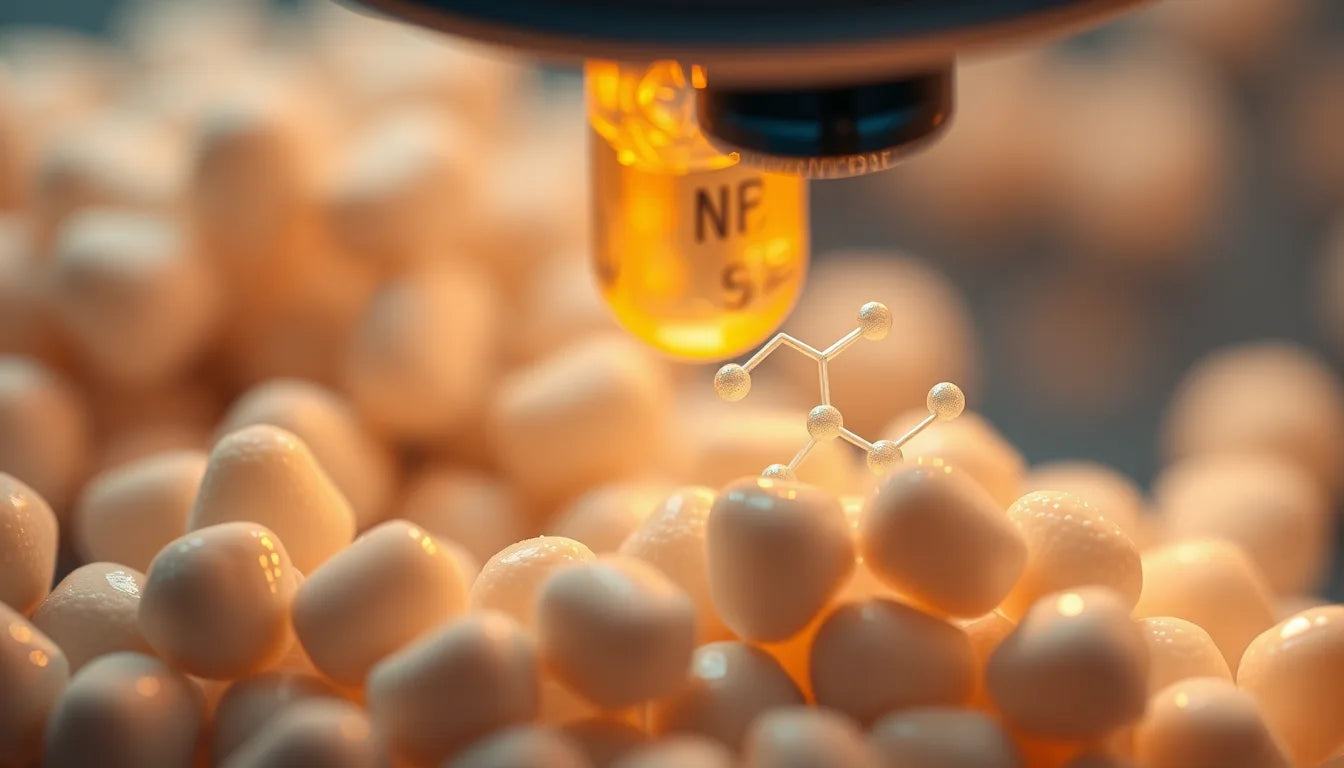
The resin is the insoluble polymer support. Most SPPS resins are based on polystyrene cross-linked with 1–2% divinylbenzene, producing porous beads typically 100–200 µm in diameter. The beads swell in solvent, exposing internal reactive sites where the peptide chain assembles.
Several resin chemistries serve different cleavage outcomes:
| Resin | Cleavage | Yields |
|---|---|---|
| Wang resin | TFA | C-terminal carboxylic acid |
| Rink amide resin | TFA | C-terminal amide |
| Trityl resin | Mild acid | Protected fragments for solution coupling |
| PEG-based resins (TentaGel, ChemMatrix) | Various | Better solvent compatibility for difficult sequences |
Side-chain protection
Each amino acid that has a reactive side chain (most of them — only Gly and Ala are fully unreactive) needs that side chain protected during synthesis to prevent side reactions. The protecting groups are chosen to be orthogonal to the N-terminal protecting group: Fmoc chemistry uses acid-labile side-chain protections (because Fmoc is base-labile, the side chains must be stable to base), and Boc chemistry uses base-stable side-chain protections (because Boc is acid-labile).
Common Fmoc-compatible side-chain protections:
- tBu (tert-butyl) — for Asp, Glu, Ser, Thr, Tyr
- Trt (trityl) — for Cys, His, Asn, Gln
- Pbf — for Arg (the bulky Pbf prevents arginine side-chain side reactions)
- Boc — for Lys (acid-labile; orthogonal to Fmoc base removal)
Cleavage and global deprotection
Once the full sequence is assembled, the peptide must be detached from the resin and all side-chain protections must be removed. For Fmoc chemistry, this happens in a single step using a TFA cleavage cocktail — typically 95% TFA with small percentages of "scavengers" (water, triisopropylsilane, ethanedithiol) that trap reactive intermediates released during deprotection.
The cleavage is performed at room temperature for 1–3 hours. The peptide is then precipitated by addition of cold diethyl ether, centrifuged, washed to remove cleavage byproducts, and dissolved in water for purification.
What emerges from cleavage is the crude peptide — a mixture of the target peptide plus accumulated impurities from incomplete couplings, side reactions, and partial deprotections. Typical crude purity for a well-executed Fmoc synthesis is 60–90% before chromatographic purification. Reversed-phase HPLC then resolves the target peptide to research-grade purity (≥95% or higher).
Common failure modes
Even with optimized chemistry, SPPS can fail on specific sequences:
Difficult sequences. Certain sequence motifs — runs of valine or isoleucine, repeats of beta-branched residues, hydrophobic stretches — fold the growing peptide into β-sheet structures that bury the reactive amino terminus inside the chain. The result is dramatically reduced coupling efficiency. Mitigations include pseudo-proline dipeptide insertions, microwave heating, or specialized solvents.
Aspartimide formation. Asp residues followed by certain neighbors can undergo intramolecular cyclization during repeated piperidine treatments, producing a five-membered aspartimide that opens to a mixture of Asp and isoAsp. The result is a contaminating impurity that's hard to remove. Specialized base mixtures (DBU/HOBt) reduce the side reaction.
Diketopiperazine formation. Some dipeptide sequences cyclize to form diketopiperazines after only two coupling steps, especially when the chain is attached to certain resins. The result is loss of the chain into solution.
Truncation impurities. When a coupling step fails completely, the chain stops growing — but the rest of the synthesis continues. The result is a truncation impurity that lacks the missed residues. Capping unreacted amines with acetic anhydride after each coupling ensures that failed couplings do not continue elongating in the next cycle.
Frequently asked questions
What is the difference between SPPS and solution-phase synthesis?
SPPS anchors the growing peptide to an insoluble resin and uses repeated wash steps to remove excess reagents. Solution-phase synthesis builds the peptide in liquid solution with intermediate purifications between each coupling. SPPS is faster, cheaper, and dominant for routine peptide work; solution-phase synthesis is used for certain specialized applications where SPPS struggles.
Why is Fmoc chemistry more common than Boc?
Fmoc deprotection uses mild base (piperidine), and the final cleavage uses TFA — both safe and routine in any standard lab. Boc deprotection uses TFA at each step, and final cleavage requires HF (hydrogen fluoride), a highly hazardous reagent that demands specialized equipment. Fmoc is the default for modern research peptide synthesis.
How long does it take to synthesize a peptide?
A 20-residue peptide takes ~10–20 hours of automated cycling on a modern SPPS instrument. Add 1–2 hours for cleavage and ~2–4 hours for HPLC purification. Total: roughly one day for an ideal synthesis; difficult sequences can extend to several days.
Why do longer peptides cost more?
Each additional residue requires another full coupling cycle (reagents, time, instrument). More importantly, longer peptides accumulate more failed-coupling impurities. A 50-residue peptide synthesized at 99% per-step efficiency retains only ~60% of the target chain — meaning more raw material and more chromatographic separation per milligram of finished product.
What is coupling efficiency?
Coupling efficiency is the percentage of growing chains that successfully receive the next amino acid in a single coupling step. Modern reagents (HATU, HBTU) achieve 99–99.5% per step for routine residues. Difficult sequences or β-branched residues can drop this to 90% or lower without optimization.
What is the maximum peptide length achievable by SPPS?
Routine SPPS handles up to ~50 residues reliably. With careful optimization (microwave heating, pseudoproline dipeptides, native chemical ligation of segments), peptides exceeding 100 residues are achievable. Full proteins (>200 residues) typically require recombinant expression rather than chemical synthesis.
Can SPPS produce non-natural amino acids?
Yes. SPPS handles any amino acid that can be Fmoc-protected and activated for coupling, including D-amino acids, N-methyl amino acids, cyclic amino acids, β-amino acids, and a wide range of unnatural residues. This is one of the major advantages over recombinant protein expression, which is limited to the 20 standard amino acids without specialized incorporation systems.
Key takeaways
- SPPS builds peptides one amino acid at a time on an insoluble polymer support, allowing reagents to wash in and out around the anchored chain.
- Merrifield invented the method in 1963 and won the 1984 Nobel Prize; SPPS has been the dominant peptide synthesis method ever since.
- The SPPS cycle is deprotection → wash → coupling → wash, repeated for each residue in the target sequence.
- Fmoc chemistry (base deprotection, TFA cleavage) is the modern standard; Boc chemistry (acid deprotection, HF cleavage) is reserved for specialized applications.
- Coupling reagents (HBTU, HATU) determine per-step efficiency, which compounds across long sequences.
- Side-chain protecting groups must be orthogonal to the N-terminal protecting chemistry.
- Common failure modes (difficult sequences, aspartimide formation, truncations) are managed through optimization and post-synthesis HPLC purification.
- SPPS made modern peptide research possible by turning weeks of solution-phase work into hours of automated cycling.
Related reading
- What is a peptide? A researcher's primer on structure and signaling
- What is HPLC and why it matters for peptide purity verification
- Glossary: 50 peptide and analytical chemistry terms
Related research
- What Is HPLC? A Researcher's Guide to Peptide Purity Verification
- What Is a Peptide? A Researcher's Primer on Structure and Signaling
- Peptide Lyophilization: The Science of Freeze-Drying Research Compounds
- Glossary: 50 Peptide & Analytical Chemistry Terms
- Reconstitution Chemistry for Research Peptides: Solvents, Solubility, and Accuracy