
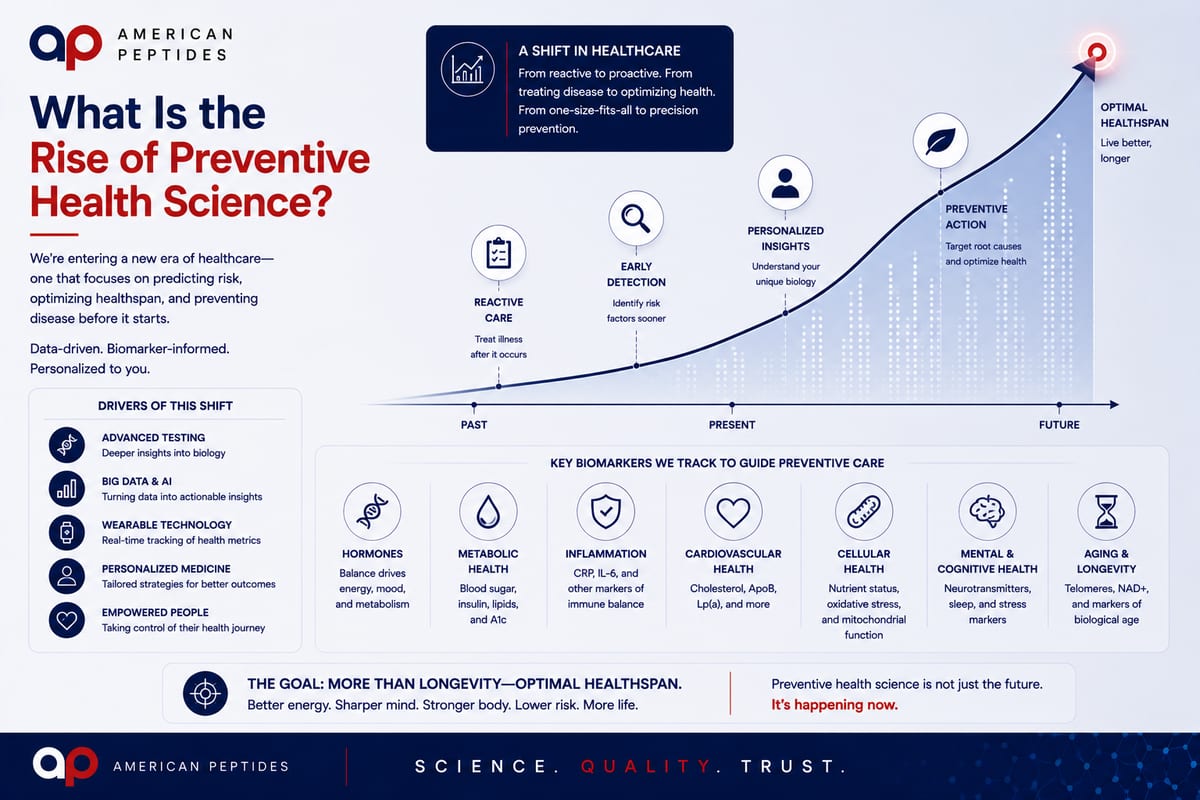
Preventive health science is the broad shift toward measuring and tracking biological markers over time to understand trends early, rather than only reacting after a problem becomes obvious. It is fundamentally a measurement and data-interpretation philosophy. This is an educational overview — not medical advice and not a product claim.
Reactive vs proactive framing
The traditional model acts after symptoms appear. The preventive framing emphasizes longitudinal measurement — baselines and trends — so changes can be understood in context earlier. The engine of this shift is the same trend principle behind ongoing lab monitoring.
Why measurement is the foundation
Preventive thinking is only as good as its data. It depends on defined markers, consistent methods, and repeated sampling — the same prerequisites as any measured variable. Without them, “prevention” is aspiration, not science.
| Model | Trigger | Information used |
|---|---|---|
| Reactive | Obvious problem | Late, single snapshots |
| Preventive | Trend over time | Baselines and trajectories |
The role of biomarkers
Preventive science leans heavily on biomarkers as early, indirect signals — which is why understanding their limits, as in inflammation biomarkers and HbA1c, is essential. A proxy misread is worse than no proxy.
The interpretation discipline
This is the crucial caveat. A preventive framing organizes data; it does not, by itself, establish that any specific action or product changes outcomes. Confusing “tracking a marker” with “influencing the outcome” is the central error the discipline must avoid — the same separation of measurement from claim seen across longevity research.
Where it connects
Preventive health science is the umbrella over recovery measurement and the broader interest in longevity medicine — conceptual relationships, not claims that any product prevents disease or extends life.
The boundary
Nothing here is medical advice or a claim that any compound, including any product offered here, prevents disease. The article describes a measurement philosophy; clinical decisions belong to licensed professionals.
Why the concept is worth knowing
As education, recognizing preventive health science as a data-and-trend philosophy — not a basket of guaranteed benefits — makes the surrounding marketing far easier to read critically.
Why the shift is happening now
Preventive health science did not emerge from a new theory so much as from the maturing of measurement. When markers became cheaper to track, methods more consistent, and longitudinal data easier to organize, the trend principle — that a direction over time carries more signal than any single point — could finally be applied broadly rather than only in research settings. That is the real engine of the movement: not a promise of new outcomes, but a change in how much comparable data can be collected and interpreted over time. It is the same logic that elevated ongoing lab monitoring and turned recovery into a measured variable. Understanding this origin matters because it sets the correct expectation: preventive science is a data-and-interpretation discipline, and its value rises or falls with measurement quality and contextual judgment, not with any single intervention.
The error the discipline must avoid
The central failure mode of preventive framing is conflating tracking a marker with influencing the outcome it proxies. A trend can be measured beautifully and still say nothing about whether a given action changes the trajectory — that requires evidence the framing itself does not supply. This is exactly the mechanism-versus-outcome separation that disciplined longevity research and biomarker science insist on. Honest preventive science is therefore explicit about what its data can and cannot establish, and it leaves clinical decisions to licensed professionals. Held to that standard, the movement is a powerful organizing lens; stripped of it, it becomes a marketing vocabulary — which is precisely why the educational distinction is worth making clearly.
The takeaway worth keeping
Preventive health science is a data-and-trend philosophy whose value scales with measurement quality and contextual judgment — not a basket of guaranteed benefits. Its defining discipline is refusing to confuse tracking a marker with influencing the outcome it proxies, the same separation enforced in biomarker science and longevity research. Read that way it is a powerful organizing lens; nothing here is medical advice or a claim that any compound, including any product offered here, prevents disease — clinical decisions belong to licensed professionals.
Why this matters for reading the field
The preventive-health vocabulary is now everywhere in marketing, which makes the tracking-versus-influencing distinction a practical skill rather than a philosophical nicety. A source that measures trends rigorously and is explicit about what its data cannot establish is doing science; one that implies the measuring itself confers benefit is selling. That filter — consistent with monitoring and biomarker literacy — is the takeaway, not any health recommendation.
Frequently Asked Questions
What is preventive health science?
A shift toward measuring and tracking biological markers over time to understand trends early, rather than only reacting after problems become obvious.
Why is measurement its foundation?
Because preventive thinking depends on defined markers, consistent methods, and repeated sampling; without them prevention is aspiration, not science.
How is it different from reactive care?
Reactive care acts on obvious problems with late snapshots; preventive framing uses baselines and trajectories to understand change earlier.
What role do biomarkers play?
They serve as early, indirect signals, which is why understanding their limits and proxy nature is essential to using them well.
Does tracking a marker change the outcome?
Not by itself. Confusing measurement with influence is the central error; a framing organizes data but does not establish that an action changes outcomes.
Does any product prevent disease?
This article makes no such claim. It describes a measurement philosophy; clinical decisions belong to licensed professionals.
Is this medical advice?
No. It is an educational overview of a conceptual movement, not a diagnosis or treatment recommendation.
Related Optimization Protocols
Reviewed by the American Peptides Education Team. Educational content only — not medical advice.
For educational purposes only. Not medical advice, a diagnosis, or a treatment recommendation. No product is implied to prevent any condition or affect any outcome.