
The science of recovery treats recovery not as a subjective feeling but as a measurable variable — a defined set of physiological readouts tracked over time to quantify how a system returns toward baseline after stress. This is an educational overview of that framework; it is not medical or performance advice and makes no product claims.
From feeling to measurement
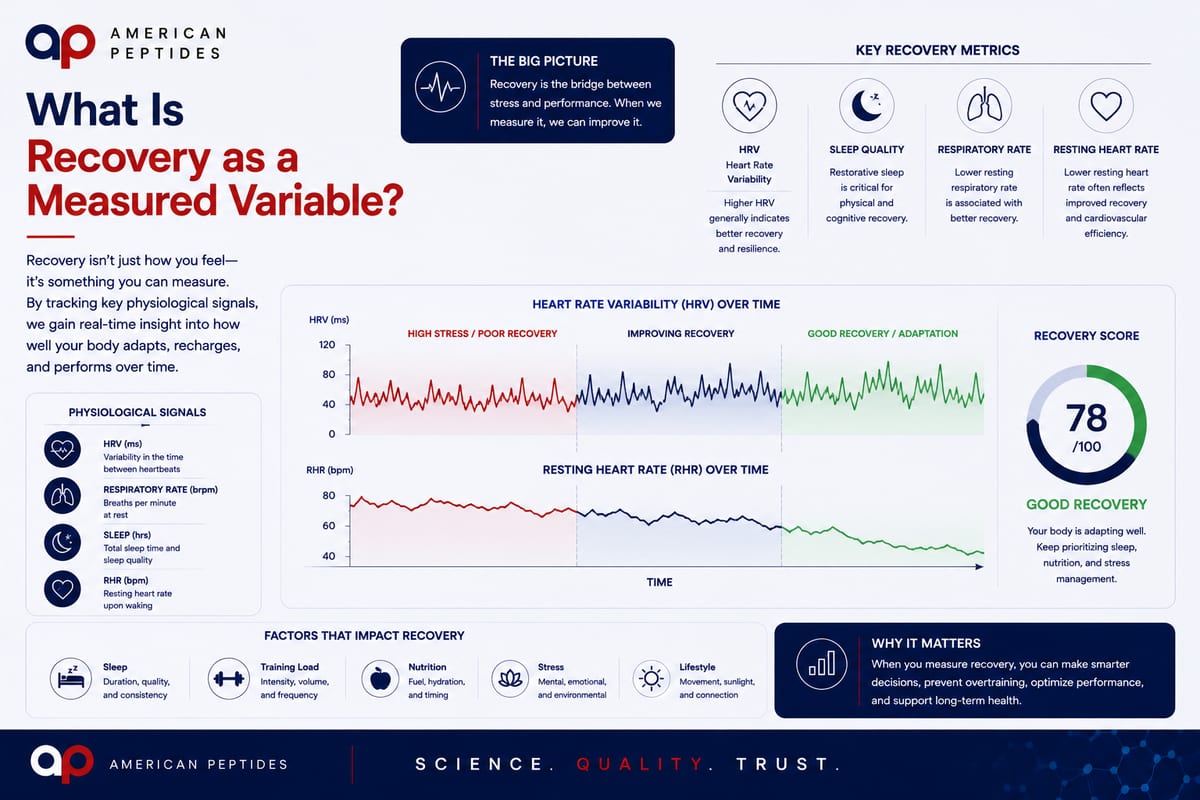
Historically “recovery” was described qualitatively. The scientific shift is to define it operationally — choose readouts, measure them repeatedly, and study the return-toward-baseline trajectory. This is the same move from anecdote to defined readout that underpins rigorous signaling research.
What makes something a measured variable
A measured variable needs a definition, a method, a baseline, and repeated sampling. Recovery qualifies once those are fixed: without a baseline and consistent method there is no trajectory to study, only impressions — the same logic as ongoing lab monitoring.
| Element | Why it is required |
|---|---|
| Definition | States what is being measured |
| Method | Makes measurements comparable |
| Baseline | Reference for “returned” |
| Repetition | Reveals the trajectory |
Why the trajectory matters
Recovery is about a curve, not a point: how far a readout deviates after stress and how it returns. A single post-stress measurement is uninterpretable without the baseline and the path — which is why recovery science is inherently about trends, echoing inflammation-biomarker interpretation.
How research treats it
In research, recovery readouts are endpoints in model systems or controlled studies. A measured change describes that system; it is not a claim that any intervention improves recovery in people. The interpretation discipline matches sleep and cellular-repair research.
Where it connects
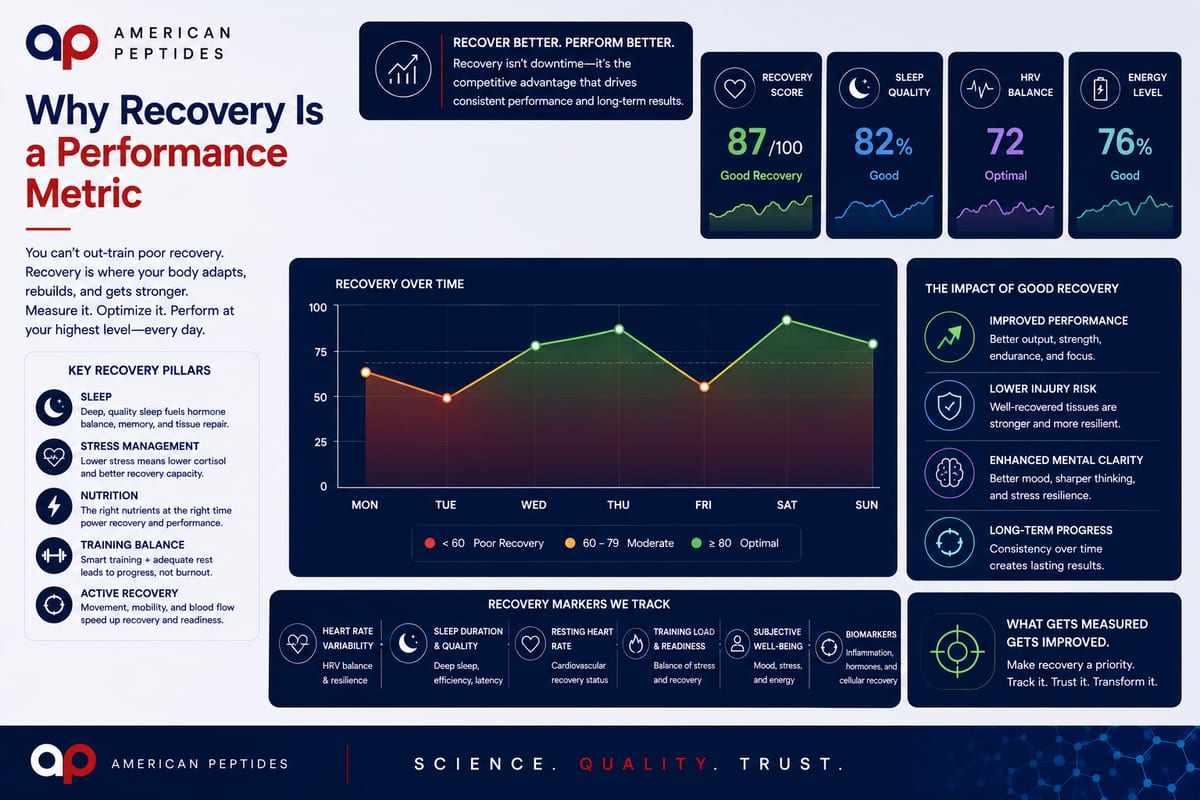
Recovery-as-measurement underlies why it is increasingly tracked as a performance signal, the subject of recovery as a performance metric, and ties into preventive health science — conceptually only.
The interpretation boundary
Defining recovery as a variable is not a claim that any compound, including any product offered here, affects it. Mechanistic and model-system descriptions are educational; human effects are a separate, rigorous question.
Why the concept is worth knowing
As education, treating recovery as a defined, tracked variable cuts through marketing that sells “recovery” as a vague benefit. Measurement literacy is the goal here.
The anatomy of a recovery measurement
To study recovery rigorously you need four fixed elements: a precise definition of the readout, a method that makes repeated measurements comparable, an established baseline that defines what “recovered” means for that system, and a sampling schedule dense enough to capture the return path. Drop any one and the result is impressions, not data — the same prerequisites that make lab monitoring meaningful. The deep point is that recovery is inherently a trajectory: how far a readout deviates after a stressor and how it returns. A post-stress value with no baseline and no path is structurally uninterpretable, which is why recovery science is, at its core, the study of curves rather than points.
From measured variable to honest claims
Once recovery is a defined variable, the temptation is to attach interventions to it — “X speeds recovery.” Disciplined science resists that leap. In research, recovery readouts are endpoints in controlled or model systems; an observed change describes that system, not a human performance benefit, exactly as in sleep and cellular-repair research. The measurement framework is what makes rigorous questions possible; it does not, by itself, answer whether any compound, including any product offered here, affects recovery in people. Keeping “we can measure it” separate from “this changes it” is the entire integrity of the field and the reason the concept is worth teaching as measurement literacy.
The takeaway in one line
Recovery science is the study of a return-toward-baseline curve, made rigorous by a definition, a consistent method, a baseline, and repeated sampling — the same scaffolding behind every trustworthy monitored variable. The framework makes precise questions possible; it does not answer whether any intervention changes recovery in people, which remains a separate evidence-bound question. Treated as measurement literacy rather than a benefit, it connects cleanly to recovery as a performance metric without drifting into claims.
Why this matters for reading the field
Holding recovery as a measured curve, not a feeling, changes how you read every claim about it: you immediately ask for the definition, the method, the baseline, and the trajectory, and you notice when those are missing. That habit — shared with biomarker interpretation and recovery as a metric — is durable measurement literacy. It does not endorse any intervention; it equips a reader to tell rigorous recovery science from marketing that borrows its vocabulary.
Frequently Asked Questions
What does "recovery as a measured variable" mean?
Treating recovery not as a feeling but as defined physiological readouts tracked over time to quantify return toward baseline after stress.
What is required to measure it?
A definition, a consistent method, a baseline, and repeated sampling — without these there is no trajectory, only impressions.
Why is the trajectory important?
Recovery is a curve, not a point: deviation after stress and the return path. A single measurement is uninterpretable without baseline and trajectory.
How does research treat recovery?
As endpoints in model systems or controlled studies; a measured change describes that system, not a human improvement claim.
Does any product improve recovery?
This article makes no such claim. It explains a measurement concept; human effects are a separate question outside its scope.
How does this relate to lab monitoring?
Both rely on baseline plus repeated, comparable measurements to reveal a trend rather than over-reading a single point.
Is this medical or training advice?
No. It is an educational overview of a measurement concept, not advice or a treatment claim.
Related Optimization Protocols
Reviewed by the American Peptides Education Team. Educational content only — not medical advice.
For research and educational use only. Not a drug, supplement, food, or medical product. Nothing here is medical, training, or performance advice, or a health outcome claim.
Related reading: For the biology behind why rest drives recovery — and how this research fits into it — see The Biology of Sleep and Recovery: How Rest Repairs the Body.