
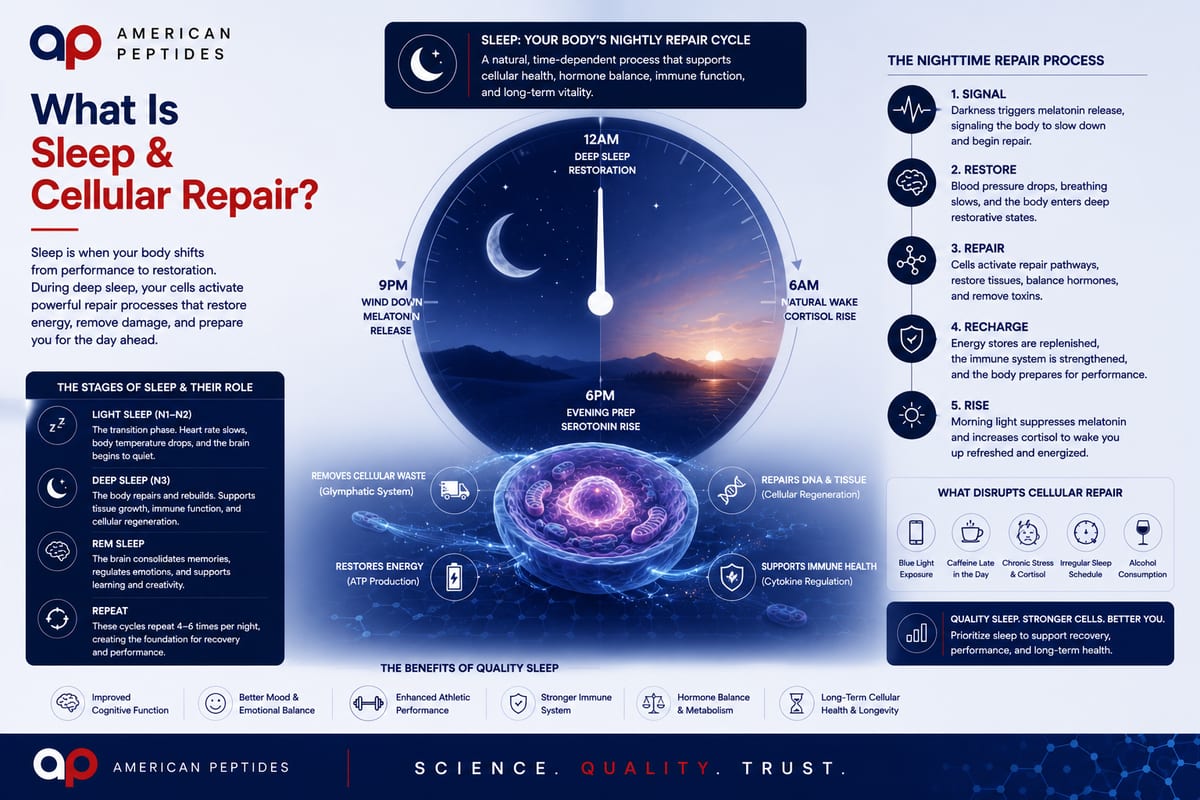
Research studies sleep as a recurring biological state during which many cellular maintenance and repair-related signaling processes are observed to be active, making it a major subject in cell biology and recovery science. This is an educational overview of the research framework — not health advice, a treatment claim, or sleep guidance.
Sleep as a studied biological state
Sleep is not passive downtime in biological terms; it is a structured state in which numerous regulated processes are observed. Researchers study it because many maintenance-associated signaling pathways — the kind discussed in cellular signaling — show characteristic activity patterns across sleep and wake.
What "cellular repair" means here
“Repair” in this context is shorthand for maintenance-type cellular activity — turnover, clearance, and signaling associated with keeping cells functioning. It is a research framing, not a single measurable event, and it overlaps conceptually with recovery as a measured variable.
| Concept | Research meaning | |
|---|---|---|
| Sleep | A structured biological state, studied as a variable | |
| Cellular repair | Maintenance-type activity and signaling |
Why the association is studied
The research interest is in associations: which processes track with sleep and wake, measured in defined systems. Association is not causation, and a pattern observed in a model is not a prescription. This is the same interpretation discipline applied throughout longevity research.
The translation gap
This is the essential caveat. Observing that repair-associated signaling tracks with sleep in a study does not establish what any intervention does to sleep or repair in a person. The gap between a model-system association and a human outcome is large and is exactly where careless claims fail. Disciplined writing keeps mechanism and human outcome separate.
Where it connects
Because maintenance signaling, inflammation, and recovery are intertwined, this topic links to inflammation biomarkers and recovery as a performance metric — conceptually, not as claims about any product or person.
The interpretation boundary
Nothing here is sleep advice or a statement that any compound, including any product offered here, affects sleep or cellular repair. Research describes observed associations in studied systems; human effects are a separate, rigorous question outside this explainer.
Why the framework is worth knowing
As education, framing sleep as a studied biological state — with an explicit association-not-causation caveat — makes the large, often over-hyped literature on sleep and recovery far easier to read critically.
Association is not instruction
The most important sentence in this whole topic is that an observed association is not a causal instruction. Research reports that many maintenance-associated signaling processes show characteristic patterns across sleep and wake in studied systems. That is a description of when things are observed, not a claim about what changing sleep does, and certainly not a claim about what any product does to sleep or repair. The gap between a model-system association and a human outcome is large — the same gap emphasized in longevity research and recovery science. Disciplined reading holds that line precisely because the topic is so easy to over-claim.
Why the framing still has educational value
Even with the strict caveats, framing sleep as a structured biological state — rather than passive downtime — is genuinely clarifying. It explains why the area is studied so heavily and connects cleanly to inflammation-biomarker interpretation and cellular-signaling logic. The point of the explainer is not to suggest any action; it is to give a reader the conceptual scaffolding to read the large, frequently hyped sleep-and-recovery literature critically, asking what was measured, in what system, and how far that is from a human claim. That scaffolding — not advice — is the deliverable.
The one principle to keep
Hold a single rule and the rest follows: research describes associations between sleep and maintenance-related signaling in studied systems, and association is not a causal instruction or a product claim. That keeps the topic anchored to signaling science and recovery measurement as conceptual scaffolding. Nothing here is sleep advice or a statement that any compound, including any product offered here, affects sleep or cellular repair; human effects are a separate, rigorous question outside this educational explainer.
Why this matters for reading the field
Sleep-and-recovery content is among the most over-claimed in wellness media precisely because the underlying associations are real and intuitively appealing. The defense is the association-is-not-instruction rule: a pattern observed across sleep and wake in a studied system describes when things happen, not what changing them does, and never what a product does. Anchored to signaling science, the framing equips critical reading — the only thing this educational explainer sets out to deliver.
Frequently Asked Questions
What does research say about sleep and cellular repair?
That many maintenance and repair-associated signaling processes show characteristic activity patterns across sleep and wake, making sleep a major research subject.
Is sleep biologically passive?
No. In biological terms it is a structured state in which numerous regulated processes are observed, which is why it is studied as a variable.
What does "cellular repair" mean here?
A research shorthand for maintenance-type activity — turnover, clearance, and associated signaling — not a single measurable event.
Is the sleep-repair link causation?
The research interest is in associations measured in defined systems. Association is not causation, and a model pattern is not a prescription.
Does any product improve sleep or repair?
This article makes no such claim. It describes a research framework; human effects are a separate question outside its scope.
How does this connect to recovery science?
Maintenance signaling, inflammation, and recovery are intertwined, so it links conceptually to recovery and inflammation-biomarker topics.
Is this medical or sleep advice?
No. It is an educational overview of a research area, not advice, a diagnosis, or a treatment claim.
Related Optimization Protocols
Reviewed by the American Peptides Education Team. Educational content only — not medical advice.
For research and educational use only. Not a drug, supplement, food, or medical product. Nothing here is medical or sleep advice, a treatment claim, or a health outcome claim.
Related reading: For the biology behind why rest drives recovery — and how this research fits into it — see The Biology of Sleep and Recovery: How Rest Repairs the Body.