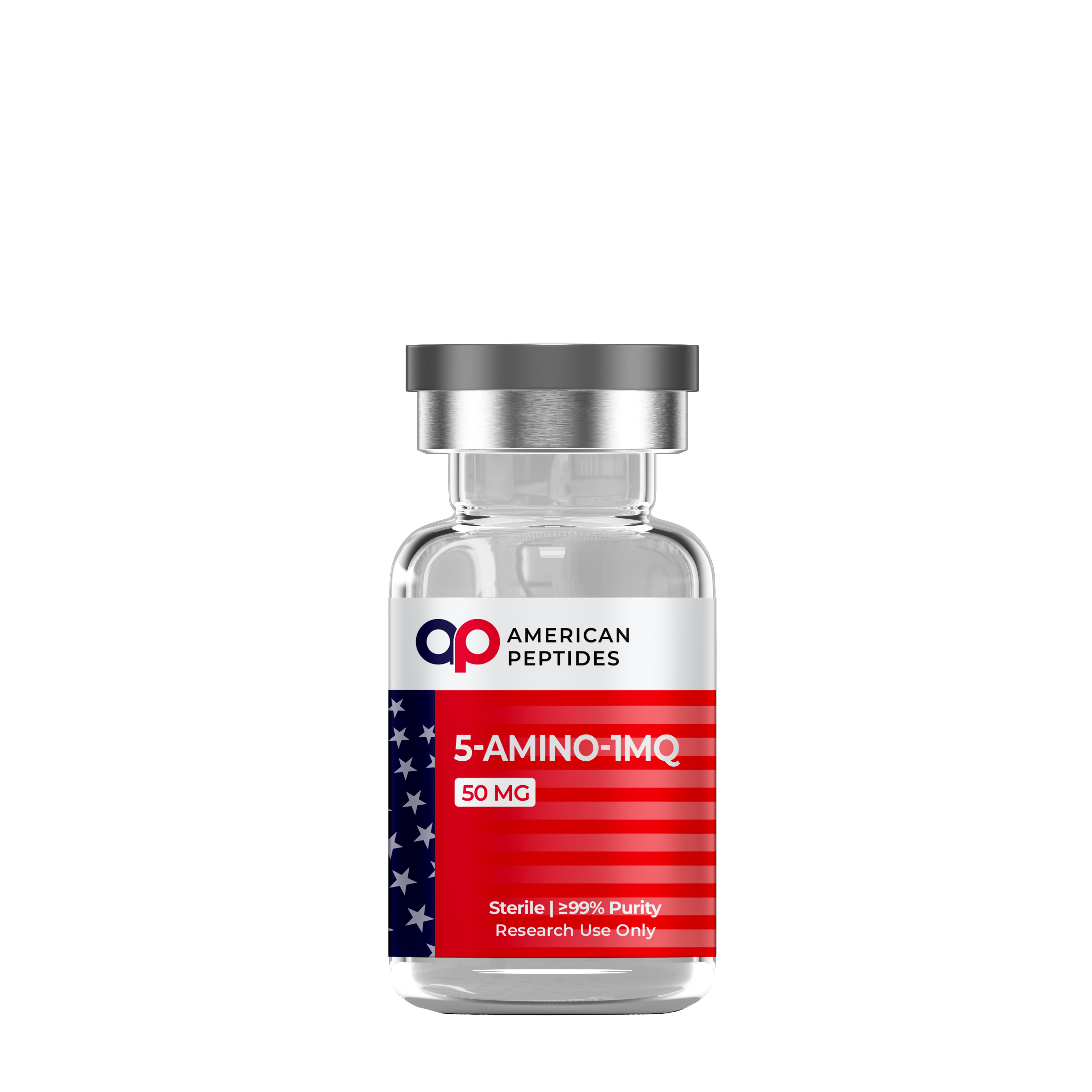

5-Amino-1MQ (5-amino-1-methylquinolinium) is a small-molecule inhibitor of nicotinamide N-methyltransferase (NNMT), the enzyme that methylates nicotinamide and in doing so draws on the cell's pool of NAD+ precursors and methyl donors. SLU-PP-332 is a synthetic pan-agonist of the estrogen-related receptors (ERRα, β and γ), orphan nuclear receptors that sit at the transcriptional end of PGC-1α-driven mitochondrial gene programs. The two compounds come from different laboratories, act on different kinds of molecular target and were never studied in the same experiment. This article covers the cell and mouse literature on each, why a researcher might set them side by side, and where the evidence stops. It is written for researchers comparing a solid research format with lyophilized powder.
Research-use-only context. This article summarizes published third-party scientific literature — the large majority of it conducted in cultured cells or animal models. It is not medical advice, not a therapeutic or performance claim, and not a usage guide. American Peptides products are sold strictly for in vitro laboratory research and are not for human or veterinary use.
5-Amino-1MQ: an NNMT inhibitor and the NAD+/SAM balance
What NNMT does inside a cell
NNMT transfers a methyl group from S-adenosylmethionine (SAM) onto nicotinamide, producing 1-methylnicotinamide (1-MNA). A 2017 review in Trends in Endocrinology & Metabolism by Pissios framed the enzyme as more than a vitamin B3 clearance step: because it consumes both a NAD+ precursor and the cell's main methyl donor, it can shift the NAD+ salvage pathway and the SAM-to-SAH ratio at once. The review also listed the open questions: which downstream effects are driven by NAD+, which by methylation capacity, and which by 1-MNA itself.
The 2014 Nature knockdown paper
The modern interest in NNMT as a metabolic target traces to a 2014 Nature paper from the Kahn laboratory (Kraus and colleagues). In white adipose tissue from adipose-specific Glut4-knockout and Glut4-overexpressing mice, Nnmt was the most strongly reciprocally regulated gene. Antisense knockdown of Nnmt in adipose tissue and liver raised adipose SAM and NAD+ levels, increased histone H3 lysine 4 methylation, and upregulated the polyamine-flux enzymes ornithine decarboxylase and SSAT. In cultured adipocytes, NNMT inhibition increased oxygen consumption in a manner that depended on those polyamine enzymes. The authors reported changes in adiposity measures and energy expenditure in knockdown mice on a high-fat diet.
From scaffold to 5-Amino-1MQ: the Watowich series
The compound itself comes from the Watowich group at the University of Texas Medical Branch. A 2017 Journal of Medicinal Chemistry paper (Neelakantan and colleagues) screened N-methylated quinolinium, isoquinolinium, pyridinium and benzimidazolium analogues against recombinant NNMT and identified quinoliniums as a scaffold with low-micromolar inhibition (IC50 near 1 micromolar for the best members). Docking into the nicotinamide-binding site tracked measured IC50 values across a 1000-fold activity range; the amine-substituted methylquinolinium that became 5-Amino-1MQ emerged as the lead.
A 2018 Biochemical Pharmacology paper from the same group characterized the series in more depth. Primary-amine methylquinoliniums crossed artificial membranes and Caco-2 monolayers and did not inhibit related SAM-dependent methyltransferases or NAD+ salvage enzymes. In cultured adipocytes, the inhibitors lowered intracellular 1-MNA, raised NAD+ and SAM, and reduced lipid accumulation. In mice on a high-fat diet given the most potent inhibitor systemically, the authors reported changes in adiposity measures, adipocyte size and plasma cholesterol with no change in food intake. The 2019 Biochemical Pharmacology follow-up moved to aged skeletal muscle: in 24-month-old mice recovering from a chemically induced muscle lesion, inhibitor-exposed animals showed higher muscle stem cell proliferation, larger regenerated fiber cross-sectional area and higher peak torque than controls, and C2C12 myoblasts incubated with the inhibitor differentiated more readily, with shifts in the NAD+/NADH ratio.
An independent inhibitor confirms the target
A 2018 Scientific Reports paper from Sanofi and Jubilant Biosys (Kannt and colleagues) used a structurally unrelated nicotinamide analogue, JBSNF-000088, and reached parallel conclusions in mice on a high-fat diet: lower 1-MNA, changes in glucose handling and adiposity measures the authors reported, and no such effect in NNMT-knockout mice, which pins the activity to the enzyme.
SLU-PP-332: a pan-ERR agonist and the PGC-1α transcription program
Why ERRs matter for oxidative metabolism
Estrogen-related receptors are orphan nuclear receptors with no confirmed natural ligand. A 2008 Endocrine Reviews article by Giguère described how their activity is instead governed by coactivators, above all the PGC-1 family, so that ERRα and ERRγ function as the primary conduits for PGC-1α signaling. Through that partnership the ERRs control large gene networks for fatty-acid oxidation, the TCA cycle, oxidative phosphorylation and mitochondrial biogenesis. Knockout mice for each subtype show deficits when challenged, and ERRα in particular had long proved hard to target with a synthetic agonist.
The 2023 ACS Chemical Biology paper
SLU-PP-332 was reported in a 2023 ACS Chemical Biology paper from the Burris laboratory with collaborators at the Salk Institute (Billon and colleagues). The compound is a pan-agonist that engages all three ERR subtypes, with the highest potency at ERRα. In a skeletal muscle cell line it increased mitochondrial function and cellular respiration. In mice it increased type IIa oxidative fibers and treadmill endurance, and RNA profiling showed an acute aerobic exercise gene program the authors tied to ERRα using knockout animals. The authors called the compound an “exercise mimetic”; that is their term for a transcriptional signature in mouse muscle, not anything demonstrated in people.
Metabolic models and the autophagy link
A second Burris-lab paper, published online in 2023 and in print in J Pharmacol Exp Ther in 2024, carried SLU-PP-332 into mice on a high-fat diet and into ob/ob mice. The authors reported increased energy expenditure and fatty-acid oxidation, changes in adiposity measures and improved insulin sensitivity in those models. A 2024 Molecular Pharmacology paper (Losby and colleagues) identified transcription factor EB (TFEB), the master regulator of the autophagy-lysosome pathway, as a direct ERR target gene; ERR activation raised TFEB and its target genes in neonatal rat ventricular myocytes and C2C12 myoblasts. A 2026 follow-up from the same group compared SLU-PP-332 with a chemically distinct pan-agonist, SLU-PP-915, and reported that both strongly induced Ddit4, a gene switched on by acute aerobic exercise, in mouse muscle.
Why researchers study the pair
Two independent nodes of cellular energy metabolism
The appeal of pairing these compounds in a cell model is conceptual rather than empirical. NNMT inhibition acts at the metabolite layer: it changes the supply of NAD+ and SAM, which in turn feeds sirtuin activity, histone methylation and polyamine flux. ERR agonism acts at the transcriptional layer: it changes which mitochondrial and oxidative genes are expressed, using the PGC-1α coactivator axis. One sets the cofactor budget a mitochondrion has to work with; the other sets how many mitochondrial proteins the cell builds. A researcher asking whether cofactor availability limits the output of a transcriptional program has two well-characterized tool compounds that touch each node without, as far as published selectivity data show, touching the other.
What a cell-model study would actually measure
The readouts already exist in the separate literatures. On the NNMT side: intracellular 1-MNA by LC-MS, NAD+/NADH ratio, SAM/SAH ratio, and lipid accumulation in cultured adipocytes, as in the 2018 and 2019 Watowich papers. On the ERR side: expression of PGC-1α target genes, Ddit4, TFEB and its targets, oxygen consumption rate and mitochondrial mass in C2C12 cells, as in the Burris papers. Running both panels in one C2C12 or 3T3-L1 experiment, with each compound alone and together, is a straightforward factorial design, and the only way to learn whether the effects are additive, independent or interfering.
Plainly stated: no published study tests them together
As of this writing, no peer-reviewed paper indexed in PubMed exposes any cell line or animal to both 5-Amino-1MQ and SLU-PP-332. A product that pairs them is a convenience for a researcher who intends to run that factorial comparison, not evidence that it has been run or what it would show.
Where the evidence stops
Both compounds are investigational. Neither 5-Amino-1MQ nor SLU-PP-332 is approved by the FDA for any purpose, and neither has published human data in PubMed. For 5-Amino-1MQ, the mouse work comes largely from one group, the NNMT-knockout control exists for JBSNF-000088 rather than for the quinolinium series, and the Pissios review was explicit that the contributions of NAD+, methylation capacity and 1-MNA had not been separated. For SLU-PP-332, the Burris laboratory discloses financial interests in ERR-based compounds; the “exercise mimetic” label describes a transcriptional signature and a treadmill endpoint in mice; and pan-agonism at three widely expressed receptors leaves the tissue-specific picture incomplete. For the pair, the evidence stops at the decision to put them on the same bench.
Solid format: what researchers check
Both compounds are small molecules rather than peptides, so they avoid the hydrolysis and aggregation that complicate solid-state peptide formulation. For a tablet lot a researcher asks for the disintegration and dissolution profile in aqueous media (immediate-release means the compound disperses quickly when the tablet is added to buffer); content uniformity across the lot; a certificate of analysis by lot with an HPLC assay for identity and purity; and moisture and light protection in storage. “No reconstitution step” is a bench-handling fact: a tablet can be weighed and dissolved directly in the chosen solvent without the vial-and-diluent step lyophilized powder requires. Strength per tablet is listed on the product page.
The 5-Amino-1MQ + SLU-PP-332 tablets pair the two compounds in a single solid research format; the 5-Amino-1MQ tablets carry the NNMT inhibitor alone for researchers who want to run the two arms of a factorial design independently. Both sit in the Tablets collection. For a deeper read on the NNMT literature by itself, see our article 5-Amino-1MQ research: what the studies show.
Frequently Asked Questions
Is 5-Amino-1MQ approved by the FDA?
No. 5-Amino-1MQ is an investigational NNMT inhibitor that has been studied in cultured adipocytes, C2C12 myoblasts and mice. It is not approved by the FDA for any use, has no published human data in PubMed, and American Peptides sells it strictly for in vitro laboratory research. The same applies to SLU-PP-332, which is also investigational and not approved by the FDA.
Has any study tested 5-Amino-1MQ and SLU-PP-332 together?
No. As of this writing there is no peer-reviewed paper in PubMed that exposes a cell line or an animal to both compounds. The literature on each is separate: the Watowich group for the NNMT inhibitor, the Burris group for the ERR agonist. The rationale for studying them side by side rests on their distinct mechanisms and shared readouts, not on any published result.
How do the two mechanisms differ?
5-Amino-1MQ inhibits NNMT, an enzyme, so it changes metabolite levels: less 1-methylnicotinamide, more NAD+ and SAM inside the cell. SLU-PP-332 activates ERRα, β and γ, which are nuclear receptors, so it changes gene expression through the PGC-1α coactivator axis. One acts on the cofactor budget, the other on the transcriptional program for oxidative metabolism.
Why a tablet format for small molecules like these?
Both are stable small molecules, so an immediate-release tablet is a practical solid research format. A researcher checks disintegration and dissolution in aqueous media, content uniformity across the lot, an HPLC-backed certificate of analysis by lot, and moisture and light protection. The tablet can be dissolved directly in the chosen solvent, with no reconstitution step. Strength per tablet is listed on the product page.
Citations
- Kraus D et al., Nature 2014. PMID 24717514
- Neelakantan H et al., J Med Chem 2017. PMID 28548833
- Neelakantan H et al., Biochem Pharmacol 2018. PMID 29155147
- Neelakantan H et al., Biochem Pharmacol 2019. PMID 30753815
- Kannt A et al., Sci Rep 2018. PMID 29483571
- Pissios P, Trends Endocrinol Metab 2017. PMID 28291578
- Giguère V, Endocr Rev 2008. PMID 18664618
- Billon C et al., ACS Chem Biol 2023. PMID 36988910
- Billon C et al., J Pharmacol Exp Ther 2024. PMID 37739806
- Losby M et al., Mol Pharmacol 2024. PMID 39168657
- Billon C et al., J Pharmacol Exp Ther 2026. PMID 41421047
This article is for laboratory research reference only. American Peptides products are sold strictly for in vitro research. Not for human consumption.
Related research
Compliance Notice: American Peptides products are sold strictly for laboratory and academic research purposes only. They are not intended for human or veterinary consumption, diagnosis, treatment, or prevention of any disease. All content on this page is educational in nature and does not constitute medical advice or product claims. Researchers are responsible for handling these compounds in accordance with their institution’s safety protocols and applicable laws.