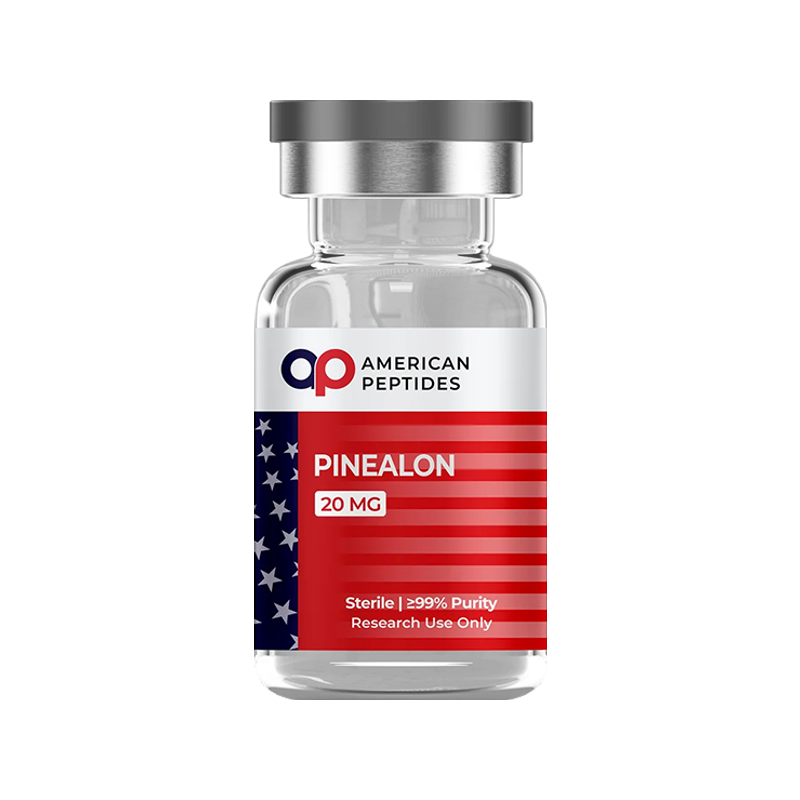

Pinealon is the trade name given to the synthetic tripeptide Glu-Asp-Arg — glutamic acid, aspartic acid, arginine, abbreviated EDR — three amino acids joined by two peptide bonds, with a molecular weight of roughly 418 daltons. It was designed by Vladimir Khavinson and colleagues at the St. Petersburg Institute of Bioregulation and Gerontology as one of a family of “short peptide bioregulators” that also includes Epithalon (Ala-Glu-Asp-Gly), Vesugen (Lys-Glu-Asp) and Vilon (Lys-Glu). This article covers the hypothesis that such short peptides act by binding DNA and modulating gene expression, what cultured neuronal and cortical cells have shown, what rat models from the Khavinson group describe, and, because it matters more here than for most compounds in this series, a frank account of where that evidence comes from.
Research-use-only context. This article summarizes published third-party scientific literature — the large majority of it conducted in cultured cells or animal models. It is not medical advice, not a therapeutic or performance claim, and not a usage guide. American Peptides products are sold strictly for in vitro laboratory research and are not for human or veterinary use.
What Pinealon is
EDR is about as small as a peptide can be while still being called one. Glutamate and aspartate carry negatively charged side chains at physiological pH; arginine carries a positive guanidinium group. That charge pattern underlies the mechanism its developers propose. Unlike most peptides in this series, EDR is not described as a ligand for a cell-surface receptor. The Khavinson group's working hypothesis, laid out in a 2020 review in Molecules, is that the tripeptide enters cells, reaches the nucleus, and binds histone proteins and/or nucleic acids directly, changing the transcription of specific genes — a model they refer to as peptide–DNA or epigenetic regulation.1 The same review lists the group's claims for EDR: reduced apoptosis in cell and animal models, and effects on the MAPK/ERK pathway, caspase-3, p53, the antioxidant enzymes SOD2 and GPX1, the transcription factors PPARA and PPARG, serotonin and calmodulin.1
What cell and tissue studies report
Entering the nucleus and binding DNA
The foundational paper for the DNA-interaction hypothesis is a 2011 study in Biochemistry (Moscow) by Fedoreyeva and colleagues, with Khavinson as co-author. HeLa cells incubated with fluorescein-labelled Epithalon, Pinealon (EDR) and Testagen (Lys-Glu-Asp-Gly) showed marked fluorescence in the cytoplasm, nucleus and nucleolus, which the authors take as evidence that such peptides can cross the plasma membrane and reach the nucleus. In a separate cell-free experiment, the unlabelled peptides quenched the fluorescence of labelled deoxyribo-oligonucleotides to differing degrees; Epithalon, Pinealon and the tetrapeptide bronchogen bound preferentially to oligonucleotides containing CNG motifs, the sites targeted by cytosine methylation, and Pinealon in particular to CAG-containing sequences.2 This is in vitro binding chemistry, not a demonstration that any gene's expression changed.
An independent physics group at St. Petersburg State University revisited the EDR–DNA interaction in 2019 in The Journal of Physical Chemistry B, using spectroscopy, NMR, viscometry and molecular dynamics. They reported that EDR can partly enter the major groove of DNA and interact with base atoms, mainly the N7 and O6 positions of guanine, and that magnesium ions promote the interaction by screening the phosphate backbone.3 A charged tripeptide associating with DNA in solution is plausible for many such molecules; sequence-specific transcriptional control in a living cell is a much larger claim, and these two papers are its main support.
Reactive oxygen species and cell survival in neuronal cultures
The most-cited functional cell study is a 2011 paper in Rejuvenation Research from Khavinson, Boldyrev and colleagues. In cultured rat cerebellar granule cells, neutrophils and PC12 cells under receptor-dependent or receptor-independent oxidative stress, Pinealon restricted the accumulation of reactive oxygen species (ROS) in a concentration-dependent way and reduced necrotic cell death measured by propidium iodide uptake. The protective effect was accompanied by a delayed time course of ERK1/2 activation and by a shift in the proportion of cells in each division phase. Because the ROS and cell-death effects saturated at lower concentrations while the proliferation effect continued at higher ones, the authors argued that EDR acts beyond antioxidant behaviour and may interact directly with the genome.4 That inference outruns the data, but the ROS and viability measurements themselves are straightforward.
Serotonin expression in cortical cell cultures
A 2014 report in the Bulletin of Experimental Biology and Medicine describes EDR and Lys-Glu-Asp increasing serotonin expression in aging cultures of brain cortex cells. Molecular docking was then used to propose that the peptides bind a CCTGCC sequence in the gene for tryptophan hydroxylase, the first enzyme of serotonin synthesis.5 Docking is a computational prediction, not a measured binding event, and the paper is a three-page communication.
Induced neurons from elderly donors
The most methodologically modern cell study is a 2024 paper in the International Journal of Molecular Sciences from the Institute of Cytology in St. Petersburg, with Institute of Bioregulation co-authors. Dermal fibroblasts from elderly human donors were transdifferentiated into induced cortical neurons, which retain age-associated features: oxidative DNA damage, reduced mitochondrial and lysosomal activity, elevated p16 and depleted dendritic trees. EDR, Lys-Glu-Asp and Ala-Glu-Asp-Gly all increased dendritic arborization, raising both the number of primary processes and total dendrite length; the tripeptides had no effect on mitochondrial or lysosomal activity or on p16, and EDR specifically reduced a marker of oxidative DNA damage.6 This is human-derived tissue, which is notable, but it is still a dish.
What animal models report
The animal literature on EDR consists of rat studies, nearly all from the Khavinson institute or collaborating Russian laboratories, much of it published in Russian in Advances in Gerontology. Two examples follow.
A 2012 study in the International Journal of Clinical and Experimental Medicine by Arutjunyan and colleagues used a prenatal hyperhomocysteinemia model: pregnant rats were loaded with dietary methionine, which raises homocysteine and impairs offspring neurodevelopment. Offspring in the EDR-exposed group showed better spatial orientation and learning in behavioural tests, and their isolated cerebellar neurons accumulated less ROS and contained fewer necrotic cells under oxidative challenge than neurons from offspring of unexposed methionine-loaded dams.7
A 2014 Russian-language paper from Mendzheritskii and colleagues, with Institute of Bioregulation co-authorship, compared Pinealon with Cortexin (a polypeptide extract) in old rats under acute hypoxic hypoxia. Caspase-3 activity in brain tissue and serum interleukin-6 and tumour necrosis factor were measured. Pinealon shifted these markers towards reference levels, interpreted by the authors as reduced neuroinflammatory signalling under hypoxia; Cortexin lowered the apoptotic readout but left interleukin-6 elevated.8 The Molecules review summarizes further rat and mouse-culture work, but the underlying papers are mostly short Russian communications.1
Where the human evidence stops
For most compounds in this series, human data are simply thin. For Pinealon the situation is different in kind. Published human reports exist: the Khavinson review states that EDR “improves memory issues” in elderly subjects,1 and PubMed holds several Russian-language papers on Pinealon in railway workers, truck drivers and older adults with chronic conditions, with outcomes expressed as “biological age” indices and work-ability questionnaires. We have not cited them because, on their abstracts, they are small, uncontrolled or poorly described, use composite endpoints not standard outside Russian gerontology, and were mostly conducted by the compound's developers or their associates. They are not controlled clinical evidence by Western standards.
The structural limitation needs stating plainly. Virtually the entire EDR literature — DNA-binding chemistry, cell culture, rat models and human reports — originates from a single institute and its collaborators. Independent replication by laboratories with no connection to the St. Petersburg Institute of Bioregulation and Gerontology is close to absent; the 2019 physical-chemistry paper is the nearest thing to it, and it addresses only whether the peptide can bind DNA in a tube.3 There are no Western randomized controlled trials, no registrations on major trial databases, no pharmacokinetic characterization in English-language journals, and no data on whether such a tripeptide survives digestion or crosses the blood–brain barrier in humans. The review's own authors frame the mechanism as an assumption — “the EDR peptide is assumed to enter cells and bind to histone proteins and/or ribonucleic acids” — not an established fact.1
Pinealon is not approved by the FDA for any indication, nor by the European Medicines Agency. In Russia it has been sold as a dietary supplement (a “cytogen”), not registered as a medicine. EDR is an investigational compound whose principal scientific interest is whether very short acidic peptides can modulate gene expression at all. For why peptide researchers study aging-related pathways, see The Biology of Cellular Aging.
What is not established
- Whether EDR binds DNA or histones inside living cells at biologically relevant concentrations, as opposed to in cell-free fluorescence and NMR experiments.2,3
- Whether any change in gene expression is sequence-specific, or a nonspecific consequence of a charged tripeptide altering the ionic environment around chromatin.
- Whether the serotonin finding in cortical cultures5 reproduces outside the originating laboratory.
- How EDR behaves in whole organisms: plasma stability, half-life and whether it reaches brain tissue.
- Whether the rat behavioural findings7,8 survive blinded, independently replicated protocols with pre-specified endpoints.
- Any controlled human outcome, since no Western trials exist and the Russian reports are small, uncontrolled and developer-affiliated.
Frequently Asked Questions
What is Pinealon chemically?
Pinealon is the trade name for the synthetic tripeptide Glu-Asp-Arg (EDR): glutamic acid, aspartic acid and arginine, about 418 daltons. It was designed by the Khavinson group at the St. Petersburg Institute of Bioregulation and Gerontology as part of the “short peptide bioregulator” family that also includes Epithalon.
How is Pinealon proposed to work?
Its developers hypothesize that the tripeptide enters the cell nucleus and binds DNA or histone proteins, altering the expression of specific genes. The evidence consists of labelled peptide seen in HeLa cell nuclei, cell-free binding to CNG- and CAG-containing oligonucleotides, and a 2019 physical-chemistry study reporting partial insertion into the DNA major groove near guanine. Sequence-specific gene regulation in living cells has not been established.
How strong is the Pinealon evidence?
Weak by conventional standards. Nearly every paper comes from a single Russian institute or its collaborators, many are short communications in Russian, independent replication is nearly absent, and there are no Western controlled trials. The cell-culture ROS and viability findings are the best-documented results; the gene-regulation mechanism remains a hypothesis.
Is Pinealon approved by the FDA?
No. Pinealon is not approved by the FDA for any indication and has not been approved by any Western regulator. In Russia it has been marketed as a dietary supplement rather than registered as a medicine. American Peptides supplies EDR strictly for in vitro research.
Citations
- Khavinson V, Linkova N, Kozhevnikova E, Trofimova S (2020). “EDR Peptide: Possible Mechanism of Gene Expression and Protein Synthesis Regulation Involved in the Pathogenesis of Alzheimer's Disease.” Molecules. 2020;26(1):159. PMID 33396470
- Fedoreyeva LI, Kireev II, Khavinson VKh, Vanyushin BF (2011). “Penetration of short fluorescence-labeled peptides into the nucleus in HeLa cells and in vitro specific interaction of the peptides with deoxyribooligonucleotides and DNA.” Biochemistry (Mosc). 2011;76(11):1210–1219. PMID 22117547
- Silanteva IA, Komolkin AV, Morozova EA, Vorontsov-Velyaminov PN, Kasyanenko NA (2019). “Role of Mono- and Divalent Ions in Peptide Glu-Asp-Arg-DNA Interaction.” J Phys Chem B. 2019;123(9):1896–1902. PMID 30762356
- Khavinson V, Ribakova Y, Kulebiakin K, Vladychenskaya E, Kozina L, Arutjunyan A, Boldyrev A (2011). “Pinealon increases cell viability by suppression of free radical levels and activating proliferative processes.” Rejuvenation Res. 2011;14(5):535–541. PMID 21978084
- Khavinson VKh, Lin'kova NS, Tarnovskaya SI, Umnov RS, Elashkina EV, Durnova AO (2014). “Short peptides stimulate serotonin expression in cells of brain cortex.” Bull Exp Biol Med. 2014;157(1):77–80. PMID 24909721
- Kraskovskaya N, Linkova N, Sakhenberg E, et al. (2024). “Short Peptides Protect Fibroblast-Derived Induced Neurons from Age-Related Changes.” Int J Mol Sci. 2024;25(21):11363. PMID 39518916
- Arutjunyan A, Kozina L, Stvolinskiy S, Bulygina Y, Mashkina A, Khavinson V (2012). “Pinealon protects the rat offspring from prenatal hyperhomocysteinemia.” Int J Clin Exp Med. 2012;5(2):179–185. PMID 22567179
- Mendzheritskii AM, Karantysh GV, Ryzhak GA, Dem'ianenko SV (2014). “[Regulation of content of cytokines in blood serum and of caspase-3 activity in brains of old rats in model of sharp hypoxic hypoxia with Cortexin and Pinealon].” Adv Gerontol. 2014;27(1):94–97. Article in Russian. PMID 25051764
Related reading
- Epithalon Research: What the Studies Actually Show
- The Biology of Cellular Aging: Pathways and Mechanisms
- The Neurobiology of Focus and Memory: Signaling Pathways in Research
- What Is a Peptide? A Researcher's Primer on Structure and Signaling
This article is for laboratory research reference only. American Peptides products are sold strictly for in vitro research. Not for human consumption.
Related research
Compliance Notice: American Peptides products are sold strictly for laboratory and academic research purposes only. They are not intended for human or veterinary consumption, diagnosis, treatment, or prevention of any disease. All content on this page is educational in nature and does not constitute medical advice or product claims. Researchers are responsible for handling these compounds in accordance with their institution’s safety protocols and applicable laws.