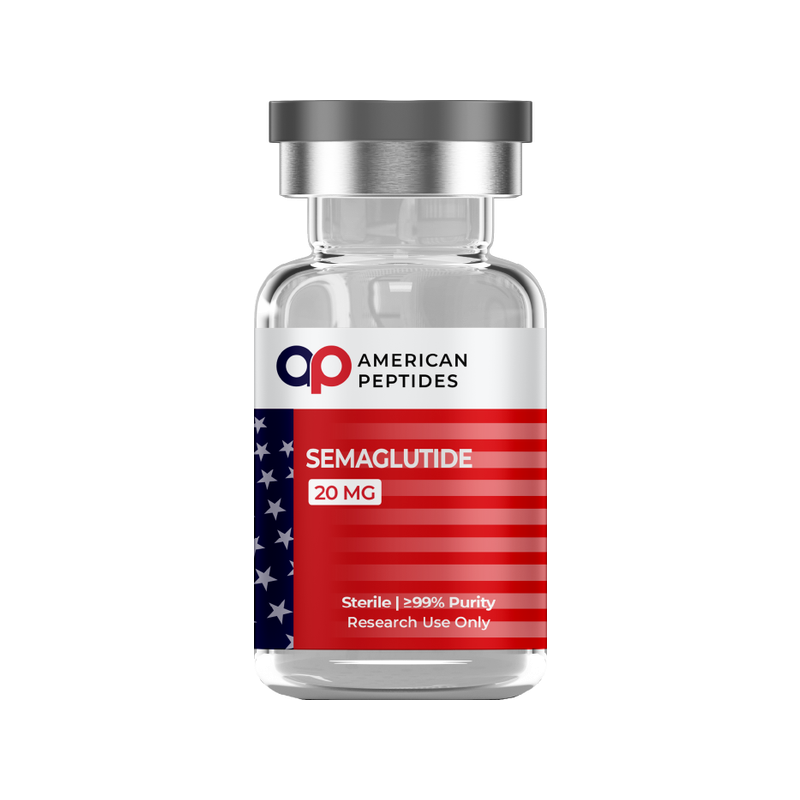


Semaglutide is the most extensively characterised long-acting glucagon-like peptide-1 (GLP-1) analogue, and almost everything written about it online concerns the finished pharmaceutical products that contain it. This article does the opposite. It goes back to the primary literature and asks what the peer-reviewed studies establish about the molecule itself: how its sequence was modified, how it sits in the GLP-1 receptor at near-atomic resolution, how laboratory species break it down, and what rodent models report. The sponsor’s clinical program is deliberately left out. For the evidence-first format used across this series, see our retatrutide research review.
Research-use-only context. This article summarizes published third-party scientific literature — the large majority of it conducted in cultured cells or animal models. It is not medical advice, not a therapeutic or performance claim, and not a usage guide. American Peptides products are sold strictly for in vitro laboratory research and are not for human or veterinary use.
What semaglutide is
Semaglutide is a synthetic analogue of human GLP-1(7-37), the 31-residue incretin hormone released from the gut after a meal. Native GLP-1 is a poor long-acting molecule: a 2025 Bioorganic & Medicinal Chemistry paper summarises the problem as rapid enzymatic degradation and a short half-life.3 Semaglutide answers it with two backbone changes and one lipid attachment. The backbone is catalogued in the peptide-chemistry literature as Aib8-Arg34-GLP-1(7-37): the alanine at position 8 is replaced by 2-aminoisobutyric acid (Aib), an unnatural amino acid, and the lysine at position 34 is replaced by arginine.2 Position 8 is where dipeptidyl peptidase-4 (DPP-4) cleaves native GLP-1, and Aib there is the standard chemistry for blocking the cut across the long-acting incretin class. The remaining lysine, at position 26, is the acylation site in the analogue-design literature that benchmarks against semaglutide, and semaglutide itself carries a C18 fatty diacid there through a hydrophilic linker.3
None of these tools is unique to semaglutide. Aib substitution and fatty-diacid acylation are the same elements used to build the dual GIP/GLP-1 agonist tirzepatide and the triple agonist retatrutide; our receptor-level comparison sets the three side by side. What distinguishes semaglutide is that it is a single-receptor molecule, designed to engage GLP-1R and nothing else, which makes it the cleanest reference compound in the class for studying GLP-1R signaling in isolation. For the biology of the receptor itself, see What is a GLP-1 receptor agonist?
What the research reports
Molecular design
The clearest first-hand account of the design logic is a 2019 Frontiers in Endocrinology review by Knudsen and Lau, two of the Novo Nordisk scientists who built the molecule.1 They describe reversible binding to serum albumin as the mechanism chosen for systemic protraction, and a screening campaign in which fatty-acid and linker combinations were varied to maximise albumin binding while maintaining GLP-1 receptor potency. The two goals pull against each other, and the semaglutide side chain is the compromise that came out of that screen.
The Aib residue has a manufacturing consequence. Because Aib is not a genetically encoded amino acid, the backbone cannot be made by straightforward fermentation. A 2022 Journal of Peptide Science paper reports that solid-phase synthesis of Aib8-Arg34-GLP-1(7-37) runs at roughly 16% yield and generates deletion peptides that complicate purification, whereas a liquid-phase fragment condensation — coupling an expressed Arg34-GLP-1(9-37) fragment to a protected His-Aib dipeptide — reached about 60% yield and more than 98% purity after one reverse-phase step.2 Deletion peptides and purity are the specifications to ask about when sourcing any research-grade GLP-1 analogue.
The lipid also sets a solubility trade-off. The 2025 paper describes lipidation-induced hydrophobicity as a problem the field is engineering around, in that case by appending a hydrophilic proline-alanine-serine (PAS) sequence to a Gly8-Arg34-GLP-1(7-37) scaffold lipidated at Lys26; its best conjugate reached roughly two-fold higher aqueous solubility than semaglutide.3 Like most current conjugate literature, it uses semaglutide as the comparator for every new analogue.
Receptor pharmacology
GLP-1R is a class B1 G-protein-coupled receptor expressed, per the Knudsen and Lau review, in the pancreas, gastrointestinal tract, heart, lungs, kidneys and brain, which is why a single-receptor agonist can still act at many sites in animal models.1 The most direct structural evidence is a 2021 Cell Reports paper from the Sexton and Wootten laboratories at Monash, which solved cryo-electron microscopy structures of semaglutide-bound and taspoglutide-bound GLP-1R–Gs protein complexes and applied cryo-EM 3D variability analysis.4 The authors report that semaglutide makes peptide–receptor interactions similar to those of native GLP-1, but that receptor and bound peptide show different motions in the two complexes. Their framing is that GLP-1R agonists display a broad spectrum of signaling profiles and that structural data on how each agonist engages the receptor has been the missing piece. Semaglutide, in other words, is a GLP-1-like ligand at the binding-site level, with dynamics of its own.
In-vitro findings
Semaglutide’s role in cell-based work is mostly as the reference standard. In the 2025 conjugate study, fifteen dual-lipidated GLP-1 analogues were screened for GLP-1 receptor activation in cells against semaglutide; the lead conjugate B1 showed approximately three-fold higher receptor activation, and surface plasmon resonance gave conjugate D1 a dissociation constant roughly three-fold lower than semaglutide’s, which the authors read as a stronger binding tendency.3 Those numbers matter less for ranking semaglutide than for showing what a well-run bench comparison looks like: activation, binding and solubility against one reference compound.
Metabolite profiling supplies the other half of the picture. A 2017 study in the European Journal of Pharmaceutical Sciences used radiolabelled semaglutide to trace what the molecule becomes in rats and monkeys.5 Intact semaglutide was the primary circulating component, accounting for 69–83% of semaglutide-related material in plasma. Breakdown proceeded by proteolytic cleavage of the peptide backbone and sequential beta-oxidation of the fatty-acid side chain — the lipid is chewed down two carbons at a time like any fatty acid — and metabolism was not confined to any specific organ. Urine and faeces were both significant routes of elimination, with urine primary, and metabolite profiles were similar across species.5
Animal-model findings
Brain access in rodents. The most mechanistically detailed animal study is a 2020 JCI Insight paper by Gabery and colleagues, which mapped where semaglutide goes in the rodent brain and what it activates there.6 Labelled semaglutide directly accessed the brainstem, septal nucleus and hypothalamus but did not cross the blood–brain barrier; it reached the brain through the circumventricular organs and select sites adjacent to the ventricles. It induced c-Fos activation, a marker of neuronal activity, in ten brain areas, including secondary regions with no direct GLP-1R contact such as the lateral parabrachial nucleus, which a connectivity analysis tied to meal-termination circuitry. Transcriptomics of microdissected tissue from semaglutide-exposed rats showed up-regulation of prolactin-releasing hormone and tyrosine hydroxylase in the area postrema, and the authors report changes in food preference and food intake without a decrease in energy expenditure.6 The receptor populations involved are the ones discussed in Understanding appetite signaling.
Atherosclerosis-prone mice. A 2018 study in JACC: Basic to Translational Science examined semaglutide and liraglutide in two genetic mouse models of atherosclerosis, apolipoprotein E-deficient (ApoE−/−) and LDL receptor-deficient (LDLr−/−) mice on a Western diet.7 Both compounds attenuated plaque lesion development, partly independently of changes in body weight and cholesterol. In aortic tissue, the Western diet altered expression of genes in pathways relevant to atherogenesis — leukocyte recruitment, leukocyte rolling, adhesion and extravasation, cholesterol metabolism, lipid-mediated signaling, extracellular-matrix protein turnover and plaque haemorrhage — and semaglutide significantly reversed those changes. The authors’ interpretation is that GLP-1R agonists act on atherosclerosis in these mice through an anti-inflammatory mechanism.7
Diet-induced fatty liver in mice. A 2022 paper in Frontiers in Endocrinology studied C57BL/6J mice with high-fat-diet-induced non-alcoholic fatty liver disease, split into normal-diet, high-fat-diet and high-fat-diet-plus-semaglutide groups.8 In the semaglutide group the authors report lower liver weight, blood glucose, triglycerides, total cholesterol and LDL, lower pro-inflammatory factors, and a higher level of the antioxidant enzyme superoxide dismutase. Histology showed less hepatocyte steatosis, ballooning degeneration and lymphoid foci, with fewer lipid droplets on Oil Red O staining; electron microscopy showed swollen mitochondria with partially broken cristae and visible mitophagy, and LC-MS metabolomics found six liver metabolites down-regulated and two up-regulated.8 This is a small study — 24 animals in three groups — describing what happened in those mice, nothing more.
Where semaglutide sits in the literature. Semaglutide differs from most peptides in this series in one respect: finished pharmaceutical products containing it hold regulatory approval for specific indications, and a large sponsor-run clinical program exists.1 This article deliberately does not summarise its results; they belong to the finished products and their sponsor, and are not what a laboratory characterising the peptide measures.
The human-evidence gap
It is tempting to assume that because semaglutide has a large human literature, research-grade semaglutide inherits it. It does not. Every published human study concerns a finished pharmaceutical product, made under a sponsor’s controls and used in a defined population under medical supervision. Research-grade material has no human data of its own; its characterisation is the cell, structural and animal work summarised above plus the analytical specifications on its certificate of analysis. No controlled data exist for off-label or unsupervised use of any form of the molecule, and reviewers are consistent that such use is unstudied rather than validated. The mechanistic evidence has limits too: the brain-mapping work is in rodents, the atherosclerosis findings are in genetically modified mice, and the liver study is in 24 animals.6,7,8 Those are the right models for asking how GLP-1R signaling works, and research-grade semaglutide is a reference compound for that question — not a route to human results that belong to a different product under different rules.
The takeaway
Semaglutide is as well-characterised as a research peptide gets: a defined Aib8-Arg34-GLP-1(7-37) backbone with a C18 fatty-diacid side chain at Lys26, a solved cryo-EM structure in complex with its receptor and Gs protein, a mapped metabolic fate in laboratory species, and a rodent literature that reaches from brainstem circuitry to aortic gene expression.2,3,4,5,6,7 It is also the reference compound against which the next generation of GLP-1 analogues is measured. What research-grade semaglutide is not is the finished pharmaceutical, and nothing transfers from one to the other. American Peptides supplies semaglutide strictly for in vitro research (see the full GLP-1 research peptide collection); formula, molecular weight and handling specifications are on the semaglutide reference monograph.
Frequently Asked Questions
What is the sequence of semaglutide?
Aib8-Arg34-GLP-1(7-37): human GLP-1(7-37) with 2-aminoisobutyric acid at position 8 and arginine at position 34, plus a C18 fatty-diacid side chain on the lysine at position 26 via a hydrophilic linker. The Aib blocks DPP-4 cleavage; the lipid binds serum albumin.
How is semaglutide different from tirzepatide and retatrutide?
Semaglutide is built on a GLP-1 backbone and engages only the GLP-1 receptor. Tirzepatide and retatrutide are built on a GIP backbone and engage two and three incretin-family receptors respectively. All three share Aib substitution and fatty-diacid acylation.
Does semaglutide cross the blood-brain barrier?
Not in the rodent mapping study. Gabery and colleagues found labelled semaglutide reached the brainstem, septal nucleus and hypothalamus through circumventricular organs and sites adjacent to the ventricles, without crossing the barrier itself.
Is semaglutide approved by the FDA?
Finished pharmaceutical products containing semaglutide hold regulatory approval for specific indications. That status belongs to those finished products and their sponsor, not to research-grade material, which is not for human use. American Peptides supplies semaglutide strictly for in vitro research.
Citations
- Knudsen LB, Lau J. “The Discovery and Development of Liraglutide and Semaglutide.” Front Endocrinol (Lausanne). 2019;10:155. PubMed: PMID 31031702
- Zhang J, et al. “Efficient synthesis of Aib(8)-Arg(34)-GLP-1 (7-37) by liquid-phase fragment condensation.” J Pept Sci. 2022;28(9):e3407. PubMed: PMID 35064598
- Wang C, et al. “Design, synthesis, and biological evaluation of long-acting glucagon-like peptide-1 (GLP-1) conjugates modified with dual fatty acids and a proline-alanine-serine (PAS) polypeptide.” Bioorg Med Chem. 2025;128:118266. PubMed: PMID 40499315
- Zhang X, et al. “Structure and dynamics of semaglutide- and taspoglutide-bound GLP-1R-Gs complexes.” Cell Rep. 2021;36(2):109374. PubMed: PMID 34260945
- Jensen L, et al. “Absorption, metabolism and excretion of the GLP-1 analogue semaglutide in humans and nonclinical species.” Eur J Pharm Sci. 2017;104:31–41. PubMed: PMID 28323117
- Gabery S, et al. “Semaglutide lowers body weight in rodents via distributed neural pathways.” JCI Insight. 2020;5(6):e133429. PubMed: PMID 32213703
- Rakipovski G, et al. “The GLP-1 Analogs Liraglutide and Semaglutide Reduce Atherosclerosis in ApoE(-/-) and LDLr(-/-) Mice by a Mechanism That Includes Inflammatory Pathways.” JACC Basic Transl Sci. 2018;3(6):844–857. PubMed: PMID 30623143
- Niu S, et al. “Semaglutide ameliorates metabolism and hepatic outcomes in an NAFLD mouse model.” Front Endocrinol (Lausanne). 2022;13:1046130. PubMed: PMID 36568109
Related reading
- Retatrutide vs Tirzepatide vs Semaglutide: A Receptor-Level Comparison
- Tirzepatide Research: What the Studies Actually Show
- What Is a GLP-1 Receptor Agonist? A Science Explainer
This article is for laboratory research reference only. American Peptides products are sold strictly for in vitro research. Not for human consumption.
Related research
Compliance Notice: American Peptides products are sold strictly for laboratory and academic research purposes only. They are not intended for human or veterinary consumption, diagnosis, treatment, or prevention of any disease. All content on this page is educational in nature and does not constitute medical advice or product claims. Researchers are responsible for handling these compounds in accordance with their institution’s safety protocols and applicable laws.