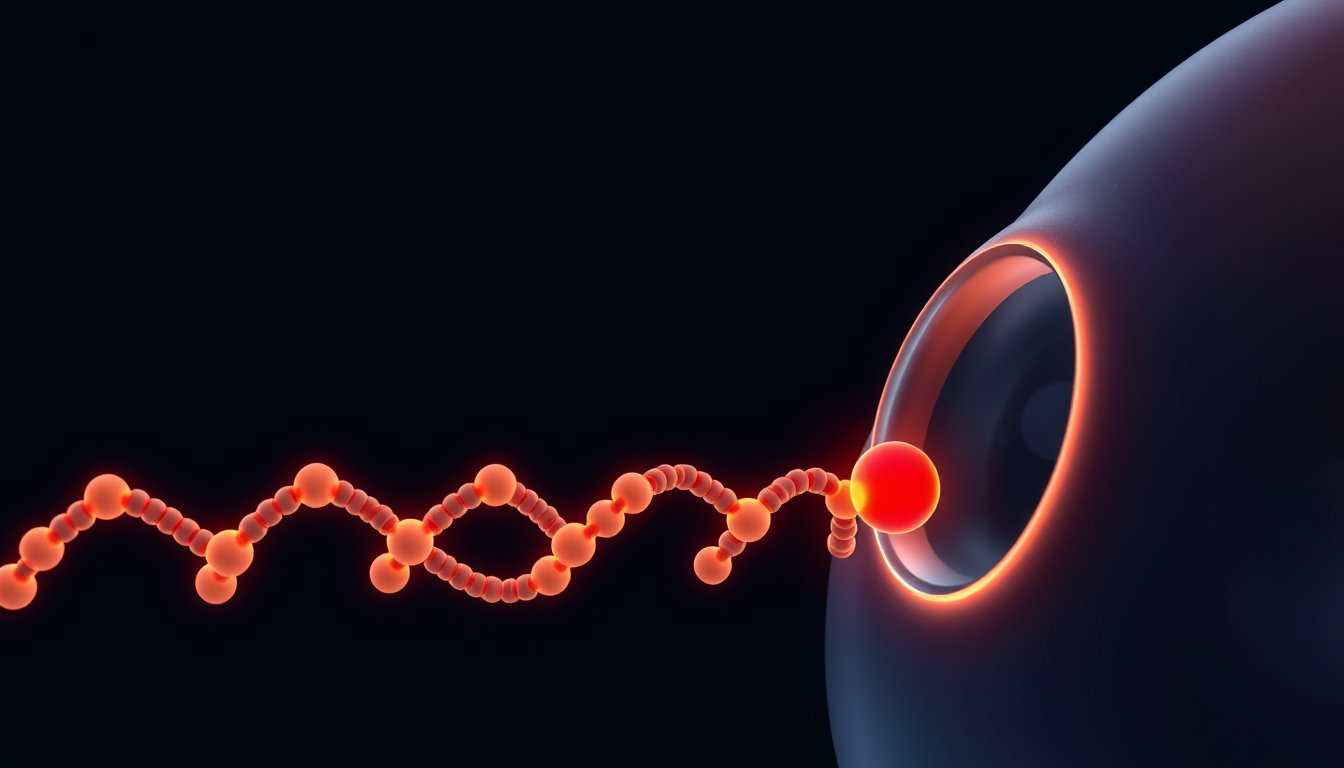


Sermorelin is the laboratory name for GRF(1-29)-NH2: the first 29 amino acids of human growth hormone-releasing hormone (GHRH), finished with an amide at the C-terminus. It is one of the oldest synthetic GHRH analogues in the literature: the foundational experiments were run in the 1980s and 1990s in rat pituitary cell cultures, and the structural picture was completed only in 2020. This summary walks through that record: why 29 residues are enough, how the molecule signals in pituitary somatotrophs, what degrades it, and where the evidence stops. For the evidence-first format used across this series, see our CJC-1295 (No DAC) research review.
Research-use-only context. This article summarizes published third-party scientific literature — the large majority of it conducted in cultured cells or animal models. It is not medical advice, not a therapeutic or performance claim, and not a usage guide. American Peptides products are sold strictly for in vitro laboratory research and are not for human or veterinary use.
What sermorelin is
Native human GHRH is a 44-residue peptide. In 1984, Ling and colleagues at the Salk Institute asked how much of that sequence was actually required. They synthesised a ladder of C-terminally shortened fragments and tested each on rat anterior pituitary cells in monolayer culture. Growth-hormone-releasing potency fell gradually as residues were removed down to hGRF(1-34)-OH, then flattened out: the (1-31), (1-30) and (1-29) amides each kept roughly half the potency of the full-length hormone. Shortening further, to (1-21), still produced fragments with full intrinsic activity — they could drive a maximal response — but at very low potency, and activity disappeared at (1-19).1 GRF(1-29)-NH2 therefore sits at the edge of the plateau: the shortest fragment that keeps both full intrinsic activity and near-native potency. A 1999 review in BioDrugs states the same conclusion in one line, describing sermorelin as “the shortest synthetic peptide with full biological activity of GHRH.”2
Nearly every synthetic GHRH analogue in circulation is built on this 29-residue scaffold. CJC-1295 began life as hGRF(1-29) carrying four amino-acid substitutions plus a reactive lysine derivative at the C-terminus, designed to bond covalently to serum albumin in the bloodstream.8 The compound sold as “CJC-1295 without DAC” or modified GRF(1-29) is that same substituted scaffold without the albumin-binding group; our CJC-1295 review covers it in detail. Tesamorelin takes the opposite route: it is a modified full-length 44-residue GRF analogue rather than a fragment. Sermorelin is the unmodified reference against which all of these are compared: native sequence, native N-terminus, native susceptibility to the enzymes that clear the parent hormone. Readers new to the receptor family may want our receptor pathways primer first.
What the research reports
Molecular design: why residues 1–29 suffice
Truncation shows which residues are dispensable, not which do the work; systematic substitution answered that. In a 1998 Journal of Medicinal Chemistry paper, Cervini, Rivier and colleagues at the Salk Institute replaced each position of [Nle27]-hGHRH(1-29)-NH2 with alanine, one at a time, and measured growth-hormone release in vitro against hGHRH(1-40)-OH as the standard. Alanine at positions 1, 3, 5, 6, 10, 11, 13, 14 or 23 produced nearly complete loss of potency. Alanine at 16, 18, 24, 25, 26 or 29 made no difference. And alanine at 8, 9, 15, 22 or 28 made the peptide two to six times more potent than the standard.3 Stacking the helpful substitutions compounded the effect: one multiply-substituted analogue released growth hormone 26 times more effectively than the standard, and lactam bridges that lock the C-terminal region into a helix gave analogues up to 17 times more potent. The authors’ summary is that receptor activation depends on amphiphilicity, helicity and dipolar character, each of which chemistry can reinforce beyond the native sequence.3
GHRH receptor pharmacology: Gs, cAMP and the somatotroph
The GHRH receptor is a seven-transmembrane, Gs-coupled receptor expressed on pituitary somatotroph cells. In a 1995 review of their cloning and signaling work, Mayo and colleagues laid out the model that still frames the field. GHRH binding produces two outputs: rapid release of stored growth hormone from secretory granules, which the authors attribute to a G-protein-mediated interaction with ion channels, and accumulation of intracellular cAMP. The cAMP signal activates protein kinase A, which phosphorylates the transcription factor CREB; one of CREB’s targets is Pit-1, the pituitary-specific transcription factor required for proper regulation of the growth-hormone gene. Pit-1 also appears to regulate the GHRH receptor gene itself, since the receptor is absent from the pituitary of dw/dw mice that lack functional Pit-1.4
The structural basis came 25 years later. In 2020, Zhou and colleagues reported a 2.6 Å cryo-electron microscopy structure of the human GHRH receptor bound to GHRH and the stimulatory G protein. The peptide sits in the receptor as a continuous α-helix, forming an extensive network of contacts with every extracellular loop, every transmembrane helix except TM4, and the receptor’s extracellular domain. The N-terminus of GHRH in particular engages a broad set of specific interactions deep in the receptor.5 Read alongside the alanine scan, the structure explains the chemistry: the positions whose replacement destroyed potency cluster in the N-terminal and central helix that the structure shows buried in the receptor core.3,5
In-vitro pituitary-cell findings
The sharpest kinetic study of GRF(1-29) is Ohlsson and Lindström’s 1990 Endocrinology paper, which perifused cultured rat somatotrophs and tracked growth-hormone secretion and calcium-45 efflux second by second. At nanomolar concentrations of either hGRF(1-29) or hGRF(1-44), both signals rose within the first 15 seconds and peaked within 75 seconds. At lower concentrations the calcium signal still appeared within 15 seconds, with secretion following 15 to 30 seconds later. The fragment and the full-length hormone behaved identically, a direct cellular confirmation of the truncation result. In calcium-depleted medium with EGTA, hGRF(1-29) still stimulated both secretion and calcium efflux at reduced magnitude, which the authors read as evidence that mobilisation of intracellular calcium, not only influx, participates.6 A membrane-permeant cAMP analogue reproduced the pattern, tying the calcium events to the Gs/cAMP pathway.
Animal-model findings as reported
Rat studies of unmodified GRF(1-29) are mostly embedded in papers about its derivatives, where it is the comparator. The clearest is the 2005 Endocrinology paper from ConjuChem that identified CJC-1295. Jetté and colleagues built three maleimido derivatives of hGRF(1-29), conjugated them to human serum albumin ex vivo, and showed the conjugates resisted dipeptidyl peptidase-IV in vitro and stayed active in a growth-hormone secretion assay in cultured rat anterior pituitary cells. In normal male Sprague Dawley rats, each derivative produced an acute rise in plasma growth hormone. The best of them, CJC-1295, produced a four-fold larger growth-hormone area-under-the-curve over two hours than hGRF(1-29) itself, was detectable in plasma beyond 72 hours, and appeared on Western blots bound to serum albumin from 15 minutes to beyond 24 hours.8 The implicit finding about sermorelin matters as much as the headline: in the same rats, unmodified GRF(1-29) produced a short, acute response and was gone. That is the native pharmacology the albumin chemistry was designed to overcome.
Stability and DPP-4 degradation as chemistry
The reason sermorelin acts briefly is enzymatic, and it has been characterised precisely. In 1992, Bongers and colleagues at Hoffmann-La Roche followed the proteolysis of synthetic GRF and its analogues by purified human placental dipeptidyl peptidase IV (DPP IV) using HPLC. The enzyme cleaves between Ala2 and Asp3, removing the N-terminal dipeptide, and it does so at essentially the same initial rate for GRF(1-44)-NH2, GRF(1-29)-NH2 and GRF(1-20)-NH2: the C-terminus is irrelevant to the enzyme. Analogues with a D-amino acid at position 1, 2 or 3, and analogues carrying desamino-tyrosine or N-methyl-tyrosine at position 1, were not cleaved at all.7
The product of that cleavage is the (3-29) fragment, which lacks Tyr1 — the residue whose replacement by alanine abolished potency in the Salk scan.3 Position-2 substitutions in modified GRF(1-29) and the albumin anchoring of CJC-1295 are both responses to this single enzymatic step. A laboratory handling sermorelin is handling the DPP-IV-susceptible reference form, and in vitro assay design should account for enzyme content in serum-containing media.
The human-evidence gap
Sermorelin differs from most peptides in this series in one respect: a finished sermorelin pharmaceutical once existed. The 1999 BioDrugs review describes its clinical evaluation, principally as a provocative diagnostic agent for assessing pituitary growth-hormone reserve, and as a finished pharmaceutical used under medical supervision.2 This article deliberately does not summarise those outcomes, and the clinical literature on that product is now decades old.
Two points follow for a laboratory reader. First, whatever regulatory status that finished product held belonged to the product and its sponsor — its manufacturing, formulation and clinical data package. None of that transfers to research-grade material. Research-grade GRF(1-29)-NH2 has no human data of its own: no study cited here was conducted with it, and a clinical history attached to a different, finished product is not evidence about a research reagent. Second, the mechanistic record is almost entirely rat — pituitary monolayers, perifused somatotrophs, and rats receiving albumin conjugates. The only human-derived result in the mechanism literature is the cryo-EM structure of the human receptor, and a structure is a molecular snapshot, not a physiological finding.5 The uses promoted for sermorelin online sit entirely inside that gap.
The takeaway
Sermorelin is the reference GHRH fragment: the shortest sequence that retains full intrinsic activity and near-native potency at the Gs-coupled GHRH receptor,1,2 with a residue-by-residue map of what each position contributes,3 a receptor structure that explains that map,5 second-by-second kinetics in rat somatotrophs,6 and a precisely characterised DPP-IV cleavage that every later analogue was built to evade.7,8 What it does not have is a human evidence base of its own. American Peptides supplies sermorelin strictly for in vitro research as part of its growth hormone research collection; for how growth-hormone signaling connects downstream, see What is IGF-1?
Frequently Asked Questions
What is sermorelin, in one sentence?
Sermorelin is GRF(1-29)-NH2, the first 29 amino acids of human growth hormone-releasing hormone with a C-terminal amide — the shortest fragment shown in rat pituitary cell assays to keep the full biological activity of the 44-residue parent hormone.
How is sermorelin different from CJC-1295?
Both are built on the GRF(1-29) scaffold. Sermorelin is the unmodified native sequence. CJC-1295 carries four amino-acid substitutions and a C-terminal reactive lysine derivative that bonds to serum albumin; in rats this extended its presence in plasma to beyond 72 hours, where unmodified GRF(1-29) produced only a brief acute response. “CJC-1295 without DAC” keeps the substitutions but drops the albumin-binding group.
Why does sermorelin degrade so quickly in plasma?
Dipeptidyl peptidase IV cleaves the bond between Ala2 and Asp3, removing the N-terminal dipeptide. The resulting (3-29) fragment lacks Tyr1, a residue that structure–activity scans show is essential for receptor activation. Analogues with a D-amino acid at position 2 are not cleaved.
Is sermorelin approved by the FDA?
No current approval covers sermorelin as a research compound. A finished sermorelin pharmaceutical was once developed and evaluated in the clinic under medical supervision; whatever status that product held belonged to it and its sponsor, not to research-grade material. American Peptides supplies sermorelin strictly for in vitro research, and it is not approved for any use.
Citations
- Ling N, et al. “Synthesis and in vitro bioactivity of C-terminal deleted analogs of human growth hormone-releasing factor.” Biochem Biophys Res Commun. 1984;123(2):854–861. PubMed: PMID 6435620
- Prakash A, Goa KL. “Sermorelin: a review of its use in the diagnosis and treatment of children with idiopathic growth hormone deficiency.” BioDrugs. 1999;12(2):139–157. PubMed: PMID 18031173
- Cervini LA, et al. “Human growth hormone-releasing hormone hGHRH(1-29)-NH2: systematic structure-activity relationship studies.” J Med Chem. 1998;41(5):717–727. PubMed: PMID 9513600
- Mayo KE, et al. “Growth hormone-releasing hormone: synthesis and signaling.” Recent Prog Horm Res. 1995;50:35–73. PubMed: PMID 7740167
- Zhou F, et al. “Structural basis for activation of the growth hormone-releasing hormone receptor.” Nat Commun. 2020;11(1):5205. PubMed: PMID 33060564
- Ohlsson L, Lindström P. “The correlation between calcium outflow and growth hormone release in perifused rat somatotrophs.” Endocrinology. 1990;126(1):488–497. PubMed: PMID 1688413
- Bongers J, et al. “Kinetics of dipeptidyl peptidase IV proteolysis of growth hormone-releasing factor and analogs.” Biochim Biophys Acta. 1992;1122(2):147–153. PubMed: PMID 1353684
- Jetté L, et al. “Human growth hormone-releasing factor (hGRF)1-29-albumin bioconjugates activate the GRF receptor on the anterior pituitary in rats: identification of CJC-1295 as a long-lasting GRF analog.” Endocrinology. 2005;146(7):3052–3058. PubMed: PMID 15817669
Related reading
- CJC-1295 (No DAC) Research: What the Studies Actually Show
- Tesamorelin Research: What the Studies Actually Show
- Ipamorelin Research: What the Studies Actually Show
This article is for laboratory research reference only. American Peptides products are sold strictly for in vitro research. Not for human consumption.
Related research
Compliance Notice: American Peptides products are sold strictly for laboratory and academic research purposes only. They are not intended for human or veterinary consumption, diagnosis, treatment, or prevention of any disease. All content on this page is educational in nature and does not constitute medical advice or product claims. Researchers are responsible for handling these compounds in accordance with their institution’s safety protocols and applicable laws.