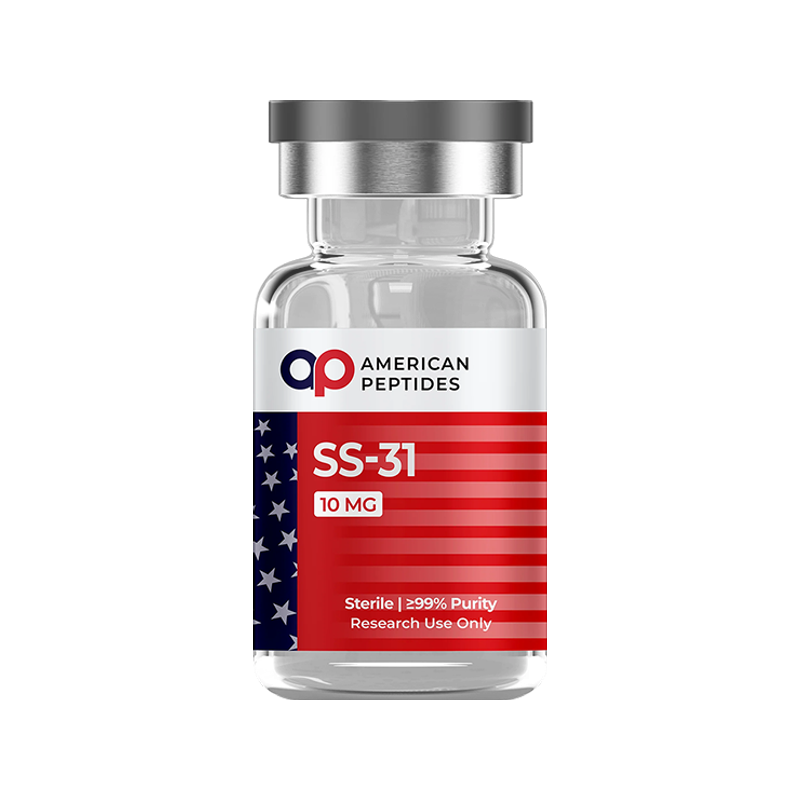


SS-31 is one of the few research peptides whose target is a lipid rather than a receptor. It concentrates in the inner mitochondrial membrane and associates with cardiolipin, the signature phospholipid of that membrane, and nearly everything in its two-decade literature follows from that single physical fact. This summary surveys what the peer-reviewed studies report about the mechanism, which models they used, and where the evidence stands. For the evidence-first format used across this series, see our MOTS-c research review.
Research-use-only context. This article summarizes published third-party scientific literature — the large majority of it conducted in cultured cells or animal models. It is not medical advice, not a therapeutic or performance claim, and not a usage guide. American Peptides products are sold strictly for in vitro laboratory research and are not for human or veterinary use.
What SS-31 is
SS-31 — also known as elamipretide, and in earlier literature as MTP-131 or Bendavia — is a synthetic tetrapeptide with the sequence D-Arg–Dmt–Lys–Phe–NH2, where Dmt is 2′,6′-dimethyltyrosine. It belongs to the Szeto-Schiller family of peptides, named for the laboratories that designed them, and its defining feature is an alternating pattern of aromatic and cationic residues. That motif lets the peptide cross cell membranes without a transporter and then partition into the inner mitochondrial membrane, where it is retained at concentrations far above the surrounding cytosol.1 Unlike most peptides in this series, SS-31 does not act at a G-protein-coupled receptor; its studied mechanism is physical association with a membrane lipid.
Two chemical details matter for reading the literature. First, the 2004 foundational study reported that mitochondrial uptake of these peptides did not depend on the mitochondrial membrane potential, which distinguishes them from lipophilic cations that accumulate only in energised mitochondria and lose their targeting when the organelle is compromised.1 Second, the dimethyltyrosine residue contributes radical-scavenging capacity, which is why the class was first described as a family of mitochondria-targeted antioxidants before the cardiolipin work reframed the mechanism. Our explainer on mitochondrial health covers the organelle biology in which that mechanism sits.
What the research reports
Mitochondrial targeting. The foundational paper is Zhao and colleagues’ 2004 study in the Journal of Biological Chemistry, which reported that these cell-permeable peptides accumulated selectively in the inner mitochondrial membrane of isolated mitochondria and cultured cells, and that they inhibited mitochondrial swelling and oxidative cell death in cell models and reduced reperfusion injury in an isolated-heart preparation.1 The paper established the class as mitochondria-targeted antioxidants and set the pattern for what followed.
Cardiolipin binding. Birk and colleagues’ 2013 paper in the Journal of the American Society of Nephrology identified the target: SS-31 binds cardiolipin through a combination of electrostatic and hydrophobic interactions.2 In the same study, the peptide prevented cardiolipin from converting cytochrome c into a peroxidase — a change that damages the membrane — and restored electron transport in mitochondria isolated from ischemic rat kidneys. A 2014 follow-up in the British Journal of Pharmacology extended the mechanism to the cytochrome c/cardiolipin complex, reporting that SS-31 promoted electron transfer through cytochrome c and increased ATP synthesis in isolated mitochondria.3
Membrane electrostatics. A 2020 Journal of Biological Chemistry study by Mitchell and colleagues used model lipid bilayers to show that SS-31 binds membranes containing anionic lipids, cardiolipin most strongly, and alters their surface electrostatic properties.4 The authors argued that this membrane-level effect, rather than any single protein target, is a key component of the mechanism — a physical-chemistry account of a peptide that is often loosely described as an “antioxidant.”
Protein interaction landscape. Also in 2020, Chavez and colleagues published in PNAS a chemical cross-linking and mass-spectrometry map of the mitochondrial proteins with which SS-31 comes into contact in mouse heart mitochondria.5 The interaction partners were concentrated among inner-membrane proteins that themselves depend on cardiolipin, including components of the ATP-synthesis machinery, which is consistent with a lipid-first mechanism that secondarily influences the proteins embedded in that lipid environment.
Review literature. A 2025 review in the International Journal of Molecular Sciences consolidates the structure, mechanism and development history and is a useful entry point to the primary papers above.6
The human-evidence gap
Almost all of the mechanistic literature is in isolated mitochondria, cultured cells, model membranes or rodent tissue. Elamipretide has also moved into clinical-development programs for rare inherited mitochondrial conditions, and reviewers describe those programs in detail. Two points follow. First, that clinical work belongs to a regulated pharmaceutical program studying specific rare diseases; a pharmaceutical formulation of elamipretide has since been developed for one of them, and that regulatory status belongs to that product alone. It does not transfer to research-grade SS-31, which is not an approved drug product and is not approved for the uses discussed online. Second, the “mitochondrial energy” and longevity uses that circulate on forums have no controlled human data behind them at all. A peptide with a clear mechanism in isolated mitochondria is still a peptide whose organism-level effects remain to be established for any general use.
The takeaway
SS-31 has one of the most mechanistically precise literatures in the peptide field: a defined lipid target, a solved interaction chemistry, and consistent effects on electron transport in isolated mitochondria. It is also a compound whose human evidence is confined to rare-disease clinical programs that say nothing about general use. American Peptides supplies SS-31 strictly for in vitro research; specifications are on the SS-31 reference monograph.
Frequently Asked Questions
What is SS-31?
A synthetic four-residue peptide (D-Arg–Dmt–Lys–Phe–NH2) from the Szeto-Schiller family that crosses cell membranes and concentrates in the inner mitochondrial membrane. It is also known as elamipretide, MTP-131 and Bendavia.
What is cardiolipin and why does it matter here?
Cardiolipin is a phospholipid found almost exclusively in the inner mitochondrial membrane, where it organises the electron-transport complexes. A 2013 study identified it as SS-31’s binding target, and later work showed the peptide alters membrane electrostatics and protects the cytochrome c/cardiolipin complex.
Is SS-31 the same as elamipretide?
Yes. SS-31 is the laboratory designation; elamipretide is the international non-proprietary name used in later literature and clinical development. MTP-131 and Bendavia are older code names for the same molecule.
Is SS-31 approved by the FDA?
Research-grade SS-31 is not an approved drug product. A separately regulated pharmaceutical formulation of elamipretide exists for a rare inherited mitochondrial disorder; that status belongs to that product alone and does not extend to research material, which is not approved for the uses discussed online. American Peptides supplies SS-31 strictly for in vitro research.
Citations
- Zhao K, et al. “Cell-permeable peptide antioxidants targeted to inner mitochondrial membrane inhibit mitochondrial swelling, oxidative cell death, and reperfusion injury.” J Biol Chem. 2004;279(33):34682–34690. PubMed: PMID 15178689
- Birk AV, et al. “The mitochondrial-targeted compound SS-31 re-energizes ischemic mitochondria by interacting with cardiolipin.” J Am Soc Nephrol. 2013;24(8):1250–1261. PubMed: PMID 23813215
- Birk AV, et al. “Targeting mitochondrial cardiolipin and the cytochrome c/cardiolipin complex to promote electron transport and optimize mitochondrial ATP synthesis.” Br J Pharmacol. 2014;171(8):2017–2028. PubMed: PMID 24134698
- Mitchell W, et al. “The mitochondria-targeted peptide SS-31 binds lipid bilayers and modulates surface electrostatics as a key component of its mechanism of action.” J Biol Chem. 2020;295(21):7452–7469. PubMed: PMID 32273339
- Chavez JD, et al. “Mitochondrial protein interaction landscape of SS-31.” Proc Natl Acad Sci U S A. 2020;117(26):15363–15373. PubMed: PMID 32554501
- Tung C, et al. “Elamipretide: A Review of Its Structure, Mechanism of Action, and Therapeutic Potential.” Int J Mol Sci. 2025;26(3). PubMed: PMID 39940712
Related reading
- What Is Mitochondrial Health? A Science Explainer
- MOTS-c Research: What the Studies Actually Show
- Humanin Research: What the Studies Show
This article is for laboratory research reference only. American Peptides products are sold strictly for in vitro research. Not for human consumption.
Related research
Compliance Notice: American Peptides products are sold strictly for laboratory and academic research purposes only. They are not intended for human or veterinary consumption, diagnosis, treatment, or prevention of any disease. All content on this page is educational in nature and does not constitute medical advice or product claims. Researchers are responsible for handling these compounds in accordance with their institution’s safety protocols and applicable laws.