
Research-use-only context. This article is an educational overview of formulation chemistry. It provides no instructions for human or animal use and makes no therapeutic or efficacy claims. American Peptides products are sold strictly for in vitro laboratory research only.
A spray-solution format is a peptide dissolved in a buffered aqueous vehicle and packaged in a metered atomizing pump. Three properties define it as a formulation: the buffer system that fixes pH in the window where the sequence is most stable, the preservation strategy that controls microbial growth in a multi-actuation container, and the atomization profile — the droplet-size distribution and emitted volume the pump produces per actuation. Because the peptide sits in the solution phase for its entire shelf life, stability behaves very differently from a sealed lyophilized vial, which is what this article covers.
What the buffer is doing
Peptide degradation in aqueous media is pH-driven. Hydrolysis of the backbone, deamidation at asparagine and glutamine residues, and oxidation at methionine and cysteine all have pH-dependent rate profiles, and every sequence has a narrow region of the pH scale where the sum of those rates is lowest. A spray formulation therefore starts with a buffer — commonly acetate, citrate, or phosphate — chosen to hold the solution in that region across its shelf life, plus a tonicity agent and, where the sequence is prone to surface adsorption or aggregation, a low level of a non-ionic surfactant such as polysorbate 80 to keep material off the container walls.
Preservation and container chemistry
A multi-actuation container is opened repeatedly, so preservation is part of the formulation rather than an afterthought. Benzalkonium chloride and phenylethyl alcohol are the classic systems described in the literature; each has documented compatibility considerations with specific peptide sequences, which is why preservative selection is validated against the actual molecule rather than assumed. The container closure matters too: the pump body, gasket, and internal tubing are all surfaces the solution contacts for months, and extractables-and-leachables testing is the standard way that interaction is characterized.
Atomization as a formulation property
Droplet size is not a handling detail — it is a measurable output of the pump-and-solution system. Laser-diffraction sizing reports the droplet-size distribution of a metered pump, and the result moves with solution viscosity, surface tension, orifice geometry, and actuation force. Spray-pattern and plume-geometry imaging characterize the same system from the other direction. Together with emitted-volume testing across the life of the container, these are the assays that establish whether each actuation is reproducible as a measured quantity.
Solution stability versus lyophilized powder
The trade-off between a pre-mixed solution and a sealed lyophilized vial comes down to residual water and molecular mobility.
| Property | Spray solution vs lyophilized powder |
|---|---|
| Residual water | High in solution, which sustains hydrolysis and deamidation chemistry; very low in a freeze-dried cake, which suppresses it |
| Characterized shelf life | Shorter for the solution, governed by buffer, preservation, and cold storage; longest for the sealed vial |
| Preparation at the bench | None for the spray; the vial requires solvent selection, volume accuracy, and gentle mixing |
| Sources of variance | Pump reproducibility for the spray; operator technique during reconstitution for the vial |
| Verification | Both by reverse-phase HPLC and mass spectrometry; the solution adds assay against label claim and stability-indicating testing |
For a side-by-side of every physical format in the catalog, see Peptide Research Formats Explained.
In-vitro permeation research on spray formulations
The formulation literature evaluates spray solutions with bench models. Franz diffusion cells mount a synthetic or excised membrane between donor and receptor chambers and measure how much analyte crosses over time under controlled temperature and stirring. Epithelial cell monolayer assays — RPMI 2650 and Calu-3 cultures grown on permeable supports — are used the same way, with transepithelial electrical resistance recorded as a barrier-integrity control and mannitol or fluorescein markers run alongside. Reported outputs are apparent permeability coefficients for cells in culture. These are laboratory measurements described strictly as methods researchers report in the literature, not statements about people.
Handling and storage in the laboratory
Spray-format material is stored cold and dark, kept upright so the dip tube stays primed, and used within the labeled shelf life. Freeze-thaw cycling is avoided because ice-front concentration effects drive aggregation. Temperature excursions are logged, since solution-phase degradation is cumulative, and any sample pulled for analysis is drawn without back-contaminating the container.
Which peptides are supplied as spray solutions
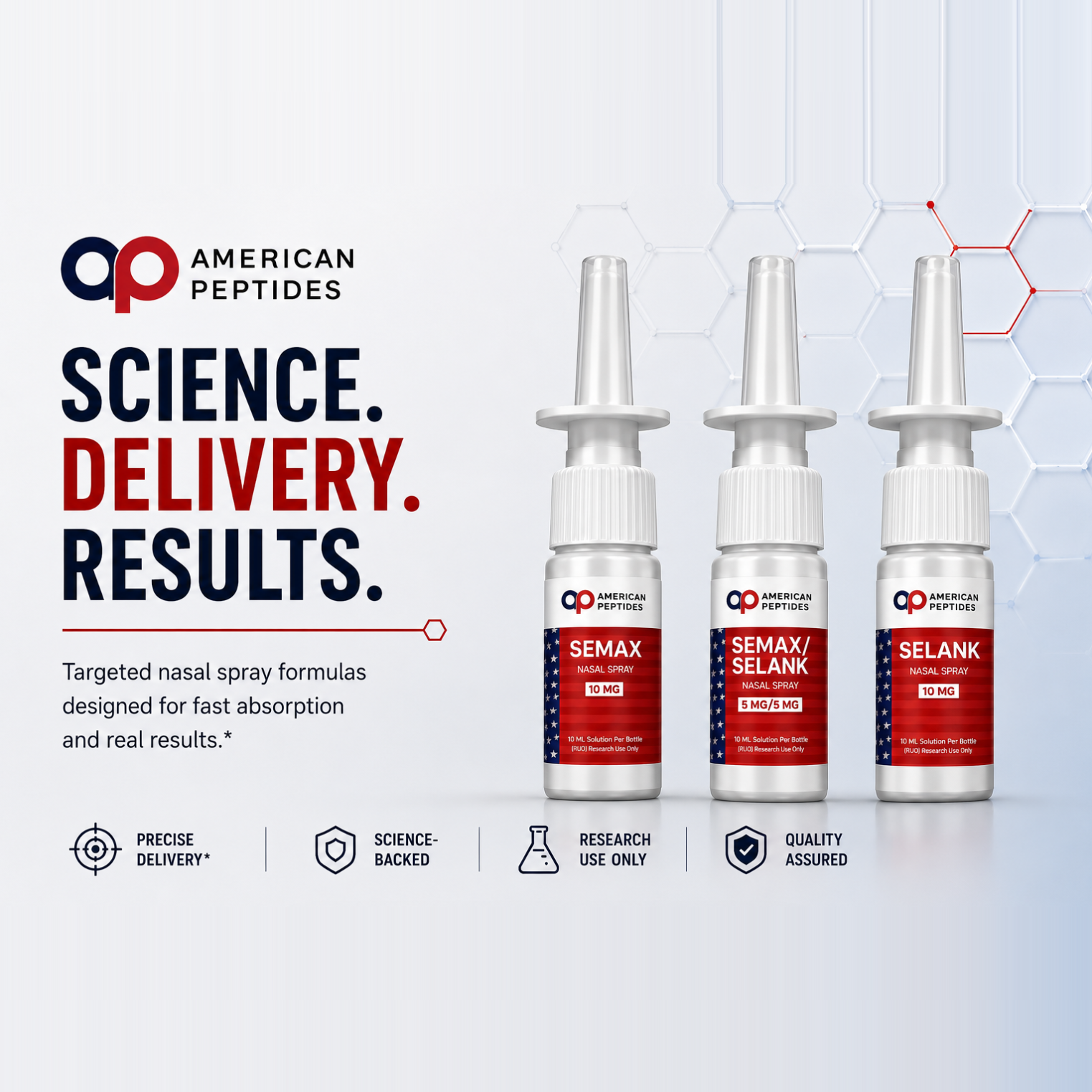
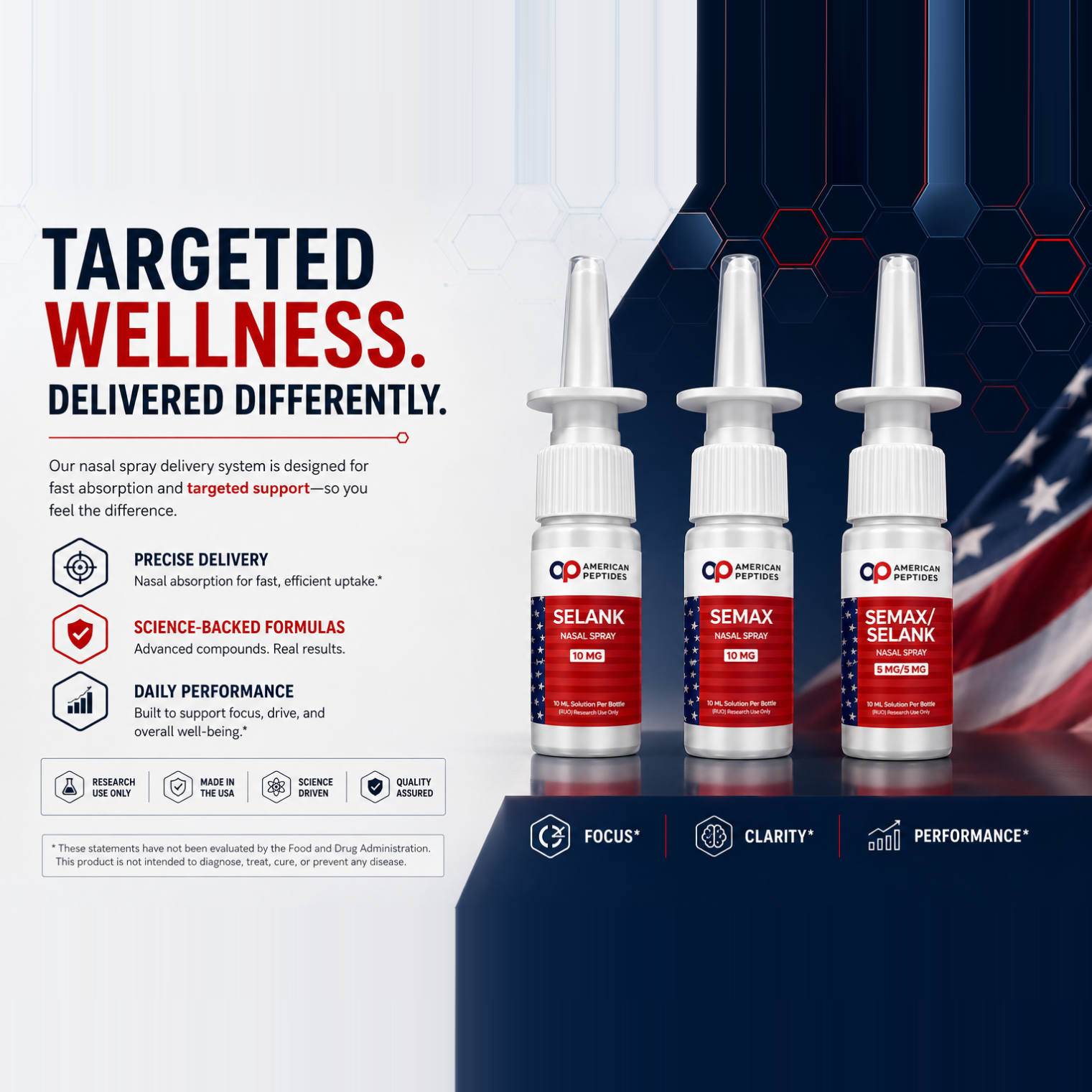
Small, water-soluble synthetic peptides are the classic candidates, because they dissolve cleanly at usable concentrations and stay in solution without co-solvents. The two most common in research catalogs are Selank and Semax — both short sequences studied in the research literature for central-signaling pathways in laboratory models. American Peptides supplies all three spray-solution formats pre-mixed:
Browse the pre-mixed lineup: Ready-to-Use Peptide Formats & Dissolving Films →
Frequently Asked Questions
What is a peptide spray-solution format?
It is a peptide dissolved in a buffered aqueous vehicle and packaged in a metered atomizing pump. The formulation is characterized by its buffer and pH, its preservation system, its container-closure compatibility, and the droplet-size distribution and emitted volume the pump produces per actuation.
Why does the buffer matter in a spray formulation?
Because peptide degradation chemistry in aqueous media is pH-dependent. Backbone hydrolysis, deamidation, and oxidation each have their own pH-rate profile, and the buffer holds the solution in the narrow region where their sum is lowest for that specific sequence across the labeled shelf life.
How is droplet size characterized?
By laser-diffraction sizing of the emitted plume, supported by spray-pattern and plume-geometry imaging and emitted-volume testing across the container's life. Droplet-size distribution varies with solution viscosity, surface tension, orifice geometry, and actuation force, so it is treated as a property of the pump-and-solution system.
Is a spray solution as stable as a lyophilized vial?
No. A sealed lyophilized vial is characterized in the literature as the more stable format, because very low residual water and restricted molecular mobility slow hydrolysis and aggregation. A pre-mixed solution trades some of that shelf life for the fact that it requires no bench preparation.
What in-vitro models are used to study spray formulations?
Franz diffusion cells with synthetic or excised membranes, and epithelial cell monolayers such as RPMI 2650 and Calu-3 grown on permeable supports with transepithelial electrical resistance as a barrier-integrity control. Both are cell-and-membrane laboratory assays reported in the research literature.
Related reading: What Is Selank? · What Is Semax? · Peptide Research Formats Explained. Verify identity and purity for any format on the COA library.
Reviewed by the American Peptides Education Team. Educational content only — not medical advice.
This article is for laboratory research reference only. American Peptides research peptides are sold strictly for in vitro research and are not for human consumption.
Related research
- Peptide Research Formats Explained: Lyophilized Vials, Solutions, Sprays, and Films
- Spray Solutions vs Reconstituted Vials: A Research Format Comparison
- Dissolving-Film Peptide Formats: The Science of Thin-Film Matrices
- What Is Selank? A Research Overview of the Peptide and Its Studied Pathways
- What Is Semax? A Research Overview of the Peptide and Its Studied Pathways
Compliance Notice: American Peptides research peptides are sold strictly for laboratory and academic research purposes only. They are not intended for human or veterinary consumption, diagnosis, treatment, or prevention of any disease. All content on this page is educational in nature and does not constitute medical advice or product claims. Researchers are responsible for handling these compounds in accordance with their institution's safety protocols and applicable laws.