
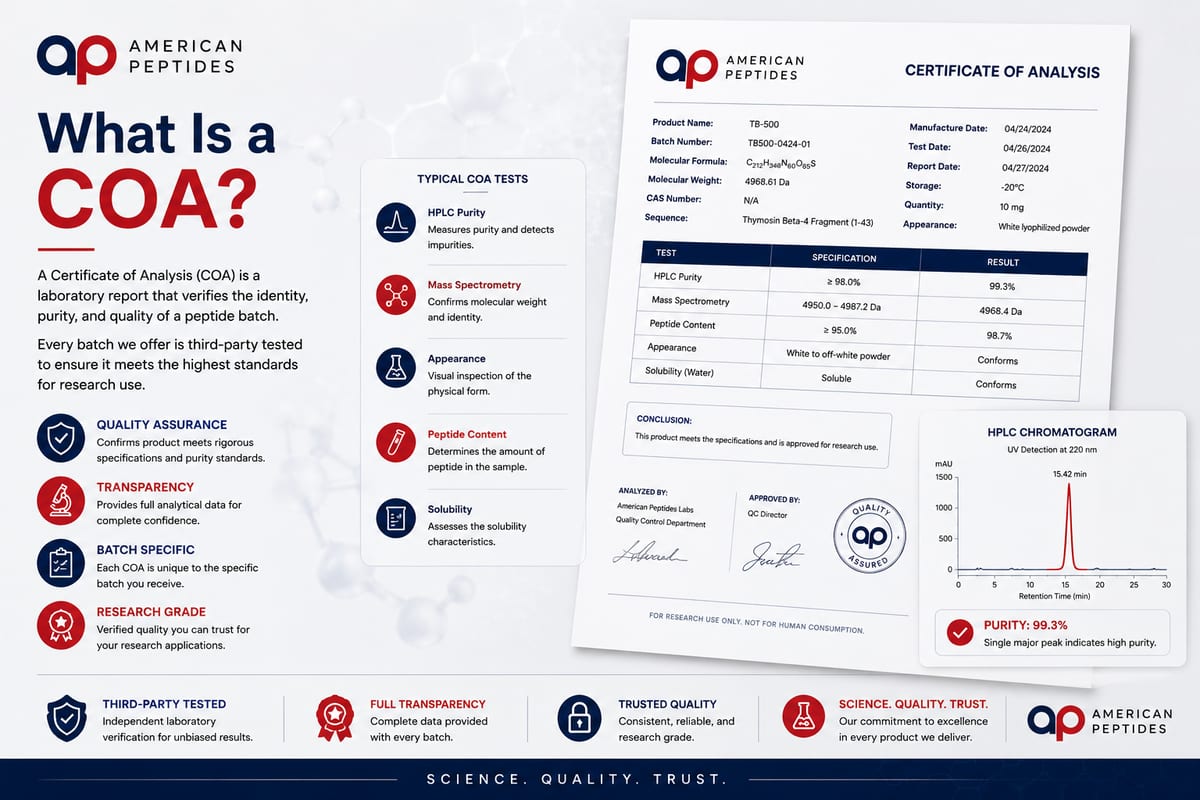
A Certificate of Analysis (COA) is a document, issued by an analytical laboratory, that reports the test results for a specific production lot of a material. For a research peptide, a credible COA reports identity and purity for that exact lot — it is the primary trust document in research sourcing.
What a credible peptide COA includes
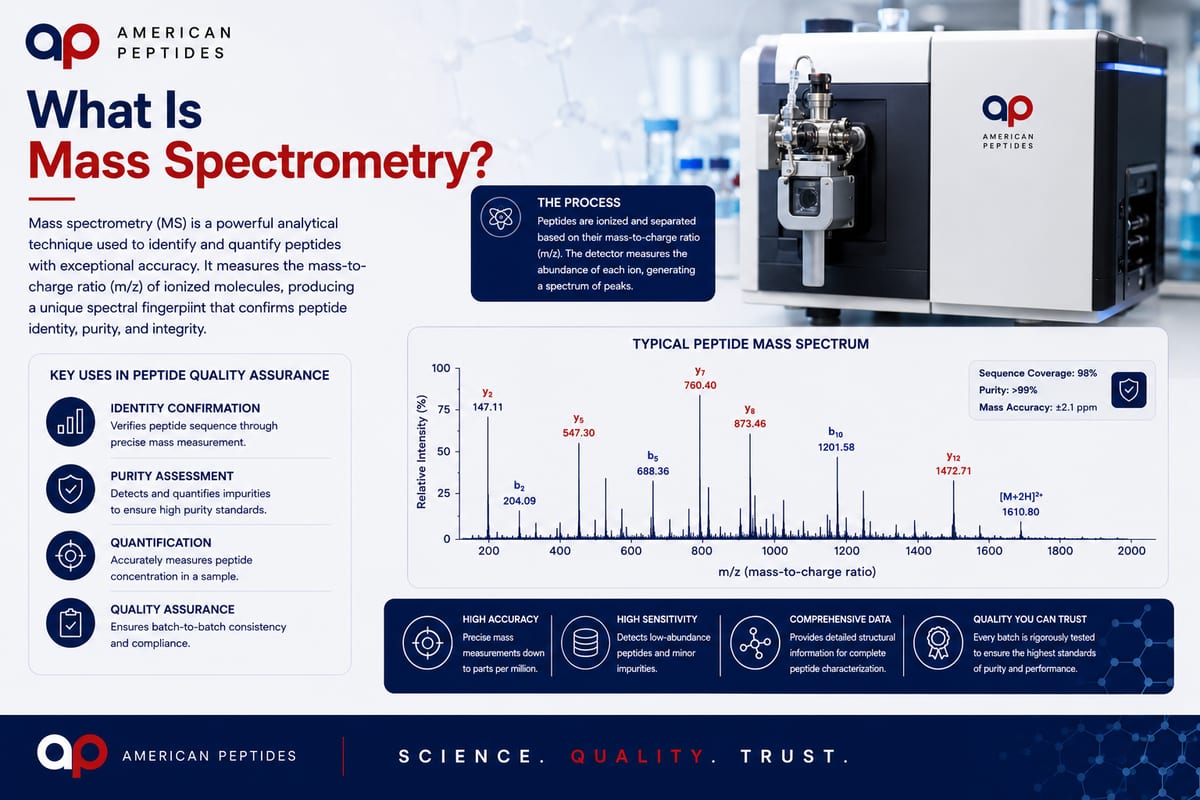
- Identity — confirmed by mass spectrometry (correct molecular mass).
- Purity — HPLC purity percentage, ideally with the chromatogram.
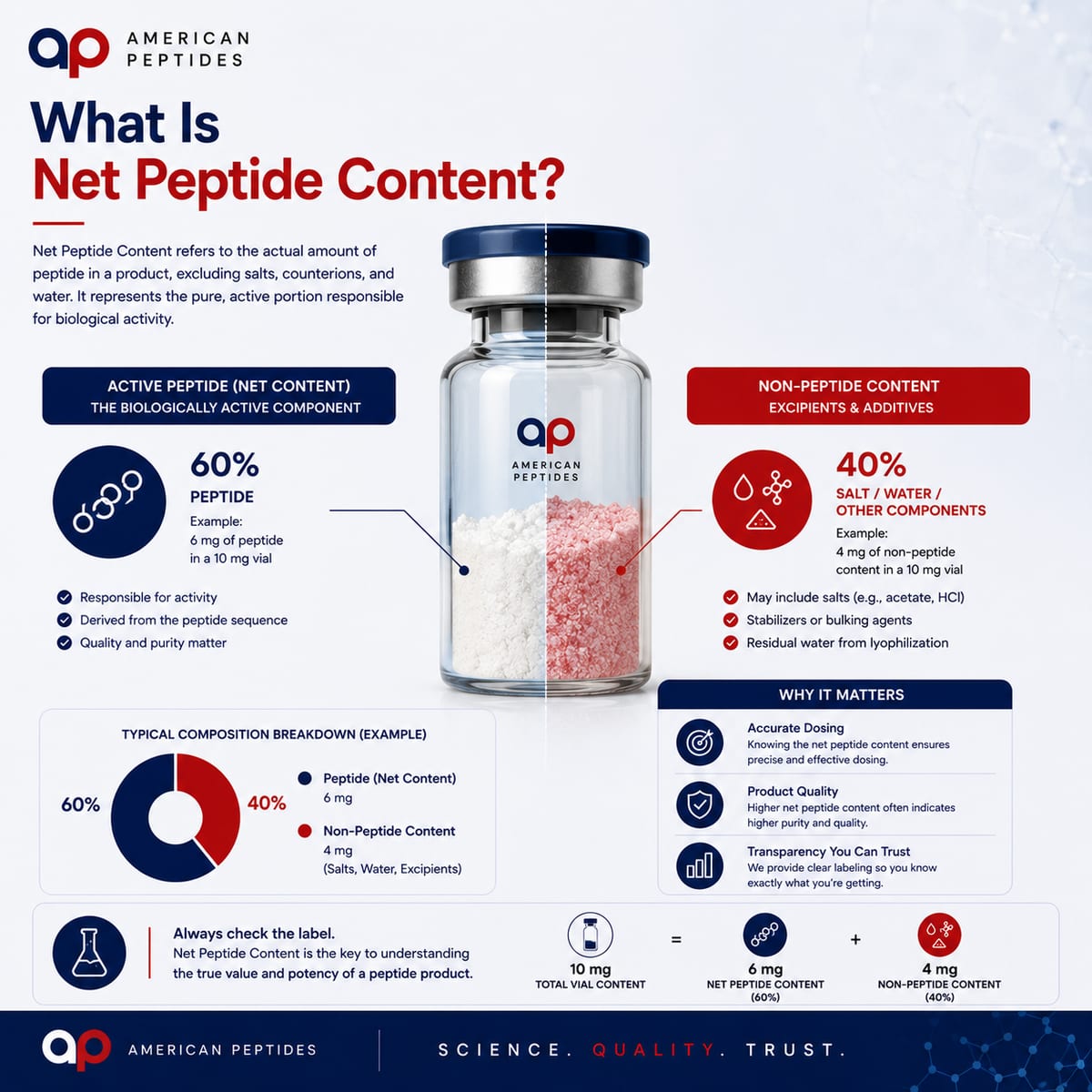
- Net peptide content — peptide mass vs salts/water.
- Lot number + date — must match the vial.
- Lab name / method — ideally an independent, accredited lab.
- Often: appearance, water content, and contamination testing.
Identity vs purity vs content: three different questions
| Field | Answers | Method |
|---|---|---|
| Identity | Is it the correct molecule? | Mass spectrometry |
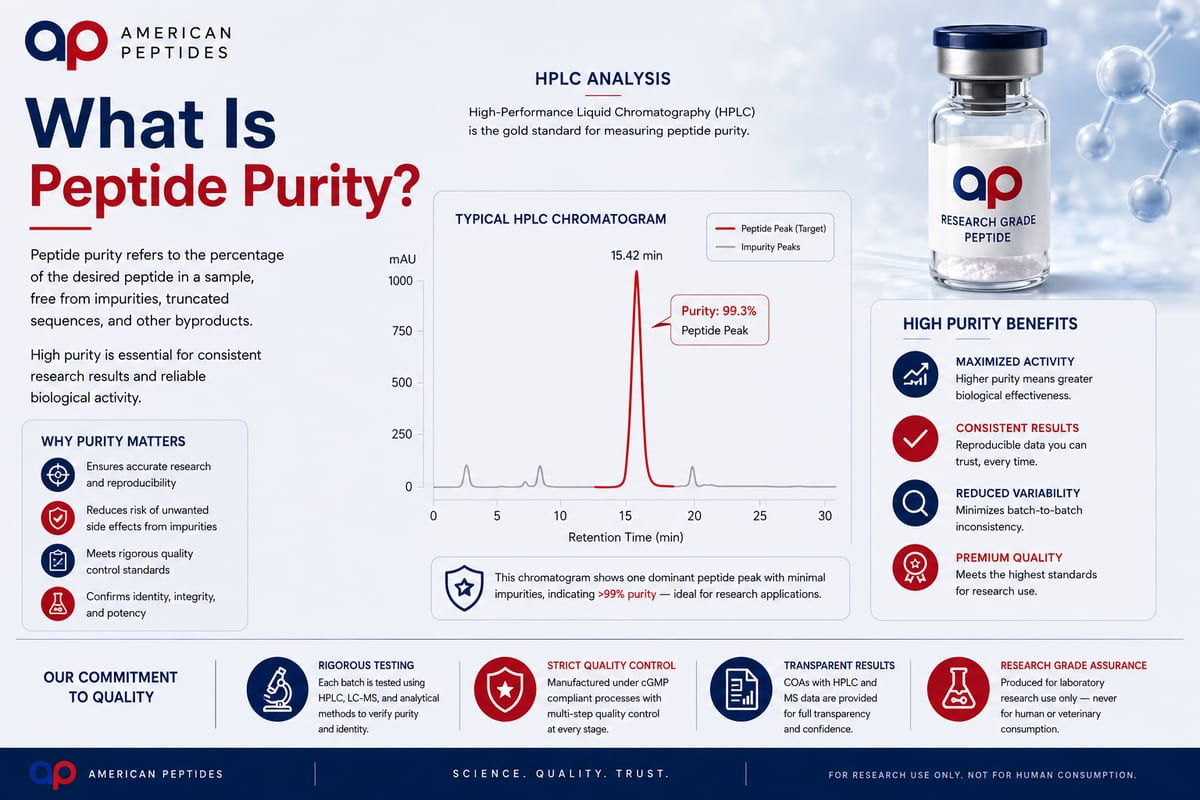
| Purity | How much is the target vs impurities? | HPLC (% peak area) |
| Net content | How much of the mass is peptide? | Content assay |
A sample can pass one and fail another — correct mass but low purity, or 99% pure but only 80% peptide by mass. A complete COA reports all three so none is assumed.
How a COA is generated
A representative sample from the finished lot is analyzed: HPLC separates the components and quantifies the dominant peak as a purity percentage; mass spectrometry measures the molecular mass to confirm the sequence is the intended one; a content assay determines how much of the dry mass is actually peptide versus counter-ions and residual water. Those measured values — not estimates — become the COA. This is why a real chromatogram is more informative than a bare number: it shows the separation the percentage came from.
The single most important habit
Match the COA’s lot number to the lot number on the vial. Results are lot-specific: a COA from a different lot says nothing about the material you actually have. A generic or unmatched COA is a weak signal; an independent, lot-specific COA is the standard. This is the same fidelity discipline that underpins reproducible signaling research.
Independent vs in-house testing
An in-house “we tested it” figure is weaker than a named, ideally accredited, third-party lab with a method and a chromatogram you can inspect. Independence reduces conflict of interest; a visible method lets a researcher judge whether the analysis was rigorous. The credibility ladder runs: blanket claim < unmatched COA < lot-matched COA < lot-matched COA from a named independent lab with chromatogram and mass spec.
How to read one in practice
Confirm the lot matches the vial; check the mass-spec value against the expected molecular weight; read the HPLC purity and look at the chromatogram (a single clean dominant peak versus a cluster); check net peptide content for quantitative work; note the date and lab. If any of these is missing or unmatched, treat the figure with caution. Background on each metric is in peptide purity and what is a peptide.
What a COA does not establish
A COA documents what a lot is and how pure it is. It does not establish safety or efficacy for any use, and it is not a license for human or animal use. It is a research-quality artifact, not a medical one — consistent with how research materials are handled generally.
Reading a chromatogram, not just a number
The most informative part of a purity result is often the chromatogram itself. A single sharp, dominant peak with a flat baseline is a strong signal; a dominant peak shadowed by a cluster of smaller ones at the same purity percentage tells a more nuanced story about related impurities. This is why a credible COA ideally shows the trace, not only the headline figure — it lets a researcher judge the separation behind the purity number rather than take it on faith.
How a COA fits the wider quality chain
A certificate is one link, not the whole chain. It is strongest when paired with stable lyophilized supply, disciplined cold storage, and a documented lot trail from synthesis to vial. Together these keep the material trustworthy end to end — the precondition for reproducible signaling research, where an unverified input silently invalidates every downstream measurement.
Frequently Asked Questions
What does a COA prove?
That a specific lot was tested and what the results were — chiefly identity (mass spectrometry) and purity (HPLC). It does not establish safety or efficacy for any use.
Why must the COA lot number match the vial?
Because results are lot-specific. A COA from a different lot says nothing about the material you actually have; matching lot numbers is the core verification step.
What makes a COA credible?
Independent (third-party) testing, a named lab and method, a lot number and date matching the product, and both HPLC purity and mass-spec identity reported — ideally with the chromatogram.
How is a COA generated?
A representative sample of the finished lot is analyzed by HPLC (purity), mass spectrometry (identity), and a content assay (net peptide), and the measured values become the certificate.
Is a purity claim without a COA enough?
No. A blanket “99% pure” with no lot-matched, lab-issued document is a weak signal. The COA itself is the evidence.
What is the difference between identity and purity on a COA?
Identity (mass spectrometry) confirms the molecule is correct; purity (HPLC) measures how much of the sample is that molecule versus impurities. Both are needed.
Does a COA mean the material is safe to use?
No. A COA is a research-quality document about composition. It does not establish safety or efficacy and is not use authorization.
Related Optimization Protocols
Reviewed by the American Peptides Education Team. Educational content only — not medical advice.
For research use only. Sold exclusively for in-vitro laboratory research. Not a drug, supplement, food, or medical product. Not for human or animal consumption, diagnostic, or therapeutic use. Nothing here is dosing, administration, or medical guidance.