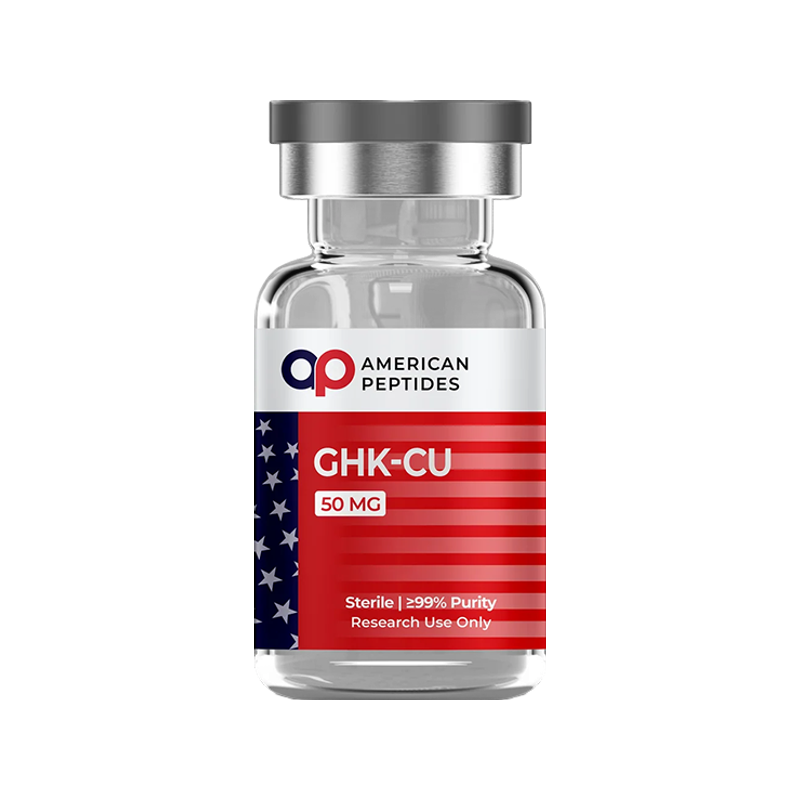

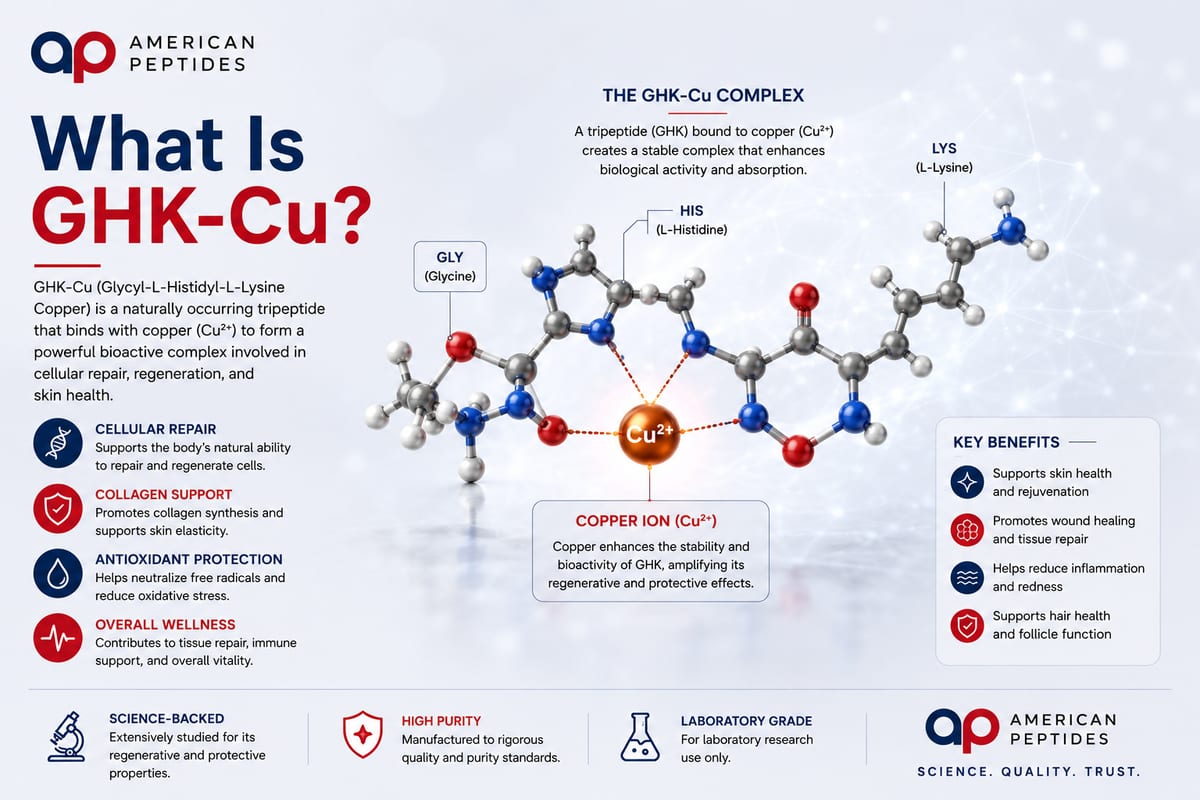
GHK-Cu is a tripeptide — glycyl-L-histidyl-L-lysine — complexed with a copper(II) ion. The peptide GHK occurs naturally; in research it is frequently studied as its copper complex for its role in copper-binding and cellular-signaling pathways. It is referenced here strictly as a research and educational topic, for in-vitro use only.
Composition and structure
GHK is a three-residue sequence: glycine–histidine–lysine (Gly-His-Lys). Its defining chemical feature, and the reason it is studied as a complex, is its high affinity for copper(II); the histidine imidazole and the terminal amine coordinate the copper ion. The “-Cu” denotes that bound copper. As a small, defined peptide it is straightforward to synthesize and verify — see what is a peptide and what is an amino acid.
Why the copper complex matters
GHK alone and GHK-Cu are studied somewhat differently in the literature because copper binding changes the molecule’s chemistry and is central to the pathways researchers investigate. This is why research material is commonly prepared and characterized specifically as the copper-bound complex rather than the bare peptide.
What the research studies
Published in-vitro work discusses GHK-Cu primarily in the context of copper transport and gene-expression signaling in cultured cells. These are molecular observations in experimental systems — not human outcomes and not guidance for use. For how peptides engage targets and relay signals generally, see how signaling peptides work and the science behind cellular signaling.
How GHK-Cu compares to other studied sequences
| Peptide | Distinctive feature | Research framing |
|---|---|---|
| GHK-Cu | 3 aa + bound Cu(II) | Copper transport / gene-expression signaling |
| BPC-157 | 15 aa peptide | NO system / growth-factor signaling |
| TB-500 | Thymosin β-4 fragment | Actin-binding / cell migration |
Handling and verification
GHK-Cu is supplied as a defined compound; verify the lot via a Certificate of Analysis with HPLC purity and mass-spectrometry identity. Storage and reconstitution follow standard lyophilized-peptide chemistry.
Common misconceptions
GHK and GHK-Cu are related but the copper complex is the form most studied; “naturally occurring” refers to the peptide sequence, not a claim about the research material’s use; mechanistic in-vitro findings are not human outcomes.
Copper coordination chemistry, briefly
What makes GHK-Cu distinctive is how the tripeptide binds copper(II): the imidazole nitrogen of histidine, the N-terminal amine, and backbone nitrogens form a coordination geometry that holds the metal ion with high affinity. Because the bound copper is central to the transport and signaling chemistry researchers study, material is characterized specifically as the copper complex — not the bare peptide — and its identity is confirmed by mass spectrometry with HPLC purity on a lot-specific Certificate of Analysis. Coordination state and stoichiometry matter for reproducibility, which is why generic “GHK-Cu” labeling without lot-matched characterization is a weak signal. None of this coordination chemistry constitutes use guidance — it is analytical context for in-vitro research.
GHK vs GHK-Cu in the research literature
A frequent source of confusion is whether studies refer to the free peptide (GHK) or the copper complex (GHK-Cu). They are chemically distinct: copper binding alters charge, conformation, and the chemistry researchers are usually probing, so the two are not interchangeable in experimental design. Most of the well-known in-vitro literature concerns the copper-bound form, which is why research material is typically characterized as GHK-Cu with defined stoichiometry. For reproducibility this means the Certificate of Analysis should make the form explicit and be matched to the lot, with identity confirmed by mass spectrometry. As with other defined sequences such as BPC-157 and TB-500, credibility rests on lot-specific characterization, not the label — and all of this is analytical context for in-vitro research, never use guidance.
Practical takeaways for researchers
For anyone evaluating GHK-Cu as a research material, three points consolidate the chemistry above. First, confirm the form: the literature you are referencing almost always concerns the copper complex, so the material and its Certificate of Analysis should state GHK-Cu explicitly, not just GHK. Second, demand lot-specific data: identity by mass spectrometry and HPLC purity tied to the exact vial, because coordination chemistry and stoichiometry are reproducibility variables, not cosmetic details. Third, keep mechanism and outcome separate: in-vitro copper-transport and gene-expression findings describe behavior in those systems and are never use guidance. Applied consistently, these habits are what make GHK-Cu research interpretable and repeatable rather than anecdotal.
Frequently Asked Questions
What does GHK-Cu stand for?
GHK is the tripeptide glycyl-histidyl-lysine; “Cu” denotes a bound copper(II) ion. Together, GHK-Cu is the copper complex of the GHK peptide.
Is GHK-Cu naturally occurring?
The GHK peptide sequence occurs naturally. In research it is commonly prepared and studied as the copper-bound complex because copper binding is its defining, well-studied chemical property.
Why is GHK studied as a copper complex?
Because copper binding changes the molecule’s chemistry and is central to the transport and signaling pathways researchers investigate, material is typically characterized as the Cu-bound form.
What is GHK-Cu studied for?
Published in-vitro research discusses it in the context of copper transport and cellular gene-expression signaling. These are molecular observations in experimental systems, not human outcomes.
Is GHK-Cu approved for human use?
No. As supplied for research it is for in-vitro laboratory use only and is not an approved drug, supplement, or medical product.
How does GHK-Cu differ from BPC-157 or TB-500?
Different chemistry: GHK-Cu is a copper-bound tripeptide; BPC-157 is a 15-residue peptide; TB-500 is a thymosin β-4 fragment. Each is studied around different pathways, with the same verification standards.
How is GHK-Cu verified for research?
Via a lot-specific Certificate of Analysis reporting HPLC purity and mass-spectrometry identity, matched to the vial’s lot number.
Related Optimization Protocols
Reviewed by the American Peptides Education Team. Educational content only — not medical advice.
For research use only. Sold exclusively for in-vitro laboratory research. Not a drug, supplement, food, or medical product. Not for human or animal consumption, diagnostic, or therapeutic use. Nothing here is dosing, administration, or medical guidance.