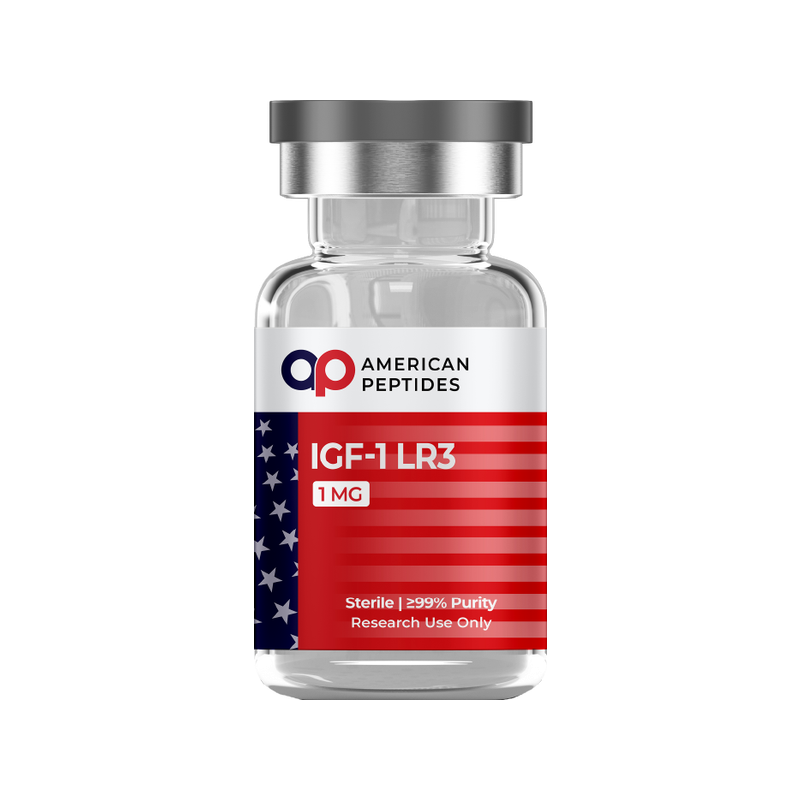
IGF-1 LR3 — Long R3 IGF-I in the original papers, LR3IGF-I in most of what followed — is an 83-amino-acid recombinant analogue of human insulin-like growth factor 1. Native IGF-1 is a 70-residue single-chain peptide with three disulfide bridges, related to proinsulin and the main circulating mediator of growth hormone action. The LR3 variant replaces the glutamate at position 3 with arginine and adds a 13-residue N-terminal extension. This article builds on our IGF-1 explainer and covers what the modification does, what cell-culture and bioprocess studies report, what the rodent work measured, and where the human evidence stops.
Research-use-only context. This article summarizes published third-party scientific literature — the large majority of it conducted in cultured cells or animal models. It is not medical advice, not a therapeutic or performance claim, and not a usage guide. American Peptides products are sold strictly for in vitro laboratory research and are not for human or veterinary use.
What IGF-1 LR3 is
IGF-1 is made mainly in the liver in response to pituitary growth hormone and circulates almost entirely bound to six high-affinity IGF-binding proteins (IGFBP-1 to -6), most of it in a ternary complex with IGFBP-3 and the acid-labile subunit. In culture, many cell lines secrete IGFBPs into the medium, where they compete with the receptor for the ligand. IGF-1 acts through the type 1 IGF receptor (IGF-1R), a heterotetrameric receptor tyrosine kinase closely related to the insulin receptor. Ligand binding recruits the adaptors IRS-1 and Shc, which engage two cascades: PI3K–Akt–mTOR, associated with protein synthesis and cell survival, and Ras–MAPK (ERK), associated with proliferation and differentiation. Our receptor pathways primer covers that machinery.
The analogue was designed in Adelaide. King, Wells, Francis and colleagues (1992, Journal of Molecular Endocrinology) described an Escherichia coli system producing IGF-1 and two position-3 variants, [Gly3]-IGF-I and [Arg3]-IGF-I, as fusion proteins that were cleaved, refolded and purified. Both variants bound very poorly to bovine IGFBP-2, bound slightly less well than IGF-1 to the type-1 receptor on rat L6 myoblasts, and were nonetheless more potent in assays of protein synthesis, DNA synthesis and inhibition of protein breakdown. The authors concluded that reduced IGFBP binding, not increased receptor binding, explained the extra potency.2 A companion paper the same year described the “Long” series: the IGF-1 sequence fused to the first 11 residues of methionyl porcine growth hormone plus a Val-Asn linker — the 13-residue extension, retained partly because it improved folding yields.1 Long [Arg3]-IGF-I is the molecule now sold as IGF-1 LR3: a roughly 9 kDa, three-disulfide recombinant protein whose defining property is not greater receptor affinity — if anything the reverse — but escape from IGFBP sequestration.
What cell and tissue studies report
Potency depends on the binding proteins in the dish
In the 1992 Francis paper, all the Long analogues were more potent than IGF-1 in rat L6 myoblasts at stimulating protein and DNA synthesis and inhibiting protein breakdown, the protein synthesis and cell proliferation readouts the field has used since. Across cell lines that secrete IGFBPs into the medium, the order was Long [Arg3]-IGF-I roughly equal to des(1-3)IGF-I, then Long [Gly3]-IGF-I, then Long IGF-I, then IGF-1. But in chicken embryo fibroblasts, which secrete no detectable IGFBPs, Long [Arg3]-IGF-I was less potent than IGF-1.1 That inversion is the key result: the analogue's advantage exists only where binding proteins are present to sequester native IGF-1.
Binding-protein escape varies by species
Lord, Bastian, Read, Walton and Ballard (1994, Journal of Endocrinology) compared how labelled IGF-1, des(1-3)IGF-I and LR3IGF-I associate with plasma binding proteins from rat, sheep, pig, human and chicken. Variants that bound extremely weakly in rat plasma bound significantly in the other species; by size-exclusion chromatography the extent of variant binding fell in the order sheep > human > pig = chicken > rat.3 LR3 binds IGFBPs less than IGF-1 in every species tested, but the near-total escape seen in rat is rat-specific, and rat data overstate the effect for human or ovine systems.
Cell-culture media: the bioprocess literature
The main legitimate use of IGF-1 LR3 is as a growth and viability factor in serum-free media for cells that manufacture recombinant proteins. Morris and Schmid (2000, Biotechnology Progress, at Immunex) set out the logic: insulin is the most commonly used growth factor in serum-free Chinese hamster ovary (CHO) cultures, and they compared it with LongR3 in two CHO lines expressing recombinant cytokine receptors. One line grew without an added growth factor but needed one for optimal performance under production conditions; the other required insulin or LongR3 to grow at all. In both, LongR3 sustained viability under production conditions better than insulin, and the authors named it the preferred growth factor for those lines.4 This is how IGF-1 LR3 appears in most of the literature — as a reagent in the media recipe, not the subject of the study.
Mitogenic signalling in cultured cancer cells
The property that makes LR3 useful in a bioreactor raises an obvious question in oncology. Wetterau, Francis, Ma and Cohen (2003, Journal of Clinical Endocrinology & Metabolism) measured telomerase activity in three human prostate cancer cell lines incubated with IGF-1 or its analogues. IGF-1 raised baseline telomerase activity two- to ten-fold, detectable within half an hour and persisting to 48 hours; Long-R3 IGF-I produced a similar roughly three-fold enhancement, whereas an analogue engineered for weak receptor binding did not. The PI3K/Akt inhibitor wortmannin abolished the effect; blocking MAPK did not.7 Telomerase activity is a readout, not an outcome, but the result places LR3 squarely on the PI3K–Akt arm of IGF-1R signalling in a transformed cell.
What animal models report
Rats under food restriction. Tomas (2001, Growth Hormone & IGF Research) studied young and adult rats fed at 100%, 78%, 56% or 33% of free-feeding intake and measured body weight, nitrogen retention, muscle protein, muscle protein turnover, body fat and plasma insulin. At every intake level the exposed rats kept 3–8% more body weight and retained more nitrogen, but muscle protein was not conserved. In young rats muscle protein turnover was unchanged; in adult rats the analogue increased protein breakdown and reduced RNA content and protein synthesis rates. The author concluded that LR3IGF-I did not spare lean tissue during short-term food restriction5 — a negative result on the question most often asked of this molecule, from the laboratory that invented it.
Rats after renal ischaemia. Martin, Gillespie, Moore, Ballard and Read (1994, Journal of Endocrinology) induced acute renal failure in male Sprague-Dawley rats by temporarily clamping both renal arteries and compared vehicle, IGF-1, des(1-3)IGF-I and LR3IGF-I groups on body weight gain, nitrogen retention, serum urea, glomerular filtration rate (GFR), urine output and concentrating ability. All three peptides improved weight gain and nitrogen retention; none improved renal function. In a follow-up on LR3IGF-I alone, GFR fell further than in controls, urinary osmolality was lower, sodium excretion was higher, and kidneys showed more tubular epithelial calcification. The authors call the analogue's effect on early renal recovery deleterious.6
Stability in blood. Mongongu and colleagues (2021, Drug Testing and Analysis) found that in rat serum LongR3-IGF-I disappeared within hours while des(1-3)-IGF-I and R3-IGF-I persisted for about a day, recovering it as N-terminally clipped products, the same products that appeared when the analogues were incubated in human whole blood in vitro.8 The extension is trimmed by circulating proteases.
Where the human evidence stops
It stops almost immediately. Mongongu and colleagues state the position at the opening of their anti-doping paper: IGF-1 and its analogues LongR3-IGF-I, Des(1-3)-IGF-I and R3-IGF-I are prohibited substances in sport, and they have not been approved for use in humans.8 That is the whole regulatory story. IGF-1 LR3 is not approved by the FDA for any indication; it has no controlled human trials, no pharmacokinetic studies in volunteers and no safety database. The World Anti-Doping Agency's Prohibited List places IGF-1 and its analogues among growth factors prohibited at all times. The 2021 detection paper also notes that black-market products it examined showed signs of lower quality, including oxidised peptide forms.8
On the mitogenic question, the mechanism is established and the outcome is not. IGF-1R signalling through PI3K–Akt is a proliferation and survival pathway, and LR3 engages the pathway in transformed cell lines at least as effectively as IGF-1.7 Whether a binding-protein-resistant analogue carries more, less or the same long-term oncogenic risk as native IGF-1 has never been tested in any species over a meaningful timescale; the 1990s rat studies ran for days and were not designed to look.5,6 On this point the literature is silent.
What is not established
- Any human pharmacology. No study has measured what IGF-1 LR3 does in people, and it is not approved by the FDA.
- Whether LR3's advantage over IGF-1 in rodents, where it barely binds IGFBPs, holds in species such as sheep or humans where it still binds substantially.3
- Whether sustained IGF-1R activation by a binding-protein-resistant ligand alters tumour initiation or progression in any intact organism; the telomerase data7 raise the question without answering it.
- Why LR3IGF-I failed to conserve muscle protein in food-restricted rats,5 and whether the renal findings after ischaemia6 reflect a general property of IGFBP-independent IGF signalling.
- Its half-life in defined culture media; peer-reviewed measurements are scarce.
Frequently Asked Questions
What is the difference between IGF-1 and IGF-1 LR3?
IGF-1 is the 70-amino-acid human hormone. IGF-1 LR3 is an 83-amino-acid recombinant analogue with arginine in place of glutamate at position 3 and a 13-residue N-terminal extension. The changes sharply reduce IGFBP binding, so potency is higher only where binding proteins are present.1,2
Why is IGF-1 LR3 used in cell-culture media?
Serum-free media for recombinant protein production need a growth and survival factor, traditionally insulin. LR3 is not sequestered by the binding proteins CHO cells secrete, and a head-to-head CHO study found it sustained viability under production conditions better than insulin.4
Is IGF-1 LR3 approved by the FDA?
No. IGF-1 LR3 is not approved by the FDA for any use, has never been evaluated in human trials, and is prohibited in sport by the World Anti-Doping Agency as an IGF-1 analogue.8 American Peptides supplies it strictly for in vitro research.
Does IGF-1 LR3 cause cancer?
Not established either way. It activates the PI3K–Akt arm of IGF-1R signalling and raised telomerase activity in prostate cancer cell lines,7 but no long-term study in any organism has examined tumour outcomes with this analogue.
Citations
- Francis GL, Ross M, Ballard FJ, et al. “Novel recombinant fusion protein analogues of insulin-like growth factor (IGF)-I indicate the relative importance of IGF-binding protein and receptor binding for enhanced biological potency.” J Mol Endocrinol. 1992;8(3):213–223. PubMed: PMID 1378742
- King R, Wells JR, Krieg P, et al. “Production and characterization of recombinant insulin-like growth factor-I (IGF-I) and potent analogues of IGF-I, with Gly or Arg substituted for Glu3, following their expression in Escherichia coli as fusion proteins.” J Mol Endocrinol. 1992;8(1):29–41. PubMed: PMID 1311930
- Lord AP, Bastian SE, Read LC, Walton PE, Ballard FJ. “Differences in the association of insulin-like growth factor-I (IGF-I) and IGF-I variants with rat, sheep, pig, human and chicken plasma-binding proteins.” J Endocrinol. 1994;140(3):475–482. PubMed: PMID 7514204
- Morris AE, Schmid J. “Effects of insulin and LongR(3) on serum-free Chinese hamster ovary cell cultures expressing two recombinant proteins.” Biotechnol Prog. 2000;16(5):693–697. PubMed: PMID 11027158
- Tomas FM. “Insulin-like growth factor-I (IGF-I) analogue, LR(3)IGF-I, ameliorates the loss of body weight but not of skeletal muscle during food restriction.” Growth Horm IGF Res. 2001;11(2):92–103. PubMed: PMID 11472075
- Martin AA, Gillespie CM, Moore L, Ballard FJ, Read LC. “Effects of insulin-like growth factor-I peptides in rats with acute renal failure.” J Endocrinol. 1994;140(1):23–32. PubMed: PMID 8138750
- Wetterau LA, Francis MJ, Ma L, Cohen P. “Insulin-like growth factor I stimulates telomerase activity in prostate cancer cells.” J Clin Endocrinol Metab. 2003;88(7):3354–3359. PubMed: PMID 12843187
- Mongongu C, Coudoré F, Domergue V, Ericsson M, Buisson C, Marchand A. “Detection of LongR(3)-IGF-I, Des(1-3)-IGF-I, and R(3)-IGF-I using immunopurification and high resolution mass spectrometry for antidoping purposes.” Drug Test Anal. 2021;13(7):1256–1269. PubMed: PMID 33587816
Related reading
- What Is IGF-1? Complete Guide to Insulin-Like Growth Factor 1
- Receptor Pathways: A Researcher's Primer
- How Signaling Peptides Work: A Complete Science Explainer
- Sermorelin Research: What the Studies Actually Show
- How to Read a Peptide Certificate of Analysis (COA)
This article is for laboratory research reference only. American Peptides products are sold strictly for in vitro research. Not for human consumption.
Related research
Compliance Notice: American Peptides products are sold strictly for laboratory and academic research purposes only. They are not intended for human or veterinary consumption, diagnosis, treatment, or prevention of any disease. All content on this page is educational in nature and does not constitute medical advice or product claims. Researchers are responsible for handling these compounds in accordance with their institution’s safety protocols and applicable laws.