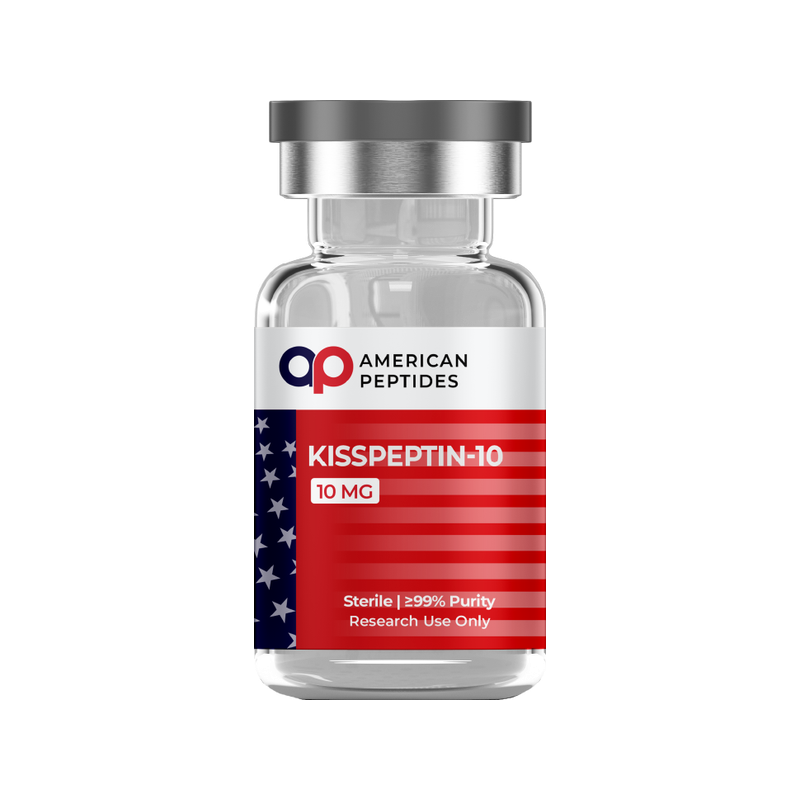

Kisspeptin-10 — KP-10, also written metastin 45–54 — is a ten-residue peptide corresponding to the carboxy-terminal end of the protein encoded by the human KISS1 gene. Its sequence is Tyr-Asn-Trp-Asn-Ser-Phe-Gly-Leu-Arg-Phe, amidated at the C terminus, and it is the shortest fragment of that protein reported to carry full intrinsic activity at the receptor now called KISS1R, known in the older literature as GPR54.8 The gene was not found by neuroendocrinologists: it was isolated in 1996 from melanoma cells as a suppressor of metastasis, and only later did receptor pharmacology and human genetics place its peptide products in the reproductive axis.1 What follows traces that literature in order, through to the point where the human record runs out. Readers new to G-protein-coupled receptor language may want our primer on receptor pathways alongside it.
Research-use-only context. This article summarizes published third-party scientific literature — the large majority of it conducted in cultured cells or animal models. It is not medical advice, not a therapeutic or performance claim, and not a usage guide. American Peptides products are sold strictly for in vitro laboratory research and are not for human or veterinary use.
What Kisspeptin-10 is
The origin story is oncological. Lee and colleagues at Pennsylvania State University were asking which gene on human chromosome 6 suppressed the metastatic ability of melanoma cells: transferring that chromosome into the human C8161 and MelJuSo lines cut metastatic capacity by at least 95% without changing their ability to form tumours. Subtractive hybridization against non-metastatic chromosome-6 hybrid clones yielded a novel cDNA they named KiSS-1, whose transcript appeared only in non-metastatic melanoma lines and, among normal tissues, was highest by a wide margin in placenta. The cDNA encoded a predominantly hydrophilic 164-amino-acid protein carrying a polyproline-rich SH3-ligand domain, and transfecting the full-length construct back into C8161 cells suppressed metastasis in proportion to expression.1 Nothing in that paper concerned the brain.
Five years later two groups independently went after the peptide product. A Takeda group purified from human placenta a C-terminally amidated 54-residue peptide encoded by KiSS-1, identified it as the endogenous ligand of an orphan G-protein-coupled receptor then called hOT7T175, and named it metastin.2 The same year, a Brussels group isolated agonist peptides for the orphan receptor GPR54 from human placenta — 54-, 14- and 13-residue species sharing a common RF-amide C terminus — and designated the family kisspeptins.3 The two names describe the same chemistry: kisspeptin-54 is metastin, the shorter natural fragments nest inside it, and all terminate in the same amidated decapeptide. Kisspeptin-10 is that decapeptide, prepared synthetically rather than purified from tissue.
The receptor is a class A G-protein-coupled receptor with roughly 40% sequence homology to the galanin receptors, part of why it sat unassigned for years.4 Its transcript was highest in placenta, pituitary, pancreas and spinal cord — a pattern the 2001 authors read as pointing to endocrine regulation.3 That hint was correct, but it took human genetics to show where.
What cell and tissue studies report
The canonical signaling description comes from the Brussels characterization. Kisspeptins bound with low nanomolar affinity to rat and human GPR54 expressed in Chinese hamster ovary K1 cells. In those cells, receptor occupancy stimulated hydrolysis of phosphatidylinositol 4,5-bisphosphate, mobilization of intracellular calcium, release of arachidonic acid, phosphorylation of ERK1/2 and p38 MAP kinase, and formation of stress fibres — while inhibiting proliferation of the same cells.3 That is a textbook Gq-coupled profile: phospholipase C activation, inositol phosphate generation, a calcium transient, downstream MAP-kinase phosphorylation. The anti-proliferative readout is the cell-level counterpart of the metastasis-suppressor phenotype the gene was named for.
The Takeda work added migration endpoints. In CHO cells engineered to express the receptor, metastin inhibited chemotaxis and invasion in vitro, and receptor-expressing B16-BL6 melanoma cells showed attenuated pulmonary metastasis in mice.2 Both halves depend on cells made to carry the receptor — the central caveat across this in vitro literature: the signaling and anti-migratory numbers come from heterologous lines overexpressing KISS1R, not from cells expressing it at native density.
One assay here was built to interpret a human mutation. Having found GPR54 coding changes in families lacking pubertal development, the Massachusetts General Hospital group transfected COS-7 cells with wild-type and mutant receptor constructs; the mutants accumulated significantly less inositol phosphate.5 Small on its own, it closes a loop: the Gq readout seen with purified peptides is the one that fails when the receptor carries a loss-of-function change found in a human family.
What animal models report
The mouse work arrived with the genetics. Alongside the human pedigrees, the 2003 Boston group generated and phenotyped a Gpr54-deficient mouse. Those animals showed isolated hypogonadotropic hypogonadism — small testes in males, delayed vaginal opening and absent follicular maturation in females — yet responded normally to exogenous gonadotropins and GnRH, with normal hypothalamic GnRH content.5 That phenotype is what moved the field: the deficit sits upstream of GnRH release, not in GnRH neuron development, the pituitary, or gonadal competence.
Where upstream was answered by slice electrophysiology. Han and colleagues recorded GnRH neurons labelled with green fluorescent protein in mouse brain slices and found that kisspeptin exposure evoked a long-lasting depolarization in more than 90% of GnRH neurons from adult males and females. In juvenile mice (postnatal days 8–19) only 27% responded, and in prepubertal mice (days 26–33) only 44%; the in vivo luteinizing hormone response measured in the same study rose in parallel. Quantitative in situ hybridization split the explanation: about 90% of GnRH neurons expressed GPR54 messenger RNA at both ages with no detectable difference in transcript content, while KiSS-1 messenger RNA in the anteroventral periventricular nucleus increased sharply across the juvenile-to-adult transition.6 What was measured is membrane potential, response prevalence by age, transcript abundance and serum luteinizing hormone — not behaviour, and not any outcome.
The anatomical synthesis that followed is the KNDy concept. A subset of arcuate-nucleus neurons co-expresses kisspeptin, neurokinin B and dynorphin. Lehman and colleagues summarized the case that this KNDy subpopulation is conserved from rodents to humans, is a major target for steroid hormones, forms a reciprocally interconnected network, and projects directly to both GnRH cell bodies and GnRH terminals — positioning these cells to convey steroid feedback onto GnRH neurons and, the review proposes, to act as a component of the GnRH pulse generator.7 This is the model most rodent and sheep kisspeptin work is now framed against.
Where the human evidence stops
Start with how the reviewers themselves write. The KNDy review is explicit that growing evidence suggests a role for these neurons, and that their anatomy potentially makes them part of the pulse generator.7 That hedging is worth preserving: the model rests on co-expression, projection mapping and steroid-receptor expression, largely in rodents and sheep, and remains a proposal rather than a settled human mechanism.
The strongest human evidence here is genetic, and it concerns the receptor rather than the peptide. A French group studied a large consanguineous family with five affected siblings and a normal GnRH receptor coding sequence, mapped a locus to chromosome 19p13, and found every affected sibling carried a homozygous 155-nucleotide GPR54 deletion spanning the intron 4–exon 5 splice acceptor site.4 The Boston group independently reported affected individuals homozygous for an L148S change, plus an unrelated proband carrying R331X and X399R.5 Both conclude that loss of GPR54 function causes autosomal recessive isolated hypogonadotropic hypogonadism — which establishes the receptor is necessary for normal GnRH physiology, and says nothing about what happens when the peptide is supplied.
Human physiology studies of KP-10 itself exist, and they are small. Studies in healthy male volunteers measured gonadotropin levels and reported a rapid rise in serum luteinizing hormone after exposure, with the response at the highest exposure level tested smaller than at a lower one. Over a longer observation window, mean luteinizing hormone rose, pulse frequency increased from roughly 0.7 to 1.0 pulses per hour, secretory burst mass increased on deconvolution analysis, and serum testosterone was higher at the end of the period than at its start.8 Group sizes were four to six volunteers — short physiological observations in a handful of healthy men, read out through assays whose interpretation is not trivial; see our note on total versus free testosterone.
Three things then need saying plainly. Kisspeptin-10 is not approved by the FDA for any use, and no kisspeptin product holds a marketing authorization as a finished product anywhere. It is investigational in the literal sense: the published human record is a handful of small mechanistic physiology studies, with no controlled outcome studies and no data on repeated or extended exposure. And research-grade KP-10 is characterised as a chemical — identity, purity, net peptide content, stability in solution — so nothing above transfers to it as a property of a product. American Peptides supplies Kisspeptin-10 strictly for in vitro laboratory research, as a reference ligand for groups studying KISS1R pharmacology.
What is not established
- Whether the Gq / calcium / MAP-kinase signature recorded in receptor-overexpressing CHO and COS-7 lines3,5 reflects signaling at native KISS1R density in human hypothalamic neurons.
- Whether the KNDy pulse-generator model, assembled largely from rodent and sheep anatomy, operates the same way in the human hypothalamus.7
- How receptor desensitization shapes the response over continued exposure. The human report observed a smaller luteinizing hormone rise at its highest exposure level than at a lower one, a non-monotonic pattern it records but does not resolve.8
- Whether the metastasis-suppression findings, which came from cell lines engineered to express the receptor,2 correspond to anything measurable in human disease.
- Whether any measured endpoint — depolarization, luteinizing hormone pulse frequency, gonadotropin concentration — connects to a human outcome. Rodent KP-10 also ends in Arg-Tyr rather than the human Arg-Phe, and most of the electrophysiology is mouse.
Frequently Asked Questions
Is Kisspeptin-10 approved by the FDA?
No. Kisspeptin-10 is not approved by the FDA for any use, and no kisspeptin product holds a marketing authorization. The published human literature consists of small mechanistic physiology studies in healthy volunteers, with no controlled outcome studies. American Peptides supplies it strictly for in vitro research.
What is the difference between kisspeptin-10, kisspeptin-54 and metastin?
They are fragments of the same protein. The KISS1 gene product yields a C-terminally amidated 54-residue peptide, isolated from human placenta in 2001 and named metastin by one group2 and kisspeptin-54 by another.3 Shorter natural species of 14 and 13 residues were purified alongside it. All end in the same amidated decapeptide, and KP-10 is that decapeptide made synthetically — reported as the minimal sequence with full intrinsic activity.8
What receptor does Kisspeptin-10 act on?
KISS1R, originally described as the orphan receptor GPR54 and also published as hOT7T175 and AXOR12. It is a class A G-protein-coupled receptor with about 40% homology to the galanin receptors.4 In receptor-expressing cell lines, kisspeptins drive phosphatidylinositol hydrolysis, calcium mobilization and ERK1/2 and p38 phosphorylation.3
What did the 2003 GPR54 genetics papers actually show?
That the receptor is required for normal reproductive maturation. A French group found a homozygous 155-nucleotide GPR54 deletion in all five affected siblings of a consanguineous family with isolated hypogonadotropic hypogonadism.4 A Boston group reported an L148S homozygous change plus compound R331X / X399R changes in an unrelated proband, and built a Gpr54-deficient mouse with a matching phenotype.5 Both are loss-of-function findings: they show necessity, not that supplying the peptide produces a benefit.
Citations
- Lee JH, Miele ME, Hicks DJ, Phillips KK, Trent JM, Weissman BE, Welch DR. “KiSS-1, a novel human malignant melanoma metastasis-suppressor gene.” J Natl Cancer Inst. 1996;88(23):1731–1737. PubMed: PMID 8944003
- Ohtaki T, Shintani Y, Honda S, et al. “Metastasis suppressor gene KiSS-1 encodes peptide ligand of a G-protein-coupled receptor.” Nature. 2001;411(6837):613–617. PubMed: PMID 11385580
- Kotani M, Detheux M, Vandenbogaerde A, et al. “The metastasis suppressor gene KiSS-1 encodes kisspeptins, the natural ligands of the orphan G protein-coupled receptor GPR54.” J Biol Chem. 2001;276(37):34631–34636. PubMed: PMID 11457843
- de Roux N, Genin E, Carel JC, Matsuda F, Chaussain JL, Milgrom E. “Hypogonadotropic hypogonadism due to loss of function of the KiSS1-derived peptide receptor GPR54.” Proc Natl Acad Sci U S A. 2003;100(19):10972–10976. PubMed: PMID 12944565
- Seminara SB, Messager S, Chatzidaki EE, et al. “The GPR54 gene as a regulator of puberty.” N Engl J Med. 2003;349(17):1614–1627. PubMed: PMID 14573733
- Han SK, Gottsch ML, Lee KJ, et al. “Activation of gonadotropin-releasing hormone neurons by kisspeptin as a neuroendocrine switch for the onset of puberty.” J Neurosci. 2005;25(49):11349–11356. PubMed: PMID 16339030
- Lehman MN, Coolen LM, Goodman RL. “Minireview: kisspeptin/neurokinin B/dynorphin (KNDy) cells of the arcuate nucleus: a central node in the control of gonadotropin-releasing hormone secretion.” Endocrinology. 2010;151(8):3479–3489. PubMed: PMID 20501670
- George JT, Veldhuis JD, Roseweir AK, Newton CL, Faccenda E, Millar RP, Anderson RA. “Kisspeptin-10 is a potent stimulator of LH and increases pulse frequency in men.” J Clin Endocrinol Metab. 2011;96(8):E1228–E1236. PubMed: PMID 21632807
Related reading
- Receptor Pathways: A Researcher’s Primer
- How Signaling Peptides Work: A Complete Science Explainer
- What Is a Peptide? A Researcher’s Primer on Structure and Signaling
- Total vs Free Testosterone: The Assay Difference Explained
- Amino Acid Signaling and Receptor Biology: A Research Primer
This article is for laboratory research reference only. American Peptides products are sold strictly for in vitro research. Not for human consumption.
Related research
Compliance Notice: American Peptides products are sold strictly for laboratory and academic research purposes only. They are not intended for human or veterinary consumption, diagnosis, treatment, or prevention of any disease. All content on this page is educational in nature and does not constitute medical advice or product claims. Researchers are responsible for handling these compounds in accordance with their institution’s safety protocols and applicable laws.