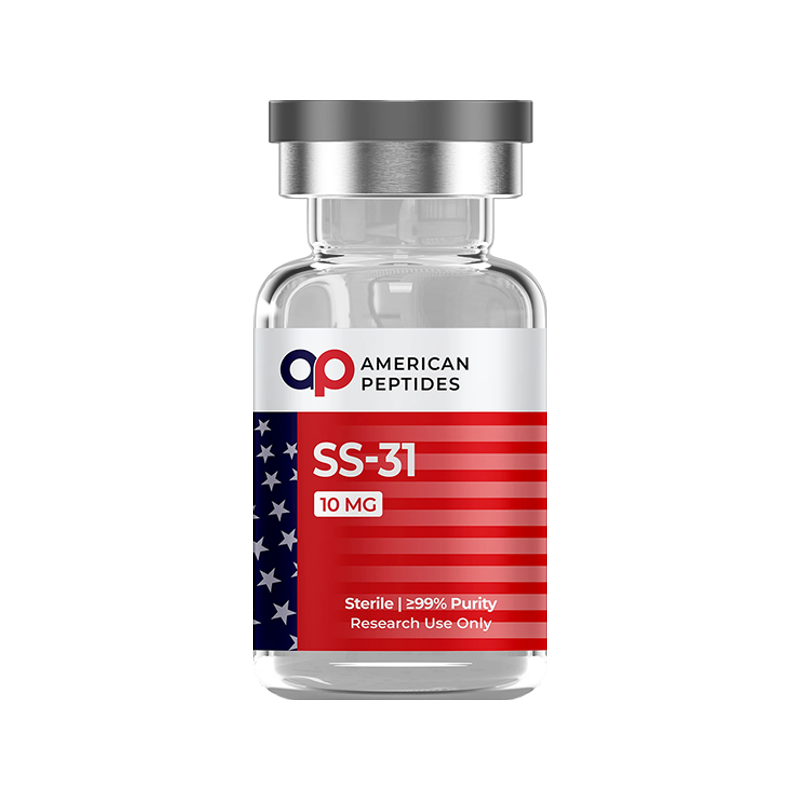

People add "reddit" to a search for SS-31 because the official sources talk past each other. A pharmaceutical label describes elamipretide, a prescription product for one ultra-rare genetic disease. Vendor pages describe "SS-31" as a research chemical. Neither explains why a chronic-fatigue forum keeps bringing the molecule up. This roundup covers SS-31 threads from r/cfs, r/covidlonghaulers, r/longevity, r/Biohackers, r/NTNPerformance and r/kidneydisease posted in 2025 and 2026, then checks the recurring claims against the published literature, from the first Szeto-Schiller peptide papers in 2004 to the regulatory decision in September 2025.
Research-use-only context. This article summarizes published third-party scientific literature — the large majority of it conducted in cultured cells or animal models. It is not medical advice, not a therapeutic or performance claim, and not a usage guide. American Peptides products are sold strictly for in vitro laboratory research and are not for human or veterinary use.
What Reddit threads say about SS-31
One caveat up front. Most SS-31 discussion on Reddit is recent, and the 2025 and 2026 threads are not yet captured in web archives, so we could verify titles, subreddits and posting periods but not full comment text. What follows is a map of the questions people are asking rather than a tally of upvoted answers.
Why a chronic-fatigue community is interested
The single largest cluster of SS-31 threads is not on r/Peptides. It is on r/cfs, the myalgic encephalomyelitis / chronic fatigue syndrome subreddit, with a spillover into r/covidlonghaulers and r/Longcovidgutdysbiosis. Titles like "peptides for CFS: SS-31, elamipretide and MOTS-c" and "SS-31 peptide: mitochondrial long-term rebuild" show the framing: these communities favor a mitochondrial-dysfunction model, and SS-31 is the best-known molecule built to target the inner mitochondrial membrane. Several posts are first-person recovery narratives, including one on r/cfs in 2025; a 2025 r/covidlonghaulers thread simply asks whether anyone has looked into the compound. Much of the discussion is about personal protocols, which this article does not reproduce.
The approval news, and the confusion it created
In October 2025 an r/longevity poster shared the headline that the FDA had granted Stealth Bio accelerated approval for elamipretide (thread). The thread sits at the center of a confusion that runs through almost every other SS-31 discussion: is the vial a research vendor sells "the same thing" as the approved pharmaceutical? Chemically, SS-31 and elamipretide are the same tetrapeptide sequence, D-Arg-Dmt-Lys-Phe-NH2. Legally and practically they are not the same product: one is released against a pharmaceutical specification and dispensed by prescription for one indication; the other is a laboratory reagent sold with a certificate of analysis for in vitro work. Reddit commenters often collapse that distinction; the literature does not.
"What the trials really show" skepticism
A 2026 r/NTNPerformance post titled "what SS-31 actually is and what the trials really show" is representative of a second, more skeptical camp. These posters point out that the pharmaceutical program ran for over a decade, that its largest trial missed its primary endpoints, and that the eventual approval was an accelerated one for an ultra-rare disease with a confirmatory study pending. As the research section shows, that reading is largely accurate.
Cost, stacking and sourcing questions
SS-31 is one of the more expensive research peptides per unit of material, and that shows up in titles like "worth it to stack expensive SS-31 with more?" on r/Biohackers. Commenters compare it with MOTS-c and other mitochondria-adjacent peptides, ask whether a cheaper alternative does the same job, and swap vendor names and certificate-of-analysis questions. A 2026 r/kidneydisease thread weighing SS-31 against stem-cell approaches shows how far its reputation has traveled.
The questions that keep coming back
- Is research SS-31 the same molecule as elamipretide, and does the approval change its status? (Same sequence; no.)
- What did the human trials actually find? (Mixed, and narrower than forum posts imply.)
- Has it been tested in fatigue or long COVID? (No controlled study exists.)
- How do I know a vial is real? (Lot-specific HPLC and mass spec data.)
What the published studies actually show
Where SS-31 came from: cell-permeable mitochondrial antioxidants
SS-31 was not designed as a longevity compound. It emerged from Hazel Szeto and Peter Schiller's work on opioid-receptor peptides, when certain small aromatic-cationic sequences turned out to concentrate in mitochondria. A 2004 Journal of Biological Chemistry paper by Zhao and colleagues (PMID 15178689) described a family of cell-permeable peptides built on alternating aromatic and basic residues, with a dimethyltyrosine residue that scavenges reactive oxygen species. In isolated mitochondria and oxidant-challenged cultured cells, the peptides reduced mitochondrial swelling, cytochrome c release and cell death, and reduced reperfusion injury in an isolated-heart preparation. Szeto's 2006 reviews in the AAPS Journal (PMID 16796378; PMID 17025271) laid out the rationale: conventional antioxidants never reach the inner mitochondrial membrane where most reactive oxygen species are produced, whereas the SS peptides concentrate there roughly a thousand-fold. A 2008 Antioxidants & Redox Signaling study by Whiteman, Szeto and colleagues (PMID 18052717) reported that SS-31 and MitoQ protected cultured human fetal liver cells from hypochlorous-acid-induced mitochondrial damage at nanomolar concentrations.
The cardiolipin mechanism Reddit keeps citing
Forum posters are right that SS-31 "binds cardiolipin," and the key paper is Birk and colleagues, 2013, Journal of the American Society of Nephrology (PMID 23813215). Using a polarity-sensitive fluorescent analog, the group showed that SS-31 binds with high affinity to cardiolipin, the anionic phospholipid of the inner mitochondrial membrane that holds cristae together and anchors cytochrome c. In a rat model of ischemic kidney injury, the peptide preserved cristae structure during ischemia and accelerated ATP recovery on reperfusion. The proposed mechanism is that the SS-31/cardiolipin complex keeps cytochrome c in its electron-carrier role rather than acting as a peroxidase. That is an animal and in vitro finding about acute ischemia, not chronic fatigue.
Animal data in heart failure
Sabbah and colleagues, 2016, Circulation: Heart Failure (PMID 26839394), randomized fourteen dogs with microembolization-induced heart failure to three months of elamipretide or saline. Left-ventricular ejection fraction rose in the elamipretide group and fell slightly in controls, and isolated cardiomyocytes from the elamipretide dogs showed higher mitochondrial respiration, membrane potential and maximum ATP synthesis rate. It is a small, well-controlled large-animal study.
The human trials: what they did and did not find
Here the r/NTNPerformance skeptics have a point. The MMPOWER program tested elamipretide in primary mitochondrial myopathy, genetically confirmed disorders of oxidative phosphorylation. The 2018 phase 1/2 study by Karaa and colleagues in Neurology (PMID 29500292) enrolled 36 participants in a five-day, placebo-controlled, escalating design and reported a trend toward greater six-minute-walk distance at the highest exposure (p = 0.053) and an exposure-dependent effect overall. The pivotal phase 3 MMPOWER-3 trial, published by the same group in 2023 (PMID 37268435), randomized 218 participants to 24 weeks of elamipretide or placebo and did not meet either primary endpoint: the between-group difference in six-minute-walk distance was −3.2 meters (p = 0.69) and the fatigue-score difference was essentially zero (p = 0.37). The authors concluded that the compound was well tolerated but did not improve the measured outcomes.
Barth syndrome was different. Reid Thompson and colleagues, 2021, Genetics in Medicine (PMID 33077895), ran TAZPOWER, a randomized, double-blind, placebo-controlled crossover study in twelve trial participants with the TAZ cardiolipin-remodeling defect, followed by an open-label extension. The crossover phase met neither primary endpoint. In the open-label extension at 36 weeks, the authors reported a 95.9-meter gain on the six-minute walk and improvement on a symptom scale. A 2026 Drugs review, "Elamipretide: First Approval" (PMID 41335372), records the outcome: in September 2025 the FDA granted accelerated approval to elamipretide (brand name Forzinity) to improve muscle strength in Barth syndrome, in individuals weighing at least 30 kilograms. A 2026 conference report in the Journal of Developmental Biology (PMID 42924728) notes that the confirmatory SPIBA-401 study is still running.
Where Reddit and the research disagree
The gap is wide. Reddit's SS-31 conversation is dominated by chronic fatigue and long COVID, and no published controlled trial has tested elamipretide in either. The human evidence comes from two rare genetic disorders, and in the larger program the phase 3 trial was negative. The approval covers one indication in one ultra-rare disease, based on a twelve-person study whose controlled phase missed its endpoints and whose open-label extension did not. That is a legitimate pathway for an ultra-rare disease, and a far narrower result than "the mitochondria peptide got approved" implies.
Second, the mechanism forum posts cite as settled is well supported in cells and animals and only indirectly in humans. Cardiolipin binding, cristae preservation and ATP recovery were shown in rat kidney, dog heart and cultured cells; whether they translate to human tissue outside Barth syndrome is unknown. The reviews that championed the molecule, including Szeto's own, describe it as investigational.
Third, the anecdotes are uncontrolled. Chronic fatigue has a fluctuating course and a well-documented placebo response, and nothing in a Reddit post separates the compound from time, co-interventions and expectation.
Sourcing and verification: what researchers check
For a laboratory buying SS-31 as a reagent, the approval changes nothing about the vial, and the checklist is the same as for any synthetic peptide. The lot should ship with a certificate of analysis showing purity by reverse-phase HPLC, ideally above 98 percent, with the chromatogram included. Identity should be confirmed by mass spectrometry against the expected mass of the D-Arg-Dmt-Lys-Phe-NH2 sequence; the dimethyltyrosine residue makes the mass distinctive, and a trace matching ordinary tyrosine instead is a red flag. The lot number should match the vial label. Lyophilized SS-31 is stored cold and protected from light and moisture; once reconstituted in a sterile diluent for bench work it is kept refrigerated and used within the stability window on the certificate. American Peptides lists its lot-specific analytical data on the SS-31 product page, and the mechanistic literature is covered in more depth in our SS-31 research summary.
Frequently Asked Questions
What does Reddit say about SS-31?
Most SS-31 threads from 2025 and 2026 are on r/cfs and r/covidlonghaulers, where posters discuss the compound as a mitochondria-targeted peptide and share personal narratives. A second group, on r/longevity and r/NTNPerformance, debates the September 2025 accelerated approval of elamipretide and argues that the human trial record is thinner than the enthusiasm suggests. Cost and sourcing questions fill out r/Biohackers.
Is SS-31 approved by the FDA?
Two different things share the name. The pharmaceutical elamipretide (Forzinity, developed by Stealth Bio) received FDA accelerated approval in September 2025 for one indication in Barth syndrome, an ultra-rare genetic disease, with a confirmatory trial pending. Research-grade SS-31 sold as a laboratory reagent is not that product, is not approved by the FDA for anything, and is not interchangeable with it. It remains an investigational compound for in vitro research only.
What is the difference between SS-31 and elamipretide?
They are the same tetrapeptide sequence, D-Arg-Dmt-Lys-Phe-NH2, under different names. SS-31 is the original laboratory designation from the Szeto-Schiller peptide series, also written MTP-131 or Bendavia in older papers. Elamipretide is the international nonproprietary name used for the pharmaceutical. The distinction that matters is regulatory and manufacturing: one is a prescription drug released to a pharmaceutical specification, the other is a research reagent.
What have the human trials of elamipretide found?
The results are mixed. The 218-person phase 3 MMPOWER-3 trial in primary mitochondrial myopathy did not meet its primary endpoints for walking distance or fatigue. The twelve-person TAZPOWER study in Barth syndrome missed its endpoints in the controlled crossover phase but reported gains during the open-label extension, which supported the 2025 accelerated approval. No controlled trial has tested the compound in chronic fatigue or long COVID.
Citations
- Zhao K et al., J Biol Chem 2004. PMID 15178689
- Szeto HH, AAPS J 2006. PMID 16796378
- Szeto HH, AAPS J 2006. PMID 17025271
- Whiteman M et al., Antioxid Redox Signal 2008. PMID 18052717
- Birk AV et al., J Am Soc Nephrol 2013. PMID 23813215
- Sabbah HN et al., Circ Heart Fail 2016. PMID 26839394
- Karaa A et al., Neurology 2018. PMID 29500292
- Reid Thompson W et al., Genet Med 2021. PMID 33077895
- Karaa A et al., Neurology 2023. PMID 37268435
- Drugs 2026 (Elamipretide: First Approval). PMID 41335372
- J Dev Biol 2026 (Barth Syndrome Foundation conference report). PMID 42924728
This article is for laboratory research reference only. American Peptides products are sold strictly for in vitro research. Not for human consumption.
Related research
Compliance Notice: American Peptides products are sold strictly for laboratory and academic research purposes only. They are not intended for human or veterinary consumption, diagnosis, treatment, or prevention of any disease. All content on this page is educational in nature and does not constitute medical advice or product claims. Researchers are responsible for handling these compounds in accordance with their institution’s safety protocols and applicable laws.