People add "reddit" to a Semax search because the formal literature is thin in English and they want to read how other people describe the compound in plain language. This roundup does that honestly. The first half summarizes archived threads from r/Nootropics, r/StackAdvice and r/neuroscience posted between 2014 and 2022, plus newer 2025 and 2026 thread titles from r/Nootropics, r/Biohackers and r/ADHD_Programmers. The second half checks the recurring claims against published studies, most of them from one network of Russian laboratories working in cultured cells and rats. Much of the Reddit discussion is about personal use, which this article does not reproduce.
Research-use-only context. This article summarizes published third-party scientific literature — the large majority of it conducted in cultured cells or animal models. It is not medical advice, not a therapeutic or performance claim, and not a usage guide. American Peptides products are sold strictly for in vitro laboratory research and are not for human or veterinary use.
What Reddit threads say about Semax
The enthusiast camp
Semax is a heptapeptide (Met-Glu-His-Phe-Pro-Gly-Pro) built from a fragment of adrenocorticotropic hormone, ACTH(4-10), with the last three residues swapped for Pro-Gly-Pro. On r/Nootropics it has a loyal following. In a January 2018 thread asking for long-term experiences, upvoted replies describe sharper verbal fluency and a steadier mood, with price rather than effect cited as the reason posters stopped buying. A December 2017 post titled "Semax Experience. So far 10/10" drew fourteen comments in the same spirit, and 2026 titles like "I went through the published research on Semax" show the camp has started reading the Russian papers rather than relying on anecdotes alone.
The "felt nothing" and "short-lived" camp
The counter-camp is just as vocal. In the 2018 experience thread the single highest-scored reply is a flat report of no effect. An August 2022 r/Nootropics thread titled "Semax giving me neutral and short-lived symptoms?" describes a brief change in alertness that fades within minutes, with the poster asking what they were "supposed to be feeling". Commenters in the 10/10 thread were quick to point out that a few days of enthusiasm proves nothing.
"There's placebo, habituation, rebound, withdrawal, etc., and it's different for everyone." — r/Nootropics, 2017
The same thread calls the compound and its cousins "hit or miss substances", and notes that posters already on stimulants may be crediting the peptide for a stimulant's effect.
Semax vs Selank vs Noopept
Almost every Semax thread turns into a comparison thread. Selank (Thr-Lys-Pro-Arg-Pro-Gly-Pro) shares the Pro-Gly-Pro tail and the same Moscow research institute, so the two are discussed as a pair: Reddit's shorthand is that Semax is the "focus" peptide and Selank the "calm" one. A September 2014 r/Nootropics thread on combining the two is mostly personal protocol talk, which this article does not reproduce. Noopept comes up as the cheaper alternative. A December 2015 r/neuroscience thread that asked researchers for their opinion of "drugs like Semax, Noopept" got a sober answer.
"A good argument can be made that there are not enough big studies done on healthy young individuals for many substances which are labeled as nootropic." — r/neuroscience, 2015
The N-acetyl and amidate confusion
Three Semax variants circulate in the hobbyist market: plain Semax, N-acetyl Semax (NA-Semax) and N-acetyl Semax amidate, which carries both an acetyl group on the N-terminus and an amide on the C-terminus. A January 2016 r/Nootropics thread titled "NA-Semax/Selank vs. regular Semax/Selank" shows how little agreement exists. Some commenters prefer the acetylated form, others the plain form, and the amidate version draws the most mixed reports.
"I suppose it shows that all brain chemistries are different." — r/Nootropics, 2016
No thread mentions that the acetylated and amidated variants are vendor inventions; the peer-reviewed literature is almost entirely about the unmodified heptapeptide.
Russian origin, sourcing and storage
Posters frequently note that Semax has been listed in the Russian pharmaceutical registry since the 1990s and that nearly every paper comes from Moscow. That origin is cited both as reassurance ("it has clinical data") and as a red flag ("none of it has been replicated in the West"). Sourcing questions follow a familiar pattern: whether a vial matches its label and whether a lyophilized powder that sat warm in transit is still intact. One commenter in the 2017 thread abandoned a sample after a refrigeration problem for exactly that reason.
What the published studies actually show
Neurotrophin expression in cells and rat brain
The mechanistic claim that comes up most on Reddit is "Semax raises BDNF". The source is a series of papers from the Institute of Molecular Genetics in Moscow. A 2001 Neuroscience Letters study by Shadrina and colleagues exposed glial cell cultures from newborn rat basal forebrain to Semax and measured a rapid rise in BDNF and NGF mRNA, peaking around thirty minutes. A 2006 Brain Research paper by Dolotov and colleagues followed up in live rats: a single exposure produced a roughly 1.4-fold increase in BDNF protein and a 1.6-fold increase in trkB receptor phosphorylation in the hippocampus, with larger changes in the corresponding mRNAs, and the animals showed more conditioned avoidance responses. A companion 2006 Journal of Neurochemistry paper from the same group reported specific, saturable binding of tritium-labelled Semax to rat basal forebrain membranes and higher BDNF protein in that region.
Two later papers add nuance that Reddit tends to drop. Agapova and colleagues (Neuroscience Letters, 2007) found the change was gene- and region-specific in normal rat brain: BDNF transcription rose in hippocampus, brainstem and cerebellum, while NGF transcription fell in frontal cortex. Shadrina and colleagues (Journal of Molecular Neuroscience, 2010) tracked twenty minutes to twenty-four hours and described "multidirectional" shifts across hippocampus, frontal cortex and retina. The published signal is real but regional, transient and rodent-only, not a uniform "BDNF boost".
Genome-wide effects in a rat stroke model
Medvedeva and colleagues published a genome-wide transcriptome analysis in BMC Genomics in 2014 using rats with permanent middle cerebral artery occlusion. Compared with untouched ischemic animals, Semax mainly changed the expression of genes tied to the immune system and vascular function, with the immune effect growing between three and twenty-four hours after occlusion. A 2017 follow-up in Molecular Genetics and Genomics narrowed in on immune-response genes. These are the papers behind the "neuroprotective" label Reddit repeats; they describe gene-expression shifts in a surgical rat model, not functional outcomes in people.
Where the design came from, and how Semax relates to Selank
The 1997 review by Ashmarin and colleagues in the Pavlov Journal of Higher Nervous Activity summarizes fifteen years of design work on the ACTH(4-10) analogue, with the Pro-Gly-Pro tail added to extend the parent fragment's very short lifetime. Ivanova, Levitskaya and colleagues (Bulletin of Experimental Biology and Medicine, 2007) compared the parent fragment and Semax in rodent nociception assays and found the substitution increased potency. On Semax versus Selank, Kost and colleagues (Bioorganic Chemistry, 2001) reported that both heptapeptides inhibit enkephalin-degrading enzymes in human serum in vitro, Semax somewhat more strongly, and that only the pentapeptide fragments kept this activity. Zolotarev and colleagues (2006) showed with tritium-labelled peptides that Semax breaks down near nerve cells mainly into His-Phe-Pro-Gly-Pro and Pro-Gly-Pro, which matters when a thread assumes the intact heptapeptide is the only active species.
Where Reddit and the research disagree
The biggest gap is the one the r/neuroscience commenter named in 2015: there are no large, independent, placebo-controlled studies in healthy adults. The human data that does exist is Russian-language and registry-era. Gusev and colleagues published a 1997 report in the Korsakov Journal of Neurology and Psychiatry on 30 people with acute hemispheric ischemic stroke compared against 80 controls who received conventional care; it was not randomized or blinded, the groups were unequal, and the work has not been replicated outside Russia. Later Russian clinical papers follow the same pattern. Reviewers from the original Moscow group describe Semax as having moved "from fundamental investigations to practical usage" inside Russia, but no Western regulator has evaluated that claim and the compound is investigational everywhere else.
Second, Reddit handles the three variants as interchangeable or as upgrades. The literature contains essentially nothing on N-acetyl Semax or the amidate, so the thread debates about which form is "stronger" rest on anecdote alone. Third, the BDNF story is cleaner on Reddit than in the papers: the published changes are region-specific, sometimes opposite in direction for NGF, and short-lived. Fourth, the rat studies measure gene expression and conditioned behavior under controlled conditions; nothing in them predicts what a given person would notice. Finally, a 2025 title ("Semax has actual human clinical data but it's all...") suggests the community is converging on the same conclusion: the data exists, but it is old, small and uncorroborated.
Sourcing and verification: what researchers check
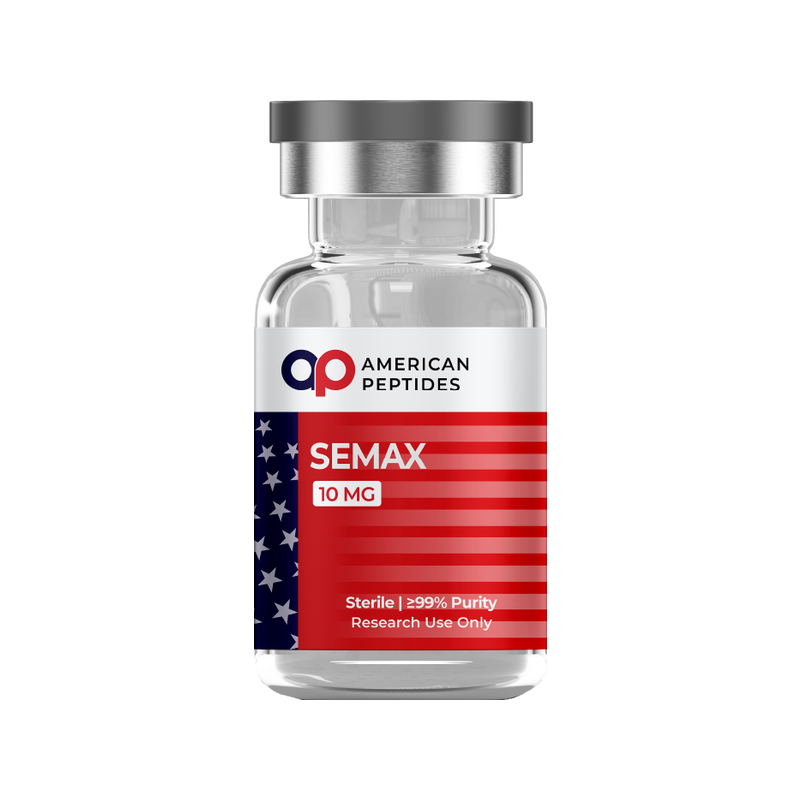
The storage and authenticity worries that run through the threads translate into standard analytical questions. For a heptapeptide like Semax, a laboratory confirms identity by mass spectrometry (an expected monoisotopic mass around 813.4 for the free peptide), confirms purity by reverse-phase HPLC, and asks for a certificate of analysis tied to a specific lot number rather than a generic document. Because Semax carries an N-terminal methionine, oxidation to methionine sulfoxide is a known degradation pathway, so the HPLC trace should be checked for the earlier-eluting oxidized peak. Lyophilized peptide is stored frozen and protected from light and moisture; once reconstituted in bacteriostatic water or buffer, solutions are kept cold. NA-Semax and the amidate have different masses, so a mass-spec report should match the form on the label. American Peptides lists Semax as a lyophilized research reagent with lot-specific testing, and also offers a pre-solubilized research format for in vitro work. For a fuller walk through the primary literature, see our companion piece, Semax Research: What the Studies Show.
Frequently Asked Questions
What does Reddit say about Semax?
Reddit is split. On r/Nootropics an enthusiast camp describes sharper focus and verbal fluency, while a "felt nothing" or "short-lived" camp often holds the top-voted comments. Threads routinely compare Semax with Selank and Noopept, argue about N-acetyl and amidate variants, and flag that nearly all the research is Russian. Much of the discussion is personal use, which this article does not reproduce.
Is Semax approved by the FDA?
No. Semax is not approved by the FDA for any purpose. It has been listed in the Russian pharmaceutical registry since the 1990s, but that listing rests on small, non-randomized Russian-language studies that have not been replicated in the West. Outside Russia, Semax is an investigational compound available strictly as a research reagent, and American Peptides sells it for in vitro laboratory use only.
What is the difference between Semax, NA-Semax and NA-Semax amidate?
Plain Semax is the heptapeptide Met-Glu-His-Phe-Pro-Gly-Pro studied in the peer-reviewed literature. NA-Semax adds an acetyl group to the N-terminal methionine; NA-Semax amidate also converts the C-terminal carboxyl to an amide. Both modified forms are vendor products with essentially no published data, and Reddit's debate over which is "stronger" rests on anecdote. Mass spectrometry distinguishes the three by their different masses.
How does Semax differ from Selank?
Both are Russian heptapeptides ending in Pro-Gly-Pro, but Semax derives from ACTH(4-10) while Selank derives from the immune peptide tuftsin. In vitro, Kost and colleagues (2001) found both inhibit enkephalin-degrading enzymes in human serum, Semax slightly more. In rat studies, Semax is examined mainly for neurotrophin expression and ischemia models, Selank mainly for anxiety-like behavior. Reddit's "focus versus calm" shorthand loosely mirrors that research split.
Citations
- Shadrina MI et al., Neurosci Lett 2001. PMID 11457573
- Dolotov OV et al., Brain Res 2006. PMID 16996037
- Dolotov OV et al., J Neurochem 2006. PMID 16635254
- Agapova TY et al., Neurosci Lett 2007. PMID 17353092
- Shadrina M et al., J Mol Neurosci 2010. PMID 19662538
- Medvedeva EV et al., BMC Genomics 2014. PMID 24661604
- Medvedeva EV et al., Mol Genet Genomics 2017. PMID 28255762
- Ashmarin IP et al., Zh Vyssh Nerv Deiat Im I P Pavlova 1997. PMID 9173745
- Ivanova DM et al., Bull Exp Biol Med 2007. PMID 18018999
- Kost NV et al., Bioorg Khim 2001. PMID 11443939
- Zolotarev YA et al., Bioorg Khim 2006. PMID 16637290
- Gusev EI et al., Zh Nevrol Psikhiatr Im S S Korsakova 1997. PMID 11517472
This article is for laboratory research reference only. American Peptides products are sold strictly for in vitro research. Not for human consumption.
Related research
Compliance Notice: American Peptides products are sold strictly for laboratory and academic research purposes only. They are not intended for human or veterinary consumption, diagnosis, treatment, or prevention of any disease. All content on this page is educational in nature and does not constitute medical advice or product claims. Researchers are responsible for handling these compounds in accordance with their institution’s safety protocols and applicable laws.