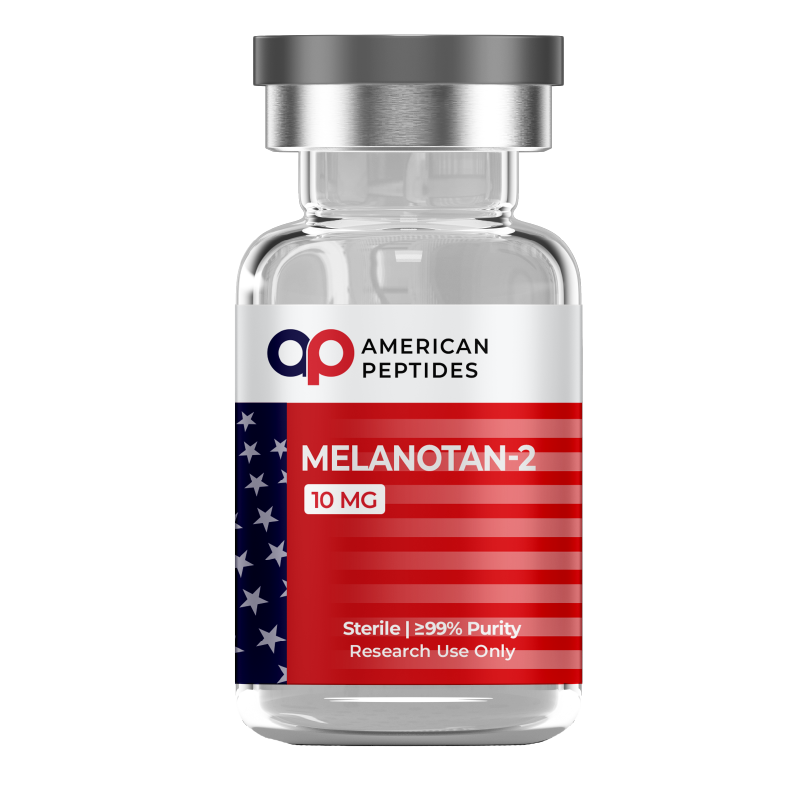

People add "reddit" to a Melanotan-2 search because the first page of Google is split between vendor pages and warnings, and neither sounds like a real person. Reddit does. This roundup reads the Melanotan-2 (MT-2) threads that come up most often — r/30PlusSkinCare (2025), r/steroids (archived 2023), r/Melanotan2 (2023 and 2024), plus 2024–2026 threads from r/GenX, r/DIYaesthetics, r/Biohackers and r/NTNPerformance — then checks each theme against the published literature: the University of Arizona melanotropin papers, the dermatology case reports on new or changed moles, and the product-analysis work on vials sold online. Most Reddit MT-2 talk is personal self-use, which this article does not reproduce.
Research-use-only context. This article summarizes published third-party scientific literature — the large majority of it conducted in cultured cells or animal models. It is not medical advice, not a therapeutic or performance claim, and not a usage guide. American Peptides products are sold strictly for in vitro laboratory research and are not for human or veterinary use.
What Reddit threads say about Melanotan-2
Why people are interested in the first place
The pull is pigmentation. Melanotan-2 is a cyclic analogue of alpha-melanocyte-stimulating hormone (α-MSH), the signal that tells melanocytes to make eumelanin. The threads are full of people with Fitzpatrick type I or II skin asking whether the chemistry is real. In the r/steroids thread, the original poster asks about both MT-2 and PT-141 (bremelanotide, a related melanocortin agonist); this is not a 2025 trend peptide.
"MT-2 does stimulate melanogenesis, but that doesn't mean that you will have a sunless tan."
— r/steroids, 2015
That is the one point nearly every thread agrees on: the pigment response depends on ultraviolet exposure. The rest of the "why" conversation drifts to libido and nausea stories, which this article covers only at the receptor level.
The regret camp: new moles and darkened freckles
The most consistent skeptical theme is not "it did nothing" but "it did something I did not want": new moles, darkened freckles, reluctance to go back. A 2024 r/GenX thread is titled "anyone else feel foolish and have regrets," a 2025 r/DIYaesthetics post reads "been using MT2, now I have new beauty marks," and r/NTNPerformance's 2026 thread is "the tanning peptide and the mole." Even the upbeat first-timer journal on r/Melanotan2 says previously removed freckles "made a comeback."
"I had more moles and freckles. Now I was considering using it again but I read this and gave up the idea. Don't risk it."
— r/30PlusSkinCare, 2025
The poster linked the Australian TGA regulator's warning page as what changed their mind.
The dermatology concern commenters raise themselves
Several threads include someone relaying what a dermatologist told them. In the r/30PlusSkinCare thread, the top reply argues that any pigment shortcut is "pouring water in a strainer" if the skin is still being sun-damaged, and attributes the view to their dermatologist. Others worry about moles that change shape or color, which is exactly what the published MT-2 case reports describe.
Melanotan-1 versus Melanotan-2 confusion
Much thread space goes to sorting out which "melanotan" is which. Melanotan-1 is afamelanotide, a linear α-MSH analogue that is a prescription product in some countries for a rare light-sensitivity condition. Melanotan-2 is the shorter cyclic lactam analogue with broader melanocortin receptor activity. Commenters conflate them, then correct each other: one r/30PlusSkinCare poster chose MT-1 because they "didn't want the darkness that MT2 offers," and another notes that regulator warnings target MT-2 specifically. The distinction matters because receptor selectivity, half-life and the safety literature differ between the two molecules.
Sourcing, purity, and "is the vial even MT-2?"
Nearly every thread has a "where do you get it" exchange, with answers from "any reputable research peptide vendor" to named overseas shops. Commenters trade purity rumors but almost nobody mentions a certificate of analysis, HPLC trace or mass-spec identity check. The gap between how much people argue about effects and how little they verify the material is the most useful thing a researcher can take from these threads.
What the published studies actually show
The pigmentation chemistry commenters are reacting to
In a 1989 Journal of Medicinal Chemistry paper, Al-Obeidi, Castrucci, Hadley and Hruby used molecular-dynamics modeling to design cyclic lactam fragments of α-MSH, bridging an Asp and a Lys side chain to lock the peptide into its active conformation. The resulting Ac-[Nle4, Asp5, D-Phe7, Lys10]α-MSH(4-10)-NH2 — now sold as Melanotan-2 — was roughly 90 times as potent as native α-MSH in the lizard-skin bioassay. A companion 1989 Pigment Cell Research paper by Hadley and colleagues found the cyclic analogue more potent, longer-acting and more protease-resistant than α-MSH in frog and lizard skin and the S91 mouse melanoma tyrosinase assay, and reported that topical application in mice shifted follicular melanocytes from pheomelanin toward eumelanin.
The 1996 Life Sciences pilot by Dorr, Hadley and colleagues was a three-volunteer single-blind study. The authors reported increased pigmentation measured by reflectance in two of three volunteers a week after the two-week protocol ended, along with nausea at most exposure levels, somnolence at the highest, and a stretching-and-yawning complex. It is a pilot, not an efficacy trial, and it is essentially the entire peer-reviewed human pigmentation dataset for MT-2.
Why the receptor profile explains the "other" effects
Melanotan-2 is a non-selective melanocortin receptor agonist: it binds MC1R on melanocytes, but also MC3R, MC4R and MC5R. A 2000 review in the International Journal of Impotence Research by Wessells, Levine, Hadley, Dorr and Hruby summarizes the Arizona group's small double-blind crossover studies and attributes the non-pigment effects, nausea and yawning to central melanocortin receptors rather than to skin. The molecule was never selective for the receptor that drives pigment, which is why MT-2 threads wander off topic and why it shares an r/steroids thread with the later, more selective bremelanotide (PT-141).
The case-report literature on new and changed nevi
This is where Reddit's "regret" threads line up with published dermatology. In a 2009 Archives of Dermatology report, Cardones and Grichnik described a 40-year-old case subject with a melanoma history who, after self-use of a synthetic α-MSH analogue, developed crops of new pigmented nevi with atypical clinical and histopathologic features; existing nevi darkened and acquired growth features, and the changes progressively reversed after the compound was stopped. A 2012 Hautarzt report by Mang, Krahl and Assmann used sequential video-dermoscopy on a 24-year-old case subject and found the nevus changes "made it difficult to differentiate a nevus from a melanoma." Paurobally and colleagues published "Melanotan-associated melanoma" in the British Journal of Dermatology in 2011.
Two reviews tie the case reports together. Habbema, Halk, Neumann and Bergman's 2017 International Journal of Dermatology review concludes that increasing numbers of case reports associate both melanotan I and II with "melanocytic changes in existing moles and newly formed moles," while separating afamelanotide, the tested and approved molecule. Burian and Jemec's 2019 American Journal of Clinical Dermatology systematic review of eruptive melanocytic nevi compiled 93 articles covering 179 case subjects and placed melanotan alongside immunosuppressive agents and chemotherapy as the suspected cause in 41% of reports; nevi in this group were typically multiple, small and widespread, and generally persisted. A 2026 JAAD Case Reports paper by Elms and colleagues is titled "The dangers of social media misinformation: a case report on the risks of Melanotan II."
Where Reddit and the research disagree
On mechanism they agree: the pigment response is real at the receptor level and needs ultraviolet exposure to express. The disagreements are about scale and certainty.
- Anecdote versus data. The threads hold hundreds of individual accounts. The peer-reviewed pigmentation dataset is a three-volunteer pilot from 1996 plus crossover studies of about twenty men focused on a different endpoint. There is no large controlled study of MT-2 pigmentation.
- How common the mole changes are. Commenters describe new or darkened nevi as near-universal. Case reports have no denominator, so the literature cannot say how common they are; what Habbema 2017 and Burian 2019 do say is that the association is consistent enough to count as a recognized pattern.
- Which molecule is being discussed. Reddit blurs MT-1 and MT-2. Every review separates them: afamelanotide has a narrow approved indication abroad, while MT-2 has no approval anywhere, and Habbema and colleagues call the products sold online "illegal melanotans" with open questions about preparation and content.
- Misinformation as a research topic. O'Connor, Rafferty and Murphy's 2022 Clinical and Experimental Dermatology review lists "promotion of tanning and Melanotan as safe practices" as a principal theme of online skin-cancer misinformation.
Reviewers' language is uniformly cautious: "unlicensed," "untested," "unregulated," "not approved." None of the papers cited here is an efficacy study.
Sourcing and verification: what researchers check
The one peer-reviewed look inside MT-2 vials bought online is Breindahl and colleagues' 2015 Drug Testing and Analysis paper. The authors validated an LC-UV and LC-MS/MS method for identity, content and purity and tested vials from three Internet shops. Identity was confirmed by retention time and five qualifying fragment ions from the doubly charged precursor (m/z 513). Vials from two shops contained unknown impurities of 4.1 to 5.9%, and labeled content did not always match measured content.
For a research lab, verification is chemistry:
- Purity by HPLC with the chromatogram on the certificate of analysis, not a bare percentage; for a cyclic lactam heptapeptide the relevant impurities are deletion sequences, uncyclized linear peptide and oxidized tryptophan.
- Identity by mass spectrometry. MT-2 has a monoisotopic mass near 1024 Da; the doubly charged ion at m/z 513 is the species Breindahl used. A COA showing observed against theoretical mass is checkable; one that only says "MT-2" is not.
- Lot number tied to the COA so the trace belongs to the vial on the bench.
- Cold chain and reconstitution chemistry. Lyophilized peptide stored cold and dark, reconstituted in bacteriostatic water for bench stability only, with the light-sensitive tryptophan residue in mind.
American Peptides lists Melanotan-2 for in vitro research with lot-specific analytical documentation, and a longer walk through the primary literature is in our Melanotan-2 research summary.
Frequently Asked Questions
What does Reddit say about Melanotan-2?
Reddit threads from r/steroids, r/30PlusSkinCare, r/Melanotan2 and others agree that MT-2's pigment effect depends on ultraviolet exposure, and the loudest theme is regret over new moles and darkened freckles. Commenters frequently confuse Melanotan-1 (afamelanotide) with Melanotan-2 and rarely discuss purity verification. Most of the discussion is personal use, which this article does not reproduce.
Is Melanotan-2 approved by the FDA?
No. Melanotan-2 is not approved by the FDA or by any other regulator for any purpose, and reviewers describe it as unlicensed and untested. Afamelanotide (Melanotan-1) is a separate molecule with a narrow approved indication in some countries. MT-2 remains an investigational research compound, and American Peptides supplies it strictly for in vitro laboratory research.
What is the difference between Melanotan-1 and Melanotan-2?
Melanotan-1 (afamelanotide) is a 13-residue linear analogue of α-MSH that acts mainly at MC1R. Melanotan-2 is a 7-residue cyclic lactam fragment designed by Al-Obeidi and colleagues in 1989 that is roughly 90 times as potent in skin bioassays and is non-selective across MC1R, MC3R, MC4R and MC5R, which is why the Arizona studies recorded effects well beyond pigmentation.
Why do dermatology papers link Melanotan-2 to new moles?
Because α-MSH signaling drives melanocyte activity, and published case reports (Cardones 2009, Mang 2012, Paurobally 2011) describe case subjects who developed new or changed melanocytic nevi, some with atypical features, after unregulated MT-2 use. Reviews by Habbema (2017) and Burian and Jemec (2019) summarize this as a recognized association, while noting that case reports cannot establish how often it occurs.
Citations
- Al-Obeidi F, Castrucci AM, Hadley ME, Hruby VJ. Potent and prolonged acting cyclic lactam analogues of alpha-melanotropin: design based on molecular dynamics. J Med Chem 1989. PMID 2555512
- Hadley ME, Marwan MM, al-Obeidi F, Hruby VJ, Castrucci AM. Linear and cyclic alpha-melanotropin [4-10]-fragment analogues that exhibit superpotency and residual activity. Pigment Cell Res 1989. PMID 2557603
- Dorr RT, Lines R, Levine N, et al. Evaluation of melanotan-II, a superpotent cyclic melanotropic peptide in a pilot phase-I clinical study. Life Sci 1996. PMID 8637402
- Wessells H, Levine N, Hadley ME, Dorr R, Hruby V. Melanocortin receptor agonists, penile erection, and sexual motivation: human studies with Melanotan II. Int J Impot Res 2000. PMID 11035391
- Cardones AR, Grichnik JM. alpha-Melanocyte-stimulating hormone-induced eruptive nevi. Arch Dermatol 2009. PMID 19380666
- Paurobally D, Jason F, Dezfoulian B, Nikkels AF. Melanotan-associated melanoma. Br J Dermatol 2011. PMID 21564053
- Mang R, Krahl D, Assmann T. Dermoscopic changes in melanocytic nevi during use of melanotan II. Hautarzt 2012. PMID 23052015
- Breindahl T, Evans-Brown M, Hindersson P, et al. Identification and characterization by LC-UV-MS/MS of melanotan II skin-tanning products sold illegally on the Internet. Drug Test Anal 2015. PMID 24771717
- Habbema L, Halk AB, Neumann M, Bergman W. Risks of unregulated use of alpha-melanocyte-stimulating hormone analogues: a review. Int J Dermatol 2017. PMID 28266027
- Adler NR, Dowling JP, Pan Y. The unregulated use of melanotan-II is of public health interest to Australian dermatologists. Australas J Dermatol 2017. PMID 28905366
- Burian EA, Jemec GBE. Eruptive Melanocytic Nevi: A Review. Am J Clin Dermatol 2019. PMID 31119650
- O'Connor C, Rafferty S, Murphy M. A qualitative review of misinformation and conspiracy theories in skin cancer. Clin Exp Dermatol 2022. PMID 35514125
- Elms AM, Vaja S, Globerson J, Liggett J. The dangers of social media misinformation: A case report on the risks of Melanotan II. JAAD Case Rep 2026. PMID 43060386
This article is for laboratory research reference only. American Peptides products are sold strictly for in vitro research. Not for human consumption.
Related research
Compliance Notice: American Peptides products are sold strictly for laboratory and academic research purposes only. They are not intended for human or veterinary consumption, diagnosis, treatment, or prevention of any disease. All content on this page is educational in nature and does not constitute medical advice or product claims. Researchers are responsible for handling these compounds in accordance with their institution’s safety protocols and applicable laws.