Type "GHK-Cu" into a search bar and the autocomplete offers "GHK-Cu reddit" almost immediately. People add the word because they want unfiltered notes, not a brand page. This roundup summarizes what Reddit threads about GHK-Cu actually say, drawing on an archived r/45PlusSkincare discussion from 2023, an r/Peptides post from the same year, and 2024–2026 threads from r/Biohackers, r/SkincareAddiction, r/tressless and r/lipedema. The back half checks the recurring claims against the published literature on the glycyl-L-histidyl-L-lysine copper complex, most of which comes from cultured fibroblasts and animal wound models.
Research-use-only context. This article summarizes published third-party scientific literature — the large majority of it conducted in cultured cells or animal models. It is not medical advice, not a therapeutic or performance claim, and not a usage guide. American Peptides products are sold strictly for in vitro laboratory research and are not for human or veterinary use.
What Reddit threads say about GHK-Cu
Why people are interested
GHK-Cu shows up in skincare subreddits as "copper peptides," the ingredient in retail serums, and in r/Peptides and r/Biohackers as a research compound. Both camps are drawn by the molecule's reputation for supporting collagen and connective-tissue remodeling, and by a long paper trail from one lab in particular (Loren Pickart's group) dating to the 1970s. The r/45PlusSkincare thread from April 2023 is a good snapshot: the original poster describes being in the "maybe they can fix everything" honeymoon stage and asks for experiences. Replies split roughly in half between enthusiasm and shrugs, a pattern that repeats across every GHK-Cu thread we looked at. Newer titles widen the scope: an r/tressless poster in 2025 asks about hair, and an r/lipedema poster asks about connective tissue. Several commenters admitted they had never heard of the peptide.
"What is their benefit? I actually haven't heard about that particular peptide. I shall Google it." — r/45PlusSkincare, 2023 (thread)
Skepticism and "did nothing" reports
The most upvoted substantive comments in the 2023 skincare thread are not the glowing ones. Several commenters describe finishing an entire bottle of a budget copper-peptide serum and noticing nothing remarkable. One poster, three months in and "religious with application," reports no visible difference. Others say the budget product did nothing but a pricier formulation with a higher stated concentration seemed to matter after three or four months. That contrast is the closest thing to a consensus the thread reaches: commenters suspect many retail serums contain too little GHK-Cu to do much, and that any change takes months rather than weeks. Nobody in the thread could verify the concentrations involved. The honest reading is that Reddit's skincare crowd is divided, with a loud minority of enthusiasts and a quieter majority who are unimpressed.
Reactions commenters describe
A 2026 r/Biohackers thread asks, bluntly, whether anyone has had "weird" reactions to GHK-Cu, and an r/SkincareAddicts thread asks about chronic hives. In the archived 2023 skincare thread, one commenter reports a copper-peptide serum seemed to help after a hives flare, while another warns that layering copper peptides with acid exfoliants is "a big no-no." Across threads, the reactions commenters describe fall into two groups: irritation or flushing after a new product, and a widely repeated belief that copper peptides should not be layered with retinoids or direct acids. None of this is controlled data, but the irritation question is one of the most common reasons people add "reddit" to a GHK-Cu search.
"Mixing acids and copper is a big nono." — r/45PlusSkincare, 2023 (related r/Biohackers thread)
Personal protocols and progress photos
The r/Peptides side reads very differently. The archived August 2023 post titled "GHK-Cu Experience" is a six-week self-report with progress photos, a detailed personal protocol, reconstitution notes and talk of stacking GHK-Cu with other compounds. A 2025 r/Biohackers progress thread follows the same template. Much of this discussion is about personal protocols and self-use, which this article does not reproduce. What is useful is the shape of the conversation: posters frame GHK-Cu as something to be reconstituted, stored cold and handled carefully, and they complain about vendors whose vials arrive without documentation. Those are chemistry questions we can address.
The questions that keep coming back
The same questions appear in nearly every GHK-Cu thread. Does it do anything for collagen or is that marketing? Why do the studies come from one lab? Why do "did nothing" reports sit next to "changed everything" reports? And how do you know a vial actually contains GHK-Cu at the stated purity? Thread titles from 2024–2026 ("Has anyone tried GHK-Cu?", "Experiences with GHK-Cu copper tripeptide") are variations on these. The rest of this article takes them in order.
"Do people have particular brands they like? ... I feel lost on what brands to use, what order and when." — r/45PlusSkincare, 2023 (r/Peptides thread)
What the published studies actually show
Collagen and extracellular matrix in cultured fibroblasts
The collagen claim is the oldest and best documented. In a 1988 FEBS Letters paper, Maquart, Pickart and colleagues at the University of Reims reported that GHK-Cu stimulated collagen synthesis in cultured fibroblasts, beginning at picomolar concentrations, peaking around 10-9 M, and independent of any change in cell number. The authors noted that the Gly-His-Lys triplet occurs in the alpha-2 chain of type I collagen and proposed that proteases might release it at a wound site. A 2000 Journal of Investigative Dermatology study from the same group (Siméon and colleagues) extended this to glycosaminoglycans and proteoglycans: in a rat wound-chamber model and rat dermal fibroblast cultures, GHK-Cu increased type I collagen and glycosaminoglycan content, raised decorin expression and lowered biglycan expression. Pickart's 2015 BioMed Research International review summarizes the broader in vitro record: GHK stimulates both synthesis and breakdown of collagen and glycosaminoglycans and modulates metalloproteinases and their inhibitors, a remodeling profile rather than simple "more collagen."
Wound and tissue models in animals
Reddit's connective-tissue interest (r/lipedema, the r/Peptides knee-recovery framing) maps onto a cluster of animal studies. Pickart's 2008 review in the Journal of Biomaterials Science, Polymer Edition catalogs chemoattraction of macrophages and capillary cells, increased collagen, elastin, VEGF and FGF-2 production, and accelerated closure in numerous wound models. A 2005 study by Arul and colleagues in the Journal of Biomedical Materials Research Part B found that a biotinylated GHK peptide bound into a collagen matrix improved wound contraction and antioxidant-enzyme expression in rats and raised copper concentration at the wound site ninefold. A 2015 Journal of Orthopaedic Research study by Fu and colleagues tested GHK-Cu in a rat ACL-reconstruction model: at six weeks the GHK-Cu groups showed smaller knee-laxity differences and stiffer grafts than controls, but by twelve weeks the difference had disappeared, and the authors called the benefit transient. A controlled animal study with a real effect that faded is more nuanced than either Reddit camp tends to allow.
Gene expression: the "4,000 genes" claim
A number Reddit commenters repeat is that GHK "resets 4,000 genes." The origin is a 2012 Genome Medicine paper by Campbell and colleagues at Boston University. The team profiled gene expression in 64 lung tissue samples from smokers with COPD, identified 127 genes tied to regional emphysema severity, then queried the Broad Institute's Connectivity Map for compounds that might reverse that signature. GHK came up, and in cultured human fibroblasts GHK exposure reproduced TGF-beta-associated gene-expression patterns and promoted actin-cytoskeleton organization. Pickart's 2015 and 2018 reviews (the latter in the International Journal of Molecular Sciences) built on this with their own Connectivity Map analyses and arrived at roughly 4,000 human genes up- or down-regulated. To be precise, that is a computational prediction from expression databases, partly validated in cell culture, not a measured outcome in a living organism. A 2020 commentary by Dou, Ladiges and colleagues at the University of Washington reports that plasma GHK falls from about 200 ng/mL at age 20 to about 80 ng/mL by age 60 and calls for further preclinical study.
Where Reddit and the research disagree
The biggest gap is anecdote versus controlled data. The 2023 skincare thread has roughly equal glowing and "did nothing" reports, with no way to tell which is closer to the truth, because none of the commenters knew the concentration, purity or stability of the product involved. The literature, by contrast, is strong on mechanism and weak on human outcomes. Collagen stimulation in fibroblast culture is reproducible; the Connectivity Map work is computational; the animal wound and ligament studies show effects that are real but sometimes transient. The human cosmetic studies Pickart's reviews cite are mostly small, industry-run and decades old, and the reviews are written by the compound's discoverer, which readers should weigh.
Three specific disagreements stand out. First, Reddit regards GHK-Cu and retail "copper peptides" as interchangeable; the literature studies the defined tripeptide-copper complex at known concentrations, which a serum rarely discloses. Second, r/tressless posters ask about hair; Pickart's 2008 review reports increased hair-follicle size in animal models, but there is no controlled human evidence. Third, the "weird reactions" question has no real answer in the literature, because the published work is overwhelmingly in vitro or in rodents. The reviewers themselves are cautious: Dou and colleagues call for further preclinical work, and Pickart's group frames its most expansive claims as proposals. GHK-Cu has not been approved by the FDA for any indication and remains an investigational compound.
Sourcing and verification: what researchers check
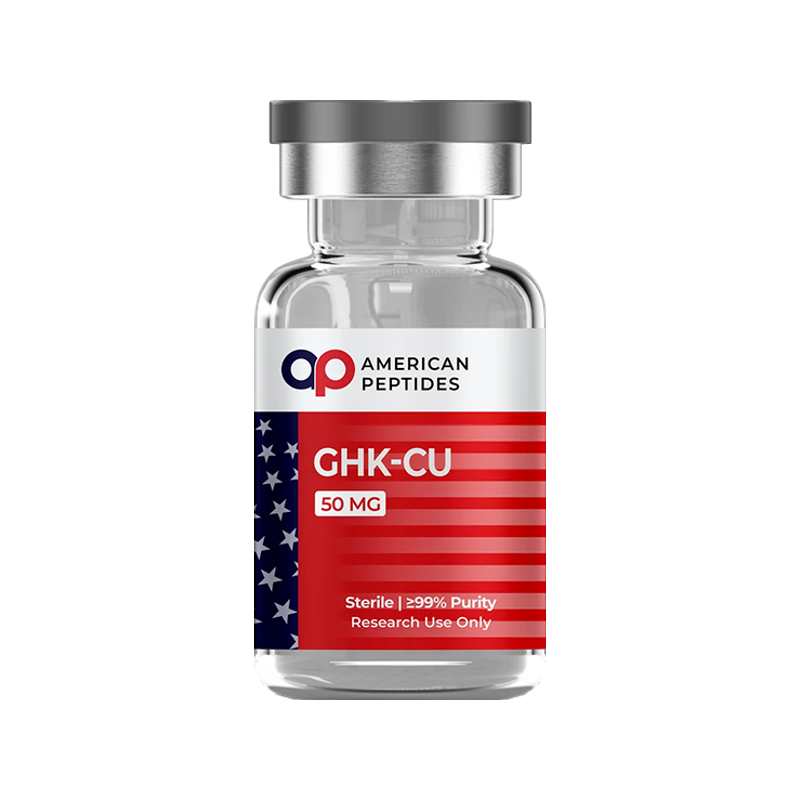
The sourcing anxiety in every r/Peptides thread is legitimate, and the fix is documentation rather than reputation. Researchers evaluating a GHK-Cu lot look for a certificate of analysis tied to a specific lot number, with purity by reverse-phase HPLC (ideally above 98%) and identity confirmed by mass spectrometry, since the expected mass of the copper complex is a fixed number a vendor either matches or does not. Copper content matters too: GHK-Cu is a 1:1 chelate, and a product sold as the complex should show it. The blue color in solution is a quick sanity check, not a substitute for analysis. Lyophilized peptide should ship cold and be stored frozen away from light; reconstituted solutions raise chemistry questions about pH, solvent and bacteriostatic preservation that belong on the vendor's stability documentation. The American Peptides copper-binding peptide GHK-Cu listing publishes lot-specific certificates for this reason. For a longer walk through the primary literature, see our GHK-Cu copper peptide research summary.
Frequently Asked Questions
What does Reddit say about GHK-Cu?
Reddit is split. Skincare subreddits such as r/45PlusSkincare hold roughly equal numbers of enthusiastic reports and "finished the bottle, noticed nothing" reports, with commenters suspecting cheap serums contain too little of the peptide. r/Peptides and r/Biohackers threads focus on sourcing, handling and personal protocols, which this article does not reproduce. The recurring questions are about collagen evidence, purity and reactions.
Is GHK-Cu approved by the FDA?
No. GHK-Cu has not been approved by the FDA for any indication. It is an investigational compound whose published evidence comes mostly from cultured fibroblasts, rat wound models and computational gene-expression analyses. Cosmetic products containing copper peptides are regulated as cosmetics, not as drugs, and make no approved claims. American Peptides supplies GHK-Cu strictly for in vitro laboratory research, not for human or veterinary use.
Does GHK-Cu really increase collagen?
In cell culture, yes. Maquart and colleagues reported in FEBS Letters in 1988 that GHK-Cu stimulated collagen synthesis in cultured fibroblasts at picomolar to nanomolar concentrations without changing cell number, and later Reims work showed more type I collagen and glycosaminoglycans in a rat wound-chamber model. Pickart's reviews describe a remodeling profile rather than one-way stimulation. Controlled human outcome data remain limited.
How do researchers verify a GHK-Cu lot?
By documentation, not color alone. A lot-specific certificate of analysis should report purity by HPLC, identity by mass spectrometry matching the expected mass of the copper complex, and ideally copper content confirming the 1:1 chelate. Researchers also check that lyophilized material shipped cold, is stored frozen away from light, and that the vial's lot number matches the certificate.
Citations
- Maquart FX, Pickart L, Laurent M, et al. FEBS Lett 1988. PMID 3169264
- Siméon A, Wegrowski Y, Bontemps Y, Maquart FX. J Invest Dermatol 2000. PMID 11121126
- Pickart L. J Biomater Sci Polym Ed 2008. PMID 18644225
- Campbell JD, McDonough JE, Zeskind JE, et al. Genome Med 2012. PMID 22937864
- Pickart L, Vasquez-Soltero JM, Margolina A. Oxid Med Cell Longev 2012. PMID 22666519
- Arul V, Gopinath D, Gomathi K, Jayakumar R. J Biomed Mater Res B Appl Biomater 2005. PMID 15803494
- Fu SC, Cheuk YC, Chiu WY, et al. J Orthop Res 2015. PMID 25731775
- Pickart L, Vasquez-Soltero JM, Margolina A. Biomed Res Int 2015. PMID 26236730
- Pickart L, Margolina A. Int J Mol Sci 2018. PMID 29986520
- Dou Y, Lee A, Zhu L, Morton J, Ladiges W. Aging Pathobiol Ther 2020. PMID 35083444
This article is for laboratory research reference only. American Peptides products are sold strictly for in vitro research. Not for human consumption.
Related research
Compliance Notice: American Peptides products are sold strictly for laboratory and academic research purposes only. They are not intended for human or veterinary consumption, diagnosis, treatment, or prevention of any disease. All content on this page is educational in nature and does not constitute medical advice or product claims. Researchers are responsible for handling these compounds in accordance with their institution’s safety protocols and applicable laws.